
Function Notation
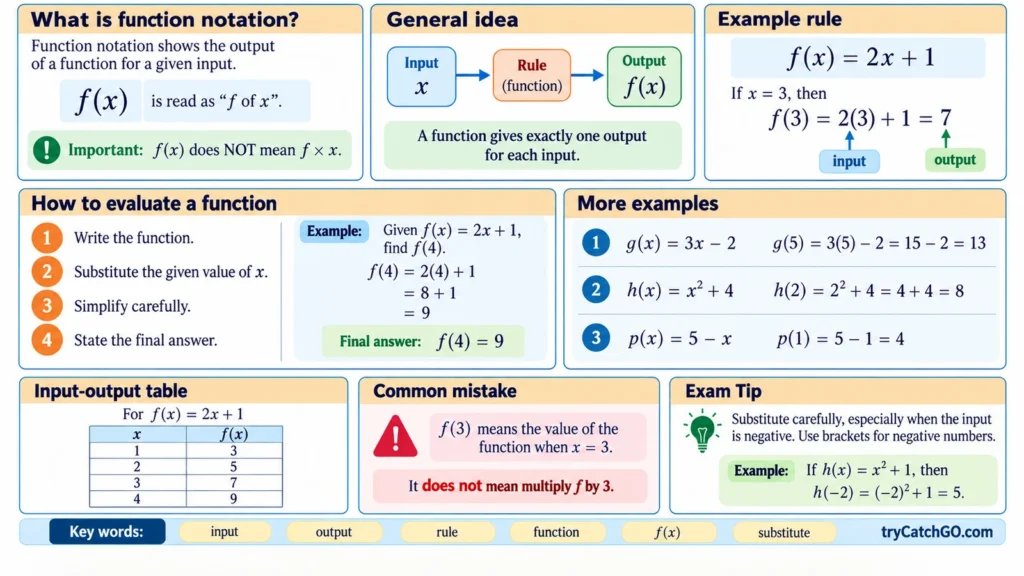
Function notation is a compact way of showing a rule that changes an input into an output.
In Cambridge O Level Mathematics D, you may be asked to evaluate functions, substitute negative numbers or fractions, find an unknown input, work with more than one function, or later use function notation with composite and inverse functions.
For example:
f(x) = 2x + 1
If:
x = 3
then:
f(3) = 2(3) + 1
= 7
So when the input is 3, the output is 7.
Concept
A function takes an input, follows a rule, and produces an output.
Think of it as:
Input → Function rule → Output
For example:
f(x) = 2x + 1
The rule means:
Multiply the input by 2, then add 1.
If the input is:
x = 4
then:
f(4) = 2(4) + 1
= 8 + 1
= 9
Therefore:
Input = 4
Output = 9
What Does f(x) Mean?
The notation:
f(x)
is read as:
“f of x”
It means:
the value of function f when the input is x
It does not mean:
f × x
This is one of the most important things to remember about function notation.
Understanding the Letters
In:
f(x) = 3x + 2
the letter:
f
is the name of the function.
The letter:
x
represents the input.
The expression:
3x + 2
is the function rule.
The value of:
f(x)
is the output.
Formula
A function may be written as:
f(x) = expression involving x
For example:
f(x) = 2x + 5
g(x) = x² – 3
h(x) = 7 – x
p(x) = 1/x
The letters f, g, h and p are simply names given to different functions.
Evaluating a Function
To evaluate a function, substitute the given input into the function rule.
Suppose:
f(x) = 2x + 1
Find:
f(4)
Replace x with 4:
f(4) = 2(4) + 1
= 8 + 1
= 9
Answer:
f(4) = 9
Example Math 1
Given:
f(x) = 3x + 5
find:
f(2)
Substitute:
x = 2
f(2) = 3(2) + 5
= 6 + 5
= 11
Answer:
11
Example Math 2
Given:
g(x) = 4x – 7
find:
g(6)
Substitute:
x = 6
g(6) = 4(6) – 7
= 24 – 7
= 17
Answer:
17
Functions with Powers
Functions are not limited to linear expressions.
For example:
h(x) = x² + 4
Find:
h(3)
Substitute:
x = 3
h(3) = 3² + 4
= 9 + 4
= 13
Answer:
13
Substituting Negative Numbers
This is especially important for A/A* questions.
Suppose:
f(x) = x² + 3x
Find:
f(-2)
Replace every x with -2:
f(-2) = (-2)² + 3(-2)
= 4 – 6
= -2
Answer:
-2
Important
When substituting a negative number, use brackets.
Write:
(-2)²
rather than:
-2²
because these expressions do not have the same value.
Substituting Fractions
You may also be given a fraction as the input.
Suppose:
f(x) = 4x + 3
Find:
f(1/2)
Substitute:
f(1/2) = 4(1/2) + 3
= 2 + 3
= 5
Answer:
5
More Than One Function
Questions may give you several functions at the same time.
For example:
f(x) = 2x + 1
g(x) = x²
Find:
f(3)
and:
g(3)
For f:
f(3) = 2(3) + 1
= 7
For g:
g(3) = 3²
= 9
So:
f(3) = 7
g(3) = 9
The same input can produce different outputs because the functions use different rules.
Finding an Unknown Input
Sometimes you are given the output and asked to find the input.
Suppose:
f(x) = 3x + 2
and:
f(x) = 20
Find x.
Since:
f(x) = 3x + 2
we write:
3x + 2 = 20
Subtract 2:
3x = 18
Divide by 3:
x = 6
Answer:
x = 6
Example Math
Given:
g(x) = 5x – 4
and:
g(x) = 31
find x.
Set:
5x – 4 = 31
Add 4:
5x = 35
Divide by 5:
x = 7
Answer:
7
Function Notation and Input-Output Tables
Suppose:
f(x) = 2x + 1
An input-output table can be created:
| x | f(x) |
|---|---|
| 1 | 3 |
| 2 | 5 |
| 3 | 7 |
| 4 | 9 |
For example:
when x = 3,
f(3) = 7
So:
3 → 7
Function Notation and Mapping
A function can also be represented as a mapping.
For:
f(x) = 2x + 1
we have:
1 → 3
2 → 5
3 → 7
4 → 9
Each input has exactly one output.
That is an essential property of a function.
Domain and Range
Function notation is closely connected to domain and range.
The domain is the set of possible input values.
The range is the set of resulting output values.
For example, let:
f(x) = 2x + 1
with domain:
{1, 2, 3, 4}
Then:
f(1) = 3
f(2) = 5
f(3) = 7
f(4) = 9
Therefore:
Domain = {1, 2, 3, 4}
Range = {3, 5, 7, 9}
A/A* Technique: Replace Every x
Consider:
f(x) = 2x² – 3x + 4
Find:
f(-2)
Do not substitute into only one part of the expression.
Replace every x:
f(-2) = 2(-2)² – 3(-2) + 4
= 2(4) + 6 + 4
= 8 + 6 + 4
= 18
Answer:
18
This is one of the most common places where students lose marks.
A/A* Technique: Work Carefully with Signs
Suppose:
g(x) = 5 – 2x
Find:
g(-3)
Substitute:
g(-3) = 5 – 2(-3)
= 5 + 6
= 11
Answer:
11
The two negative signs produce a positive result.
Function Notation with Algebraic Inputs
The input does not always have to be a number.
Suppose:
f(x) = 2x + 3
Find:
f(a)
Replace x with a:
f(a) = 2a + 3
Now find:
f(a + 1)
Replace x with:
a + 1
So:
f(a + 1) = 2(a + 1) + 3
= 2a + 2 + 3
= 2a + 5
This type of question is especially useful preparation for harder function problems.
Example Math: Algebraic Input
Given:
f(x) = x² + 2x
find:
f(a)
Replace x with a:
f(a) = a² + 2a
Now find:
f(a + 1)
f(a + 1) = (a + 1)² + 2(a + 1)
Expand:
= a² + 2a + 1 + 2a + 2
= a² + 4a + 3
Answer:
a² + 4a + 3
Function Notation vs Multiplication
A very common mistake is to interpret:
f(3)
as:
f × 3
This is incorrect.
If:
f(x) = 2x + 1
then:
f(3)
means:
substitute x = 3 into the function
So:
f(3) = 2(3) + 1
= 7
Exam Tip
Whenever you see:
f(number)
your first thought should be:
“Replace every x with that number.”
For example:
f(-4)
means:
replace every x in the function with -4.
Using brackets for negative values will help prevent sign errors.
Common Mistakes
Mistake 1: Treating f(x) as multiplication
Incorrect:
f(x) = f × x
Correct:
f(x) means the output of function f for input x.
Mistake 2: Replacing only one x
Given:
f(x) = x² + 4x – 1
and x = 2, every x must become 2:
f(2) = 2² + 4(2) – 1
Mistake 3: Forgetting brackets with negative inputs
Correct:
f(-3) = (-3)² + 2(-3)
Mistake 4: Mixing up the function names
If:
f(x) = 2x
and:
g(x) = x + 5
then f and g have different rules.
Always check which function the question asks you to use.
Mistake 5: Thinking f(3) means x = f
The number inside the brackets is the input.
So:
f(3)
means:
x = 3
Question & Answer
1. What is function notation?
Function notation is a way of showing the output of a function for a particular input.
2. How do you read f(x)?
“f of x”.
3. Does f(x) mean f multiplied by x?
No.
4. What does f(5) mean?
It means the value of function f when:
x = 5
5. Given f(x) = 3x + 1, find f(2).
f(2) = 3(2) + 1
= 7
6. Given g(x) = x², find g(-4).
g(-4) = (-4)²
= 16
7. Can functions use letters other than f?
Yes.
You may see:
g(x), h(x), p(x)
and other names.
8. What should I do when the input is negative?
Put the negative value in brackets when substituting.
9. Can the input be an algebraic expression?
Yes.
For example:
f(a + 2)
means replace every x with:
a + 2
10. What is the safest way to evaluate a function?
Substitute carefully, replace every x, simplify using the correct order of operations, and check signs.
Practice Questions
1
Given:
f(x) = 4x + 3
find:
f(2)
2
Given:
g(x) = 5x – 4
find:
g(7)
3
Given:
h(x) = x² + 3
find:
h(-4)
4
Given:
p(x) = 3x² – 2x
find:
p(2)
5
Given:
f(x) = 2x + 7
and:
f(x) = 21
find x.
6
Given:
g(x) = 10 – 3x
and:
g(x) = -5
find x.
7
Given:
f(x) = 5x + 1
find:
f(a)
8
Given:
f(x) = 2x – 3
find:
f(a + 2)
9
Given:
h(x) = x² + x
find:
h(-3)
10
Given:
f(x) = x² + 2x + 1
find:
f(a + 1)
Answers
1
f(2) = 4(2) + 3
= 11
2
g(7) = 5(7) – 4
= 31
3
h(-4) = (-4)² + 3
= 19
4
p(2) = 3(2²) – 2(2)
= 12 – 4
= 8
5
2x + 7 = 21
2x = 14
x = 7
6
10 – 3x = -5
-3x = -15
x = 5
7
f(a) = 5a + 1
8
f(a + 2) = 2(a + 2) – 3
= 2a + 4 – 3
= 2a + 1
9
h(-3) = (-3)² + (-3)
= 9 – 3
= 6
10
f(a + 1) = (a + 1)² + 2(a + 1) + 1
= a² + 2a + 1 + 2a + 2 + 1
= a² + 4a + 4
Want to Know More?
After mastering function notation, continue with Evaluating Functions, Domain and Range, Finding Unknown Inputs, Composite Functions, Inverse Functions, Mapping Diagrams, and Functions and Graphs.
These topics all use the same fundamental idea:
input → function rule → output
Final Exam Reminder
When you see:
f(x) = 2x + 1
and the question asks for:
f(4)
remember:
f(4) means substitute x = 4.
So:
f(4) = 2(4) + 1
= 9
For harder questions, remember three things:
Replace every x.
Use brackets for negative or algebraic inputs.
f(x) is function notation — it is not multiplication.
Master these habits and you will have a strong foundation for the more advanced composite and inverse function questions in O Level Mathematics D.