Corresponding Angles
When two parallel lines are crossed by a transversal, several pairs of angles are formed. Angles that occupy the same relative position at the two intersections are called corresponding angles.
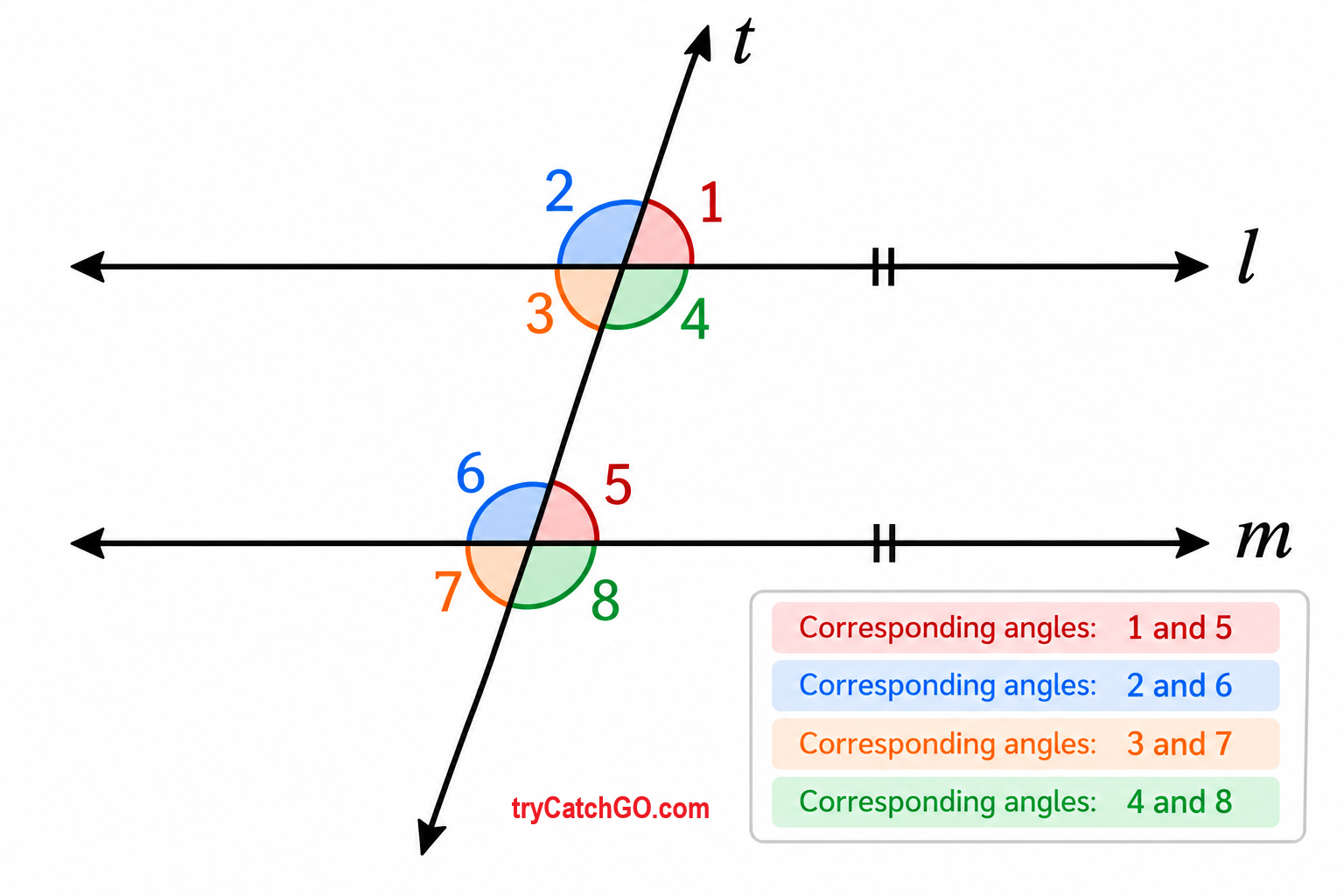
Look at the diagram above. The colours make the corresponding pairs particularly easy to recognise.
📘 Concept
In the diagram:
- and are parallel lines.
- is the transversal because it crosses both parallel lines.
- Eight angles are formed, numbered 1 to 8.
Corresponding angles are the angles that sit in the same position at each intersection.
For example, look at angle 1 and angle 5.
Angle 1 is:
above line and to the right of the transversal.
Angle 5 is:
above line and to the right of the transversal.
They occupy exactly the same relative position.
Therefore:
Because :
🎨 Find All Four Corresponding Pairs
Your diagram uses matching colours to make the four pairs easy to see.
🔴 Angles 1 and 5
Both are shown in red and occupy the upper-right position at their intersections.
Therefore:
🔵 Angles 2 and 6
Both are shown in blue and occupy the upper-left position.
Therefore:
🟠 Angles 3 and 7
Both are shown in orange and occupy the lower-left position.
Therefore:
🟢 Angles 4 and 8
Both are shown in green and occupy the lower-right position.
Therefore:
So the complete set is:
🧠 Easy Way to Understand It
Imagine each intersection has four seats:
upper-left | upper-right | lower-left | lower-right
Now imagine moving from the top intersection to the bottom intersection.
You don’t change seats.
So:
- upper-right matches upper-right → 1 and 5
- upper-left matches upper-left → 2 and 6
- lower-left matches lower-left → 3 and 7
- lower-right matches lower-right → 4 and 8
That’s corresponding angles.
⭐ Same position at each intersection = corresponding angles.
🔤 The F-Shape Trick
Corresponding angles are sometimes remembered as F angles.
You can often trace an F-like shape using the parallel lines and transversal.
The two matching corners of the F represent corresponding angles.
A quick memory trick is:
F → Corresponding → Equal
However, an exam diagram may be turned around, tilted or drawn differently.
So the safest method is always:
Look for the same relative position.
🧮 Formula / Rule
If two parallel lines are crossed by a transversal:
In this diagram:
Therefore:
💡 Exam Tip
Check for parallel lines first
Before using the corresponding-angle rule, make sure the two lines are actually parallel.
In the diagram, the matching marks on and tell us:
You can therefore use the corresponding-angle rule.
Match the positions
A very quick exam method is to ask:
“Where is this angle at the first intersection?”
Then find the angle occupying the same position at the second intersection.
For example:
Angle 2 is upper-left.
Go to the second intersection and find upper-left.
That’s angle 6.
Therefore:
Give the reason
If an exam asks you to find an angle and give a reason, write:
Reason: Corresponding angles are equal.
⚠️ Common Mistakes
Mistake 1 — Matching angles just because they are close
Corresponding angles are identified by their position, not by how close they are.
For example, angles 1 and 2 are close together, but they are not corresponding angles.
The corresponding partner of angle 1 is angle 5.
Mistake 2 — Confusing corresponding and alternate angles
Corresponding angles occupy the same relative position.
Alternate angles appear on opposite sides of the transversal.
Remember:
Corresponding = same position
Mistake 3 — Thinking corresponding angles add to
For parallel lines, corresponding angles are equal.
So:
not:
Mistake 4 — Using the rule without parallel lines
Corresponding positions still exist when a transversal crosses two lines, but the corresponding angles are guaranteed to be equal only when the two lines are parallel.
Always check for the parallel marks.
✏️ Math
Example 1 — Find Angle 5
Suppose:
Find angle 5.
From the diagram, angles 1 and 5 are corresponding angles.
Corresponding angles are equal.
Therefore:
Example 2 — Find Angle 6
Suppose:
Angles 2 and 6 occupy the same upper-left position.
Therefore they are corresponding angles.
So:
Example 3 — Find Angle 7
Suppose:
From the diagram:
because they are corresponding angles.
Therefore:
Example 4 — Find Angle 8
Suppose:
Angles 4 and 8 are corresponding.
Therefore:
Example 5 — A Little Algebra
Suppose:
and:
Angles 1 and 5 are corresponding, so they are equal:
Subtract 10:
Divide by 3:
To check:
So both corresponding angles are . ✅
📌 Quick Revision
From the diagram:
and is the transversal.
There are four pairs of corresponding angles:
🔴 1 and 5
🔵 2 and 6
🟠 3 and 7
🟢 4 and 8
Because the lines are parallel:
⭐ The easiest rule to remember
Same position → Corresponding angles → Equal
Once a student can identify the four positions around each intersection, corresponding-angle questions become very straightforward.