Alternate Angles
When two parallel lines are crossed by a transversal, special pairs of angles are formed. Some of these are called alternate angles.
Alternate angles are easy to recognise once you remember one important idea:
They are on opposite sides of the transversal.
There are two types:
- Alternate interior angles — between the parallel lines
- Alternate exterior angles — outside the parallel lines
And when the two lines are parallel:
📘 Concept
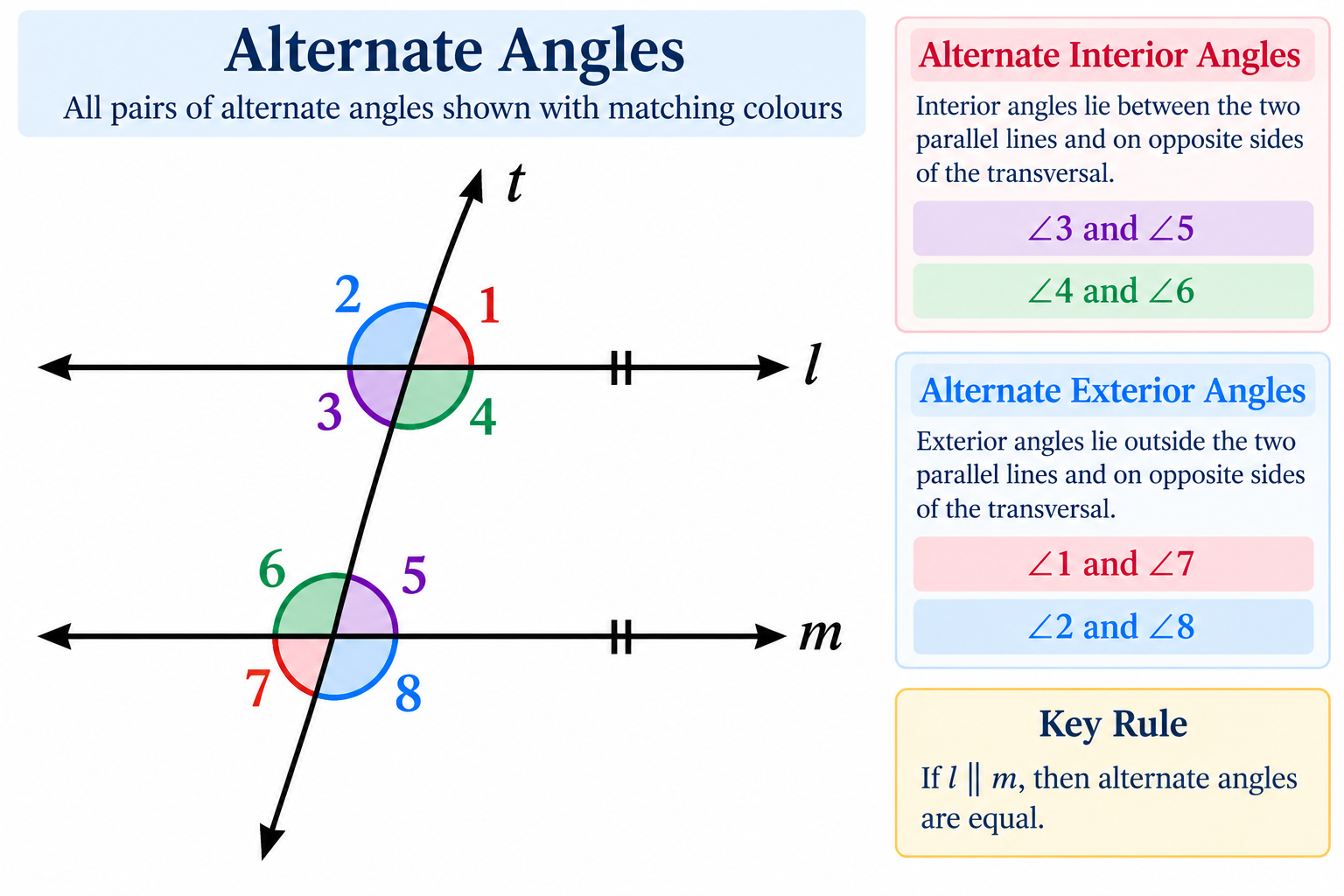
Look at the diagram above.
- and are parallel lines.
- is the transversal.
- The transversal crosses both parallel lines.
- Eight angles are formed, numbered to .
The parallel marks tell us:
Now we can identify the alternate-angle pairs.
The diagram uses matching colours to help us see which angles belong together.
Alternate Interior Angles
📘 Concept
The word interior means inside.
So alternate interior angles are:
Angles that lie between the two parallel lines and on opposite sides of the transversal.
Look at the space between ll and mm.
The four interior angles are:
But not every pair of interior angles is an alternate pair. They must also be on opposite sides of transversal tt.
🟣 First Pair: Angles 3 and 5
Angle is:
- below line
- between the parallel lines
- on the left of the transversal
Angle is:
- above line
- between the parallel lines
- on the right of the transversal
They are inside the parallel lines and on opposite sides of .
Therefore:
The diagram shows both in purple to help you recognise the pair.
🟢 Second Pair: Angles 4 and 6
Angle is inside the parallel lines on the right of the transversal.
Angle is inside the parallel lines on the left of the transversal.
Therefore they are also alternate interior angles:
The diagram shows this pair in green.
Alternate Exterior Angles
📘 Concept
The word exterior means outside.
So alternate exterior angles are:
Angles that lie outside the two parallel lines and on opposite sides of the transversal.
The exterior angles in our diagram are:
Again, we need to match angles on opposite sides of the transversal.
🔴 First Pair: Angles 1 and 7
Angle is:
- above line
- outside the parallel lines
- on the right of the transversal
Angle is:
- below line
- outside the parallel lines
- on the left of the transversal
Therefore:
The diagram shows this pair in red.
🔵 Second Pair: Angles 2 and 8
Angle is outside the parallel lines on the left of the transversal.
Angle is outside the parallel lines on the right of the transversal.
Therefore:
The diagram shows this pair in blue.
🧮 Formula / Rule
There isn’t really a formula to memorise. There is one very important angle rule:
When two parallel lines are cut by a transversal, alternate angles are equal.
For the diagram above:
Alternate Interior Angles
Alternate Exterior Angles
This works because:
🧠 Easy Way to Remember
There are just two questions to ask.
Question 1: Are the angles inside or outside?
Inside the parallel lines:
Interior
Outside the parallel lines:
Exterior
Question 2: Are they on opposite sides of the transversal?
If yes, they may be an alternate pair.
So remember:
Inside + Opposite sides = Alternate Interior
Outside + Opposite sides = Alternate Exterior
🔤 The Z-Shape Trick
Alternate angles are often remembered using a Z shape.
When you trace along the parallel lines and transversal, alternate interior angles can form the corners of a Z-like shape.
So a useful memory trick is:
Z → Alternate → Equal
But be careful! ⚠️
An exam may rotate or turn the diagram, so don’t depend only on finding a perfect letter Z.
The stronger method is:
Check whether the angles are on opposite sides of the transversal.
💡 Exam Tip
Tip 1 — Check the Parallel Marks
Before saying alternate angles are equal, make sure the lines are parallel.
In our diagram:
The matching marks on and tell us this.
Tip 2 — Find the Transversal
The line crossing both parallel lines is:
That’s your transversal.
Now look on opposite sides of tt.
Tip 3 — Decide Interior or Exterior
Imagine the space between and as the inside zone.
Angles:
are interior.
Angles:
are exterior.
This makes finding the correct pairs much easier.
Tip 4 — Give the Geometrical Reason
If you calculate:
and the question asks for a reason, write:
Alternate angles are equal.
Or, more specifically:
Alternate interior angles are equal.
⚠️ Common Mistakes
Mistake 1 — Confusing Alternate with Corresponding Angles
Corresponding angles occupy the same relative position at the two intersections.
Alternate angles are on opposite sides of the transversal.
Remember:
Corresponding → same position
Alternate → opposite sides
Mistake 2 — Choosing Two Interior Angles on the Same Side
For example:
are both interior angles, but they are not alternate interior angles because they lie on the same side of the transversal.
The correct partners are:
and:
Mistake 3 — Mixing Up Interior and Exterior
Remember:
Interior = between the parallel lines
Exterior = outside the parallel lines
So:
and:
Mistake 4 — Adding Alternate Angles to
Alternate angles are equal when the lines are parallel.
If:
then:
not .
✏️ Math
Example 1 — Alternate Interior Angles
Given:
Find .
Angles and are alternate interior angles.
Therefore:
So:
Reason: Alternate angles are equal.
Example 2 — Find Angle 6
Given:
Find .
From the diagram:
because they are alternate interior angles.
Therefore:
Example 3 — Alternate Exterior Angles
Given:
Find .
Angles and are alternate exterior angles.
Therefore:
So:
Example 4 — Find Angle 8
Given:
Find .
Angles and are alternate exterior angles.
Therefore:
Example 5 — Algebra Question
Suppose:
and:
Angles and are alternate interior angles, so:
Subtract :
Divide by :
Check:
Correct. ✅
📌 Quick Revision
For the diagram above:
🟣 Alternate Interior
🟢 Alternate Interior
🔴 Alternate Exterior
🔵 Alternate Exterior
⭐ The Rule to Remember
And for recognising them:
Interior = Inside + Opposite sides
Exterior = Outside + Opposite sides
One final memory trick 📐
Z → Alternate → Equal
Once you can recognise inside/outside and opposite sides of the transversal, alternate-angle questions become much easier.