
Range of a Function
The range of a function is the set of all possible output values produced by the function.
In function notation, the output is usually written as:
f(x)
or sometimes:
y
So when we talk about the range, we are asking:
Which output values can the function produce?
For Cambridge O Level Mathematics D, range questions often appear together with:
- domain
- function notation
- mapping diagrams
- input-output tables
- graphs
Understanding the difference between domain and range is essential for A/A* level questions.
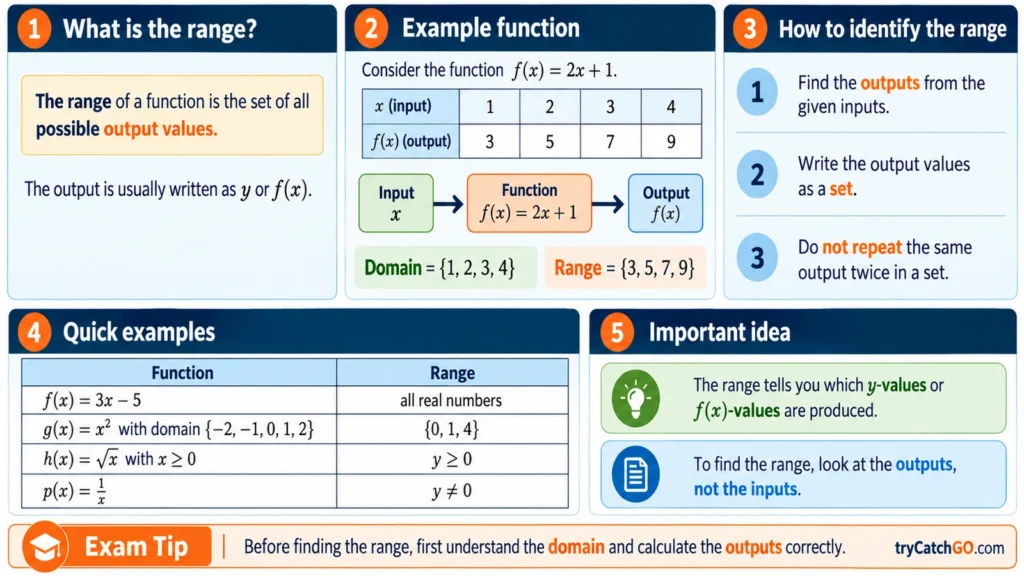
Concept
A function works like this:
Input → Function Rule → Output
The domain contains the input values.
The range contains the output values.
For example:
f(x) = 2x + 1
Suppose the domain is:
{1, 2, 3, 4}
Then:
f(1) = 3
f(2) = 5
f(3) = 7
f(4) = 9
Therefore:
Domain = {1, 2, 3, 4}
Range = {3, 5, 7, 9}
What Is the Range?
The range is the set of values that come out of the function.
For example:
f(x) = x + 3
with domain:
{1, 2, 3}
The outputs are:
4, 5, 6
So:
Range = {4, 5, 6}
Domain vs Range
This is one of the most important distinctions in functions.
Domain = input values
Range = output values
A useful way to remember it is:
Domain → Function → Range
For:
x → f(x)
the x-values belong to the domain.
The f(x)-values belong to the range.
Example Math
Given:
f(x) = 2x + 1
and domain:
{1, 2, 3, 4}
find the range.
Calculate each output:
f(1) = 2(1) + 1
= 3
f(2) = 2(2) + 1
= 5
f(3) = 2(3) + 1
= 7
f(4) = 2(4) + 1
= 9
Therefore:
Range = {3, 5, 7, 9}
Do Not Repeat Values in a Set
This is important.
Suppose:
f(x) = x²
with domain:
{-2, -1, 0, 1, 2}
Calculate:
f(-2) = 4
f(-1) = 1
f(0) = 0
f(1) = 1
f(2) = 4
The outputs are:
4, 1, 0, 1, 4
But in a set, repeated values are written only once.
Therefore:
Range = {0, 1, 4}
Not:
{4, 1, 0, 1, 4}
Range from an Input-Output Table
Consider:
| x | f(x) |
|---|---|
| 1 | 3 |
| 2 | 5 |
| 3 | 7 |
| 4 | 9 |
The domain is the x-column:
{1, 2, 3, 4}
The range is the f(x)-column:
{3, 5, 7, 9}
So when you are given a table:
look at the output column to find the range.
Range from a Mapping Diagram
Suppose:
1 → 4
2 → 7
3 → 10
4 → 13
The range is:
{4, 7, 10, 13}
The values on the right-hand side are the outputs.
Range of a Linear Function
Consider:
f(x) = 3x – 5
If the domain is all real numbers, then x can take any real value.
Because a non-constant linear function can produce any real output:
Range = all real numbers
So for:
f(x) = 3x – 5
Domain:
all real numbers
Range:
all real numbers
Range of a Quadratic Function
Quadratic functions require more thought because they usually have a minimum or maximum value.
Consider:
f(x) = x²
Since:
x² ≥ 0
for every real value of x,
the smallest possible output is:
0
Therefore:
Range: y ≥ 0
or:
f(x) ≥ 0
Example
Consider:
f(x) = x² + 4
Since:
x² ≥ 0
we have:
x² + 4 ≥ 4
Therefore:
Range: y ≥ 4
The minimum output is 4.
Range of a Shifted Quadratic
Consider:
f(x) = (x – 2)² + 3
We know:
(x – 2)² ≥ 0
Therefore:
(x – 2)² + 3 ≥ 3
So:
Range: y ≥ 3
The minimum value is:
3
Quadratic with a Maximum
Consider:
f(x) = -x² + 5
Since:
-x² ≤ 0
the greatest possible value occurs when:
x = 0
Then:
f(0) = 5
Therefore:
Range: y ≤ 5
This function has a maximum value of 5.
Range from a Graph
When finding the range from a graph, look at the vertical y-values covered by the graph.
Remember:
Domain → left to right
Range → bottom to top
For example, if a graph starts at:
y = -2
and continues upwards forever,
then:
Range: y ≥ -2
If the graph has a maximum value of:
y = 6
and extends downward,
then:
Range: y ≤ 6
Range of a Square Root Function
Consider:
f(x) = √x
A square root can never produce a negative real output.
Therefore:
f(x) ≥ 0
So:
Range: y ≥ 0
Example
Consider:
f(x) = √x + 3
Since:
√x ≥ 0
then:
√x + 3 ≥ 3
Therefore:
Range: y ≥ 3
Range of a Reciprocal Function
Consider:
f(x) = 1/x
This function can produce positive and negative values.
But it can never produce:
0
because:
1/x = 0
has no solution.
Therefore:
Range: y ≠ 0
Example
For:
f(x) = 2/x
again:
f(x) ≠ 0
So:
Range: y ≠ 0
Formula
There is no single formula that gives the range of every function.
Instead, identify the type of function and think about which outputs are possible.
Linear function
Usually:
Range = all real numbers
Quadratic function
Find the minimum or maximum value.
Square root function
Output is usually restricted to values at or above a certain number.
Reciprocal function
Certain output values may be impossible.
Finding Range from a Given Domain
Suppose:
f(x) = x² + 1
Domain:
{-3, -2, -1, 0, 1, 2, 3}
Calculate:
f(-3) = 10
f(-2) = 5
f(-1) = 2
f(0) = 1
f(1) = 2
f(2) = 5
f(3) = 10
So the outputs are:
10, 5, 2, 1, 2, 5, 10
Remove repeated values.
Therefore:
Range = {1, 2, 5, 10}
A/A* Example
Given:
f(x) = x² – 4
with domain:
{-3, -2, -1, 0, 1, 2, 3}
find the range.
Calculate:
f(-3) = 9 – 4 = 5
f(-2) = 4 – 4 = 0
f(-1) = 1 – 4 = -3
f(0) = -4
f(1) = -3
f(2) = 0
f(3) = 5
Outputs:
5, 0, -3, -4, -3, 0, 5
Remove repeats.
Therefore:
Range = {-4, -3, 0, 5}
Range Using Inequalities
Sometimes the range is expressed using inequality notation.
Examples:
y ≥ 0
means:
all output values greater than or equal to 0.
y < 5
means:
all output values less than 5.
-2 ≤ y ≤ 6
means:
all outputs from -2 to 6, including both endpoints.
Function Notation for Range
Instead of y, you may also see:
f(x) ≥ 0
For example:
f(x) = x²
Since:
x² ≥ 0
we can write:
f(x) ≥ 0
or:
y ≥ 0
Both describe the same range.
Example Math
Example 1
Find the range of:
f(x) = x²
for all real x.
Since:
x² ≥ 0
Answer:
y ≥ 0
Example 2
Find the range of:
f(x) = x² + 6
Since:
x² ≥ 0
then:
x² + 6 ≥ 6
Answer:
y ≥ 6
Example 3
Find the range of:
f(x) = -x² + 8
Since:
-x² ≤ 0
then:
-x² + 8 ≤ 8
Answer:
y ≤ 8
Example 4
Find the range of:
f(x) = √x + 2
Since:
√x ≥ 0
then:
√x + 2 ≥ 2
Answer:
y ≥ 2
A/A* Exam Technique
When asked for the range, first decide whether the domain is:
- a finite list of values
- all real numbers
- restricted by an inequality
Then use the correct approach.
If the domain is a finite set
Calculate every output and list the unique values.
If the function is linear
The range is normally all real numbers if the domain is all real numbers.
If the function is quadratic
Find the minimum or maximum value.
If the function contains a square root
Think about the smallest possible output.
If the function is reciprocal
Check which output values are impossible.
Exam Tip
Always understand the domain before finding the range.
The same function can have different ranges if the domain changes.
For example:
f(x) = x²
If the domain is all real numbers:
Range:
y ≥ 0
But if the domain is:
{1, 2, 3}
then:
Range = {1, 4, 9}
So the domain can completely change the range.
Common Mistakes
Mistake 1: Confusing Domain and Range
Remember:
Domain = inputs
Range = outputs
Mistake 2: Repeating Values in a Set
For:
f(x) = x²
with domain:
{-2, -1, 0, 1, 2}
do not write:
{4, 1, 0, 1, 4}
Write:
{0, 1, 4}
Mistake 3: Looking at x-values on a Graph
When finding range from a graph, look at the y-values, not the x-values.
Mistake 4: Assuming Every Range Is All Real Numbers
For:
f(x) = x²
the range is not all real numbers.
Negative outputs are impossible.
So:
y ≥ 0
Mistake 5: Forgetting the Domain
If the domain is restricted, the range may also be restricted.
Always read the entire question.
Question & Answer
1. What is the range?
The set of all possible output values of a function.
2. What variable usually represents the output?
y or f(x)
3. What is the difference between domain and range?
Domain = inputs.
Range = outputs.
4. What is the range of:
f(x) = 2x + 1
for all real x?
All real numbers.
5. What is the range of:
f(x) = x²
for all real x?
y ≥ 0
6. What is the range of:
f(x) = x² + 3
y ≥ 3
7. What is the range of:
f(x) = -x² + 5
y ≤ 5
8. What is the range of:
f(x) = √x
y ≥ 0
9. What is the range of:
f(x) = 1/x
y ≠ 0
10. When reading range from a graph, which direction should you look?
Look from bottom to top, because range concerns y-values.
Practice Questions
1
Find the range of:
f(x) = 3x – 4
for all real x.
2
Find the range of:
f(x) = x²
3
Find the range of:
f(x) = x² + 7
4
Find the range of:
f(x) = -x² + 9
5
Find the range of:
f(x) = √x
6
Find the range of:
f(x) = √x + 5
7
Given:
f(x) = 2x + 1
and domain:
{1, 2, 3, 4}
find the range.
8
Given:
f(x) = x²
and domain:
{-3, -2, -1, 0, 1, 2, 3}
find the range.
9
Given:
f(x) = x² – 1
and domain:
{-2, -1, 0, 1, 2}
find the range.
10
Find the range of:
f(x) = 1/x
for all allowed real x.
Answers
1
All real numbers
2
y ≥ 0
3
y ≥ 7
4
y ≤ 9
5
y ≥ 0
6
y ≥ 5
7
Calculate:
f(1) = 3
f(2) = 5
f(3) = 7
f(4) = 9
Therefore:
Range = {3, 5, 7, 9}
8
Outputs:
9, 4, 1, 0, 1, 4, 9
Therefore:
Range = {0, 1, 4, 9}
9
Outputs:
3, 0, -1, 0, 3
Therefore:
Range = {-1, 0, 3}
10
The function can never equal zero.
Therefore:
y ≠ 0
Want to Know More?
After mastering the range of a function, continue with:
- Domain of a Function
- Function Notation
- Evaluating Functions
- Domain and Range from Graphs
- Mapping Diagrams
- Composite Functions
- Inverse Functions
- Quadratic Graphs
- Range of Quadratic Functions
These topics build directly on your understanding of inputs and outputs.
Final Exam Reminder
Remember:
Domain = possible input values
Range = possible output values
For a finite domain:
calculate the outputs and remove repeated values.
For a graph:
Range → read the y-values from bottom to top.
For common function types:
f(x) = x²
gives:
y ≥ 0
f(x) = x² + 4
gives:
y ≥ 4
f(x) = -x² + 6
gives:
y ≤ 6
f(x) = 1/x
gives:
y ≠ 0
For A/A* Math D questions, always consider the domain first, because the allowed inputs determine which outputs can appear in the range.