
Inverse Functions
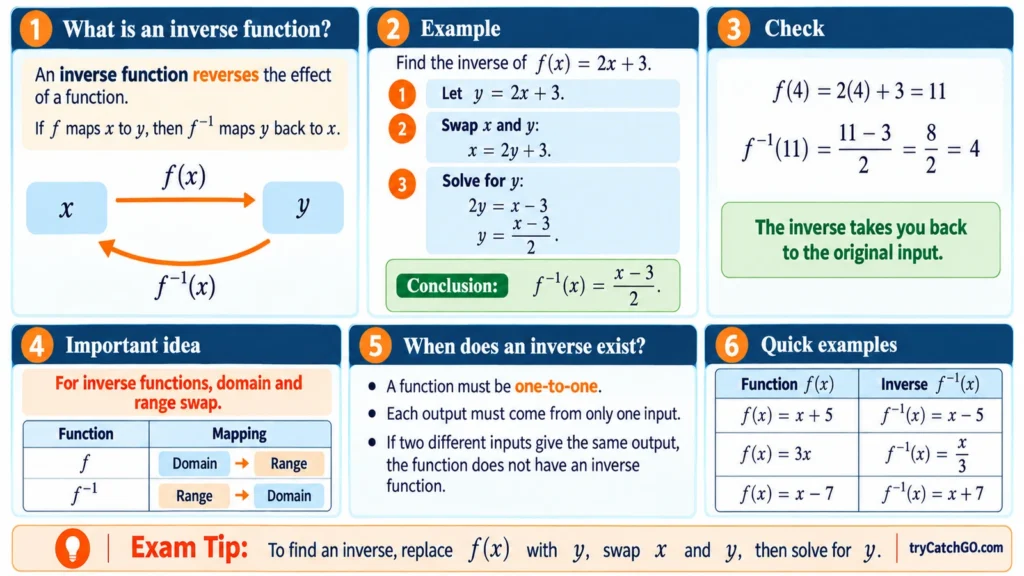
An inverse function reverses the effect of a function.
If a function takes an input and changes it into an output, the inverse function takes that output and brings you back to the original input.
For example, suppose:
f(x) = 2x + 3
If:
x = 4
then:
f(4) = 2(4) + 3
= 11
The inverse function must take:
11
back to:
4
So:
f⁻¹(11) = 4
This idea is extremely important in Cambridge O Level Mathematics D because inverse functions connect directly with function notation, domain, range, algebra and composite functions.
Concept
A function works in one direction:
input → function → output
An inverse function works in the opposite direction:
output → inverse function → original input
If:
f maps x to y
then:
f⁻¹ maps y back to x
So:
f(x) = y
means:
f⁻¹(y) = x
What Does f⁻¹(x) Mean?
The notation:
f⁻¹(x)
is read as:
“f inverse of x”
It means the inverse function of f.
Important
f⁻¹(x) does not mean:
1 / f(x)
These are completely different ideas.
For example:
f⁻¹(x)
means:
inverse function
while:
1 / f(x)
means:
reciprocal of the function value
Do not confuse them.
Why Do We Need an Inverse Function?
Suppose:
f(x) = 3x + 5
The function tells us:
- multiply by 3
- add 5
To reverse this, we must undo the operations in the opposite order:
- subtract 5
- divide by 3
Therefore:
f⁻¹(x) = (x – 5) / 3
The inverse reverses everything the original function did.
Formula
There is no single formula for every inverse function.
Instead, use this method:
Step 1
Write:
y = f(x)
Step 2
Swap x and y.
Step 3
Rearrange the equation to make y the subject.
Step 4
Replace y with:
f⁻¹(x)
Finding an Inverse Function
Consider:
f(x) = 2x + 3
Find:
f⁻¹(x)
Step 1: Replace f(x) with y
y = 2x + 3
Step 2: Swap x and y
x = 2y + 3
Step 3: Make y the subject
Subtract 3:
x – 3 = 2y
Divide by 2:
y = (x – 3) / 2
Step 4: Write the inverse
Therefore:
f⁻¹(x) = (x – 3) / 2
Check the Inverse
It is always a good idea to check your inverse.
Given:
f(x) = 2x + 3
and:
f⁻¹(x) = (x – 3) / 2
Take:
x = 4
Original function:
f(4) = 2(4) + 3
= 11
Now apply the inverse:
f⁻¹(11) = (11 – 3) / 2
= 8 / 2
= 4
We returned to the original input.
So the inverse is correct.
Function and Inverse as Opposite Operations
Consider:
f(x) = 4x – 7
The original operations are:
×4, then -7
The inverse operations must be:
+7, then ÷4
Therefore:
f⁻¹(x) = (x + 7) / 4
This mental method can be very fast for simple linear functions.
Example Math 1
Find the inverse of:
f(x) = x + 5
Step 1
y = x + 5
Step 2
Swap x and y:
x = y + 5
Step 3
Solve for y:
y = x – 5
Therefore:
f⁻¹(x) = x – 5
Example Math 2
Find the inverse of:
f(x) = 3x
Write:
y = 3x
Swap:
x = 3y
Divide by 3:
y = x / 3
Therefore:
f⁻¹(x) = x / 3
Example Math 3
Find the inverse of:
f(x) = 5x – 4
Write:
y = 5x – 4
Swap x and y:
x = 5y – 4
Add 4:
x + 4 = 5y
Divide by 5:
y = (x + 4) / 5
Therefore:
f⁻¹(x) = (x + 4) / 5
Example Math 4
Find the inverse of:
f(x) = (x + 6) / 2
Write:
y = (x + 6) / 2
Swap:
x = (y + 6) / 2
Multiply by 2:
2x = y + 6
Subtract 6:
y = 2x – 6
Therefore:
f⁻¹(x) = 2x – 6
Checking with Composition
For an inverse function:
f⁻¹(f(x)) = x
and:
f(f⁻¹(x)) = x
This means applying a function and then its inverse returns the original value.
For:
f(x) = 2x + 3
and:
f⁻¹(x) = (x – 3) / 2
calculate:
f⁻¹(f(x))
Substitute:
f(x) = 2x + 3
into the inverse:
f⁻¹(2x + 3)
= [(2x + 3) – 3] / 2
= 2x / 2
= x
So the two functions undo each other.
Domain and Range of an Inverse
For inverse functions, the domain and range swap.
If the original function has:
Domain = A
Range = B
then its inverse has:
Domain = B
Range = A
So:
Domain of f = Range of f⁻¹
and:
Range of f = Domain of f⁻¹
Example
Suppose:
f maps:
{1, 2, 3}
to:
{5, 7, 9}
Then:
Domain of f = {1, 2, 3}
Range of f = {5, 7, 9}
For the inverse:
Domain of f⁻¹ = {5, 7, 9}
Range of f⁻¹ = {1, 2, 3}
When Does an Inverse Function Exist?
For a function to have an inverse that is also a function, it must be one-to-one on the domain being used.
This means:
different inputs must give different outputs
For example:
f(x) = 2x + 1
is one-to-one over the real numbers.
So it has an inverse function.
One-to-One Functions
Consider:
f(x) = 3x + 2
Suppose:
f(1) = 5
f(2) = 8
f(3) = 11
Every different input gives a different output.
So this function is one-to-one.
Its inverse can also be a function.
A Function That Is Not One-to-One
Consider:
f(x) = x²
Over all real numbers:
f(2) = 4
and:
f(-2) = 4
Two different inputs produce the same output.
So:
f(x) = x²
is not one-to-one over all real numbers.
Therefore it does not have an inverse function over the whole real-number domain.
Restricting the Domain
However, if we restrict:
f(x) = x²
to:
x ≥ 0
then each output corresponds to only one input.
The inverse is:
f⁻¹(x) = √x
This is an important A/A* idea.
Graph of a Function and Its Inverse
A function and its inverse are reflections of each other in the line:
y = x
This happens because the coordinates swap.
If the original function contains:
(2, 7)
then its inverse contains:
(7, 2)
So:
(x, y)
becomes:
(y, x)
Mapping Diagram
Suppose:
f maps:
1 → 4
2 → 7
3 → 10
Then the inverse reverses the arrows:
4 → 1
7 → 2
10 → 3
This is another useful way to understand inverse functions.
A/A* Exam Technique
When finding an inverse algebraically, follow the same four-step routine every time:
1. Write
y = f(x)
2. Swap
x and y
3. Rearrange
Make y the subject
4. Rename
y as:
f⁻¹(x)
This method works reliably and avoids guessing.
Example Math 5
Find the inverse of:
f(x) = 7 – 2x
Write:
y = 7 – 2x
Swap:
x = 7 – 2y
Rearrange:
2y = 7 – x
y = (7 – x) / 2
Therefore:
f⁻¹(x) = (7 – x) / 2
Example Math 6
Find the inverse of:
f(x) = (3x – 4) / 5
Write:
y = (3x – 4) / 5
Swap:
x = (3y – 4) / 5
Multiply by 5:
5x = 3y – 4
Add 4:
5x + 4 = 3y
Divide by 3:
y = (5x + 4) / 3
Therefore:
f⁻¹(x) = (5x + 4) / 3
Finding a Value of an Inverse
Suppose:
f(x) = 4x + 3
Find:
f⁻¹(19)
First find the inverse:
y = 4x + 3
Swap:
x = 4y + 3
x – 3 = 4y
y = (x – 3) / 4
So:
f⁻¹(x) = (x – 3) / 4
Now substitute:
x = 19
f⁻¹(19) = (19 – 3) / 4
= 16 / 4
= 4
Answer:
4
Reverse Operations Method
For simple linear functions, you can often find the inverse by reversing the operations.
Suppose:
f(x) = 5x + 8
Original operations:
×5
then:
+8
Reverse them in the opposite order:
-8
then:
÷5
So:
f⁻¹(x) = (x – 8) / 5
This method is quick, but the algebraic method is safer for harder questions.
Exam Tip
Do not simply “change the signs” to find an inverse.
For example:
f(x) = 2x + 3
The inverse is not:
2x – 3
You must reverse both operations:
subtract 3
then divide by 2
Therefore:
f⁻¹(x) = (x – 3) / 2
Common Mistakes
Mistake 1: Thinking f⁻¹(x) Means 1/f(x)
Incorrect:
f⁻¹(x) = 1/f(x)
The symbol:
-1
means inverse function, not reciprocal.
Mistake 2: Swapping x and y but Not Rearranging
If:
x = 2y + 3
you are not finished.
You must solve for y:
y = (x – 3) / 2
Mistake 3: Reversing Operations in the Wrong Order
If the original function:
- multiplies by 3
- then adds 4
the inverse must:
- subtract 4
- then divide by 3
The order matters.
Mistake 4: Forgetting Domain Restrictions
A function such as:
f(x) = x²
does not have an inverse function over all real numbers because it is not one-to-one.
A suitable domain restriction may be needed.
Mistake 5: Confusing f⁻¹(5) with [f(5)]⁻¹
These are different.
f⁻¹(5)
means:
apply the inverse function to 5.
It does not mean:
1 / f(5)
Question & Answer
1. What is an inverse function?
A function that reverses the effect of another function.
2. How is an inverse function written?
f⁻¹(x)
3. Does f⁻¹(x) mean 1/f(x)?
No.
4. What happens to domain and range under an inverse?
They swap.
5. What is the inverse of:
f(x) = x + 4
f⁻¹(x) = x – 4
6. What is the inverse of:
f(x) = 5x
f⁻¹(x) = x/5
7. What is the inverse of:
f(x) = 2x + 7
f⁻¹(x) = (x – 7)/2
8. How can I check an inverse?
Check that:
f⁻¹(f(x)) = x
or:
f(f⁻¹(x)) = x
9. What type of function has an inverse function?
A function that is one-to-one on its stated domain.
10. What happens to graph coordinates under an inverse?
(x, y) becomes:
(y, x)
Practice Questions
1
Find the inverse of:
f(x) = x + 8
2
Find the inverse of:
f(x) = 4x
3
Find the inverse of:
f(x) = 3x + 5
4
Find the inverse of:
f(x) = 7x – 2
5
Find the inverse of:
f(x) = (x + 4)/3
6
Find the inverse of:
f(x) = (2x – 5)/4
7
Given:
f(x) = 2x + 1
find:
f⁻¹(11)
8
Given:
f(x) = 5x – 3
find:
f⁻¹(22)
9
Explain why:
f(x) = x²
does not have an inverse function over all real numbers.
10
If the point:
(3, 11)
lies on the graph of f, which point lies on the graph of f⁻¹?
Answers
1
f(x) = x + 8
Therefore:
f⁻¹(x) = x – 8
2
f(x) = 4x
Therefore:
f⁻¹(x) = x/4
3
y = 3x + 5
Swap:
x = 3y + 5
x – 5 = 3y
Therefore:
f⁻¹(x) = (x – 5)/3
4
y = 7x – 2
Swap:
x = 7y – 2
x + 2 = 7y
Therefore:
f⁻¹(x) = (x + 2)/7
5
y = (x + 4)/3
Swap:
x = (y + 4)/3
3x = y + 4
Therefore:
f⁻¹(x) = 3x – 4
6
y = (2x – 5)/4
Swap:
x = (2y – 5)/4
4x = 2y – 5
4x + 5 = 2y
Therefore:
f⁻¹(x) = (4x + 5)/2
7
First:
f⁻¹(x) = (x – 1)/2
Then:
f⁻¹(11) = (11 – 1)/2
= 5
Answer:
5
8
For:
f(x) = 5x – 3
the inverse is:
f⁻¹(x) = (x + 3)/5
Therefore:
f⁻¹(22) = (22 + 3)/5
= 25/5
= 5
Answer:
5
9
Because:
f(2) = 4
and:
f(-2) = 4
Two different inputs give the same output.
So the function is not one-to-one over all real numbers.
10
Swap the coordinates.
Answer:
(11, 3)
Want to Know More?
After mastering inverse functions, continue with:
- Function Notation
- Domain of a Function
- Range of a Function
- Composite Functions
- One-to-One Functions
- Mapping Diagrams
- Functions and Graphs
- Graphs of Inverse Functions
- Domain Restrictions
These topics work together and are especially important in harder O Level function questions.
Final Exam Reminder
An inverse function undoes the original function.
If:
f(x) = 2x + 3
then:
f⁻¹(x) = (x – 3) / 2
Remember the method:
Write y = f(x)
Swap x and y
Make y the subject
Replace y with f⁻¹(x)
And always remember:
f⁻¹(x) does not mean 1/f(x).
For A-grade and A* questions, also check whether the function is one-to-one, remember that domain and range swap, and use:
f⁻¹(f(x)) = x
as a powerful way to verify your answer.