
18.5 Finding the Equation of the Graph
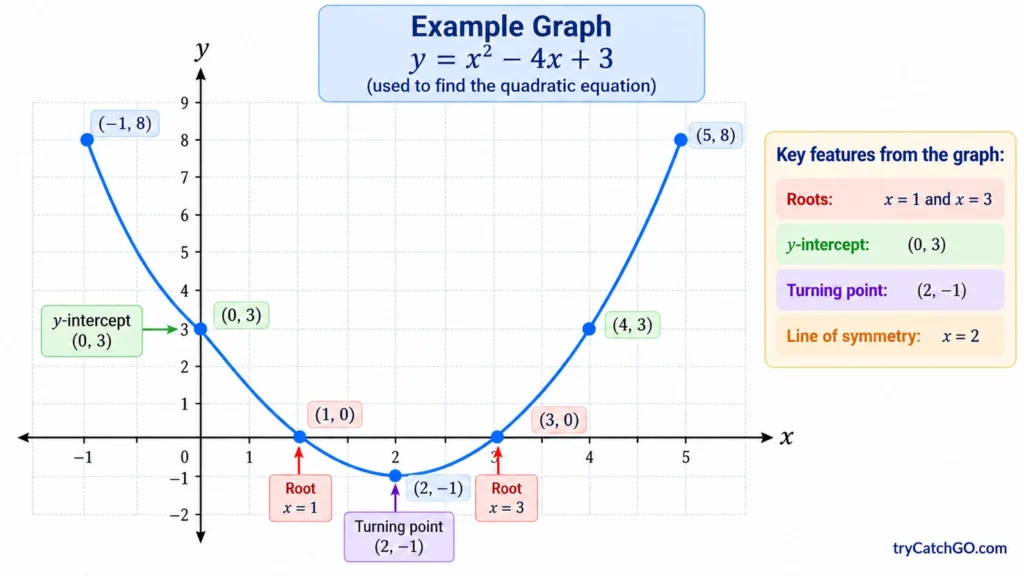
A quadratic graph gives us important information about its equation. If we can identify features such as the roots, turning point, and another point on the curve, we can work backwards and find the equation of the quadratic.
For the graph above, we will find the equation in two different ways:
Method 1 — Using the roots
Method 2 — Using the turning point
Both methods must lead to the same quadratic equation.
🔵 Concept
A quadratic equation can be written in several equivalent forms.
The standard form is:
where:
However, when we are given a graph, standard form is not always the easiest form to start with.
If the roots are clearly visible, we can use the root form:
If the turning point is clearly visible, we can use the turning-point form:
The graph tells us most of the information needed for these formulas. We then use one additional point on the graph to calculate the unknown value of .
🟢 Information From Our Graph
From the graph, we can read:
Roots
and
y-intercept
Turning point
Line of symmetry
We can now use this information to find the equation.
🟣 Method 1: Finding the Equation Using the Roots
If the graph shows two roots, the root form is usually the easiest method.
🟢 Formula — Root Form
The root form of a quadratic equation is:
where:
- is the first root,
- is the second root,
- is an unknown constant.
The roots are the points where the graph crosses or touches the x-axis.
At a root:
🟨 Step 1: Find the Roots From the Graph
Our graph crosses the x-axis at:
and:
Therefore, the roots are:
and:
🟨 Step 2: Substitute the Roots Into the Formula
Start with:
Substitute:
and:
Therefore:
We now know the two factors, but we still do not know the value of a.
🟨 Step 3: Choose Another Known Point
The easiest point to use is usually the y-intercept.
From the graph:
This means:
and:
We substitute these values into:
🟨 Step 4: Find the Value of
Substitute:
So:
Simplify the brackets:
Since:
we get:
Divide both sides by :
Now we know the value of .
🟨 Step 5: Write the Equation in Root Form
Substitute:
into:
Therefore:
This is the equation in root form.
🟨 Step 6: Convert to Standard Form
If the question requires the equation in the form:
expand the brackets:
Multiply:
So the equation of the graph is:
🟣 Method 2: Finding the Equation Using the Turning Point
Sometimes the roots are difficult to read, or the question gives you the turning point directly.
In this situation, we can use the turning-point form.
🟢 Formula — Turning-Point Form
The turning-point form of a quadratic equation is:
where:
is the turning point.
Here:
- is the x-coordinate of the turning point,
- is the y-coordinate of the turning point,
- is an unknown constant.
🟨 Step 1: Find the Turning Point
From our graph, the turning point is:
Therefore:
and:
🟨 Step 2: Substitute the Turning Point Into the Formula
Start with:
Substitute:
and:
Therefore:
Notice why the equation contains:
rather than .
The formula contains , and here:
so:
Therefore:
We still need to find .
🟨 Step 3: Choose Another Point
Again, the y-intercept is convenient:
Therefore:
and:
Substitute these values into:
🟨 Step 4: Find the Value of
Substitute:
So:
Simplify:
Since:
we get:
Add to both sides:
Divide both sides by :
🟨 Step 5: Write the Equation in Turning-Point Form
Substitute:
into:
Therefore:
This is the equation in turning-point form.
🟨 Step 6: Convert to Standard Form
Expand:
Remember:
Therefore:
Simplify:
🟠 Exam Tip: Which Method Should I Choose?
Look carefully at the information shown on the graph.
If the roots are clearly given, use:
If the turning point is clearly given, use:
You do not normally need to use both methods in an exam unless the question specifically asks you to.
Choose whichever method uses the information that is easiest to read accurately from the graph.
🟠 Exam Tip: The y-Intercept Is Often the Best Extra Point
To calculate , you need another point on the curve.
The y-intercept is often convenient because:
For our graph:
so:
Substituting often makes the algebra much simpler.
However, any accurately known point on the parabola can be used.
For example, our graph also contains:
That point would also give the same value of .
🔴 Common Mistake: Assuming
Suppose the roots are:
and:
You can immediately write:
But you cannot immediately write:
because that assumes:
You must use another point on the graph to determine .
🔴 Common Mistake: Using the Wrong Signs in Root Form
If:
the formula is:
not:
Always remember:
corresponds to the factor:
🔴 Common Mistake: Reading the Turning Point Incorrectly
If the turning point is:
then:
Therefore:
Do not write:
The formula is:
🔴 Common Mistake: Squaring a Negative Number Incorrectly
During Method 2 we obtained:
Remember:
because:
The brackets are important.
🧠 Easy Method to Remember
When using roots:
ROOTS → FACTORS → EXTRA POINT → FIND aa → EQUATION
Start with:
When using the turning point:
TURNING POINT → SUBSTITUTE h,kh,k → EXTRA POINT → FIND aa → EQUATION
Start with:
❓ Question & Answer
Q1. What formula should I use if I know both roots?
Use:
Q2. What formula should I use if I know the turning point?
Use:
where:
is the turning point.
Q3. Why do I need another point?
The roots or turning point determine part of the equation, but they do not usually determine .
Another point allows us to calculate:
Q4. Does the extra point have to be the y-intercept?
No.
You can use any known point on the graph.
The y-intercept is simply convenient because:
Q5. What is the root form for roots and ?
Start with:
Therefore:
Q6. What is the turning-point form if the turning point is ?
Since:
we have:
Q7. Do both methods always give the same equation?
Yes. If the calculations and graph readings are correct, both methods describe the same parabola, so they must produce equivalent quadratic equations.
For our graph:
and:
both simplify to:
✅ Final Check
Before finishing a question, check:
- Have I identified the correct information from the graph?
- If using roots, did I use both roots?
- Did I use the correct signs in the factors?
- If using the turning point, did I identify and correctly?
- Did I include before using another point?
- Did I substitute both the – and -coordinates of the extra point?
- Did I solve for correctly?
- Did I write the final equation?
- Did I expand it if standard form was required?
- Does my equation agree with the graph?