
17.7 Quadratic Curve When It Opens Downwards
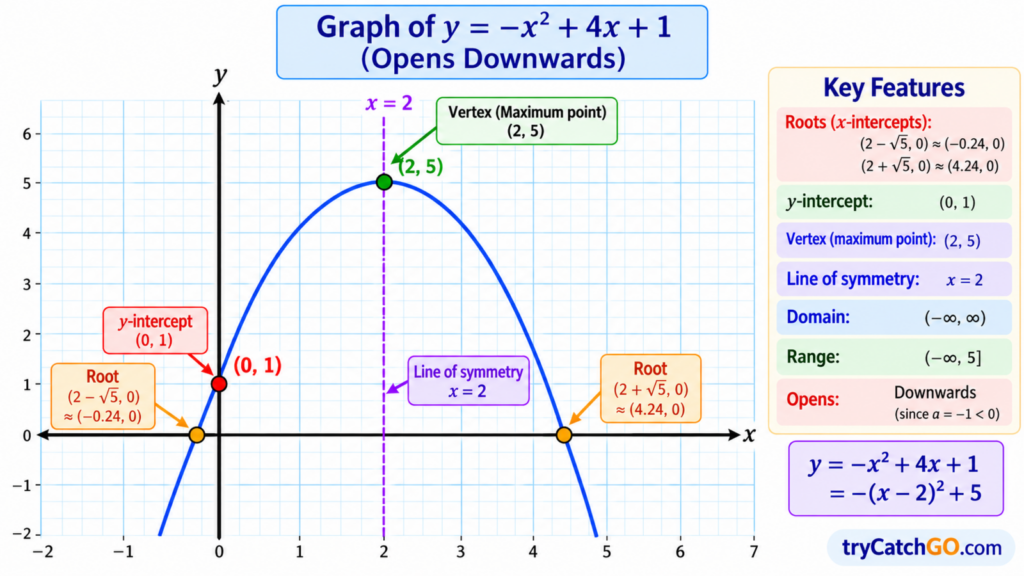
🟦 Concept
A quadratic equation can be written in the general form:
The value of aa tells us whether the quadratic curve opens upwards or downwards.
When:
the curve opens downwards and has an upside-down U-shape ∩.
A downward-opening quadratic has a maximum turning point, which is the highest point on the curve.
Remember:
Negative a → Opens downwards ∩ → Maximum
🟩 Example Math
Consider the quadratic equation:
Compare it with:
Therefore:
Since:
the quadratic curve opens downwards.
Now let’s calculate its important features before plotting the graph.
1. Find the Turning Point
The x-coordinate of the turning point is:
Substitute and :
Now substitute into the original equation:
Therefore, the turning point is:
Because the curve opens downwards, this is a maximum turning point.
The axis of symmetry is:
2. Find the Roots
The roots are the points where the curve crosses the x-axis.
At the x-axis:
Therefore:
Multiply by :
This does not factorise easily, so we can use the quadratic formula:
For:
we have:
Therefore:
So the roots are:
and
Approximately:
3. Find the y-intercept
The y-intercept occurs where the curve crosses the y-axis.
At the y-axis:
Substitute :
So the y-intercept is:
🟨 Now Plot the Quadratic Curve
We now have the key information needed to draw the graph:
| Feature | Result |
|---|---|
| Equation | |
| Value of | — negative |
| Direction | Opens downwards ∩ |
| Turning point | |
| Type | Maximum |
| Axis of symmetry | |
| Roots | , |
| Approximate roots | , |
| y-intercept |
Plot the important points and join them with a smooth downward-opening curve.
The graph is symmetrical about:
🟪 Range
The highest point of the graph is the turning point:
Therefore, the greatest possible value of is:
The rest of the curve extends downwards.
So the range is:
💡 Exam Tip
Always check the coefficient of first.
For:
a>0a>0 → Opens upwards ∪ → Minimum
a<0a<0 → Opens downwards ∩ → Maximum
This tells you the basic shape of the quadratic before you even plot it.
⚠️ Common Mistake
Don’t confuse the turning point with the maximum value.
For this example:
Turning point:
Maximum value:
The turning point is a coordinate, while the maximum value is the highest y-value.
⭐ Quick Summary
For:
a=−1<0a=-1<0 → curve opens downwards ∩
Turning point:
Maximum value:
Axis of symmetry:
Roots:
y-intercept:
Range:
Remember
Negative aa → Downwards ∩ → Maximum