
12.2 Term-to-Term Rules
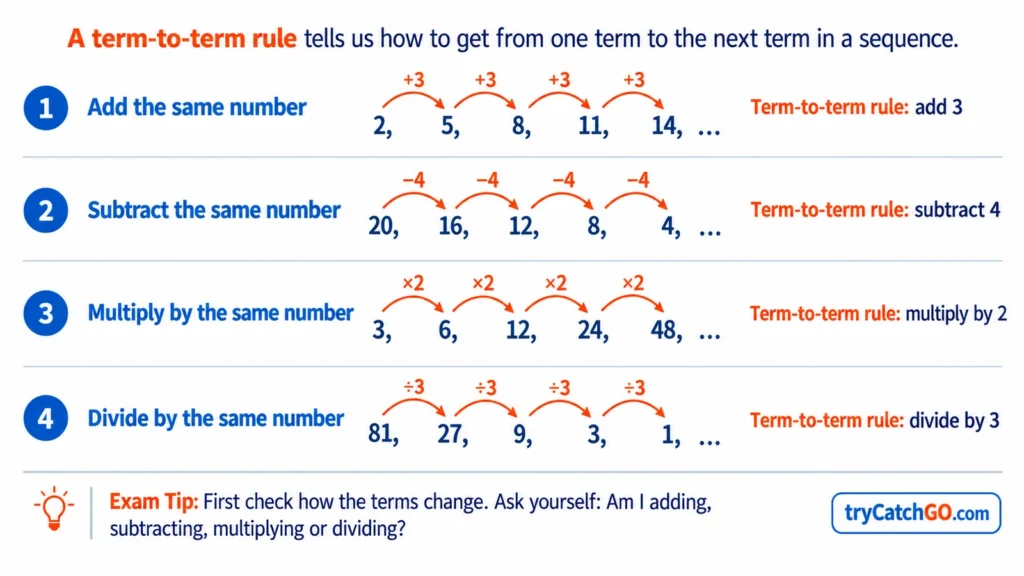
A term-to-term rule tells us how to get from one term in a sequence to the next.
For example:
2, 5, 8, 11, 14, …
Each term is found by adding 3 to the previous term.
So the term-to-term rule is:
Add 3
Term-to-term rules may involve:
- addition
- subtraction
- multiplication
- division
- alternating operations
- more complicated changing patterns
Recognising the correct rule is one of the first skills you need when solving sequence questions.
Concept
A sequence is an ordered list of numbers that follows a pattern.
For example:
2, 5, 8, 11, 14, …
To understand how this sequence is formed, compare consecutive terms.
2 → 5
5 → 8
8 → 11
11 → 14
Each time:
+3
Therefore:
Term-to-term rule = add 3
This means that if you know one term, you can find the next term by adding 3.
What Does Term-to-Term Mean?
The words term-to-term simply mean:
from one term to the next term
For example:
7, 12, 17, 22, 27, …
Start with 7.
7 + 5 = 12
12 + 5 = 17
17 + 5 = 22
22 + 5 = 27
Therefore:
Term-to-term rule = add 5
1. Adding the Same Number
Consider:
2, 5, 8, 11, 14, …
Find the difference between consecutive terms:
5 – 2 = 3
8 – 5 = 3
11 – 8 = 3
14 – 11 = 3
The same number is being added each time.
Therefore:
Term-to-term rule = add 3
The next term is:
14 + 3 = 17
So the sequence continues:
2, 5, 8, 11, 14, 17, …
Example Math
Find the next two terms:
6, 10, 14, 18, …
Check the difference:
10 – 6 = 4
14 – 10 = 4
18 – 14 = 4
Therefore:
Term-to-term rule = add 4
Continue:
18 + 4 = 22
22 + 4 = 26
Answer:
22, 26
2. Subtracting the Same Number
Consider:
20, 16, 12, 8, 4, …
Each term becomes smaller.
Check the difference:
16 – 20 = -4
12 – 16 = -4
8 – 12 = -4
4 – 8 = -4
Therefore:
Term-to-term rule = subtract 4
The next term is:
4 – 4 = 0
So the sequence continues:
20, 16, 12, 8, 4, 0, …
Example Math
Find the next two terms:
35, 29, 23, 17, …
Difference:
29 – 35 = -6
23 – 29 = -6
17 – 23 = -6
So:
Term-to-term rule = subtract 6
Continue:
17 – 6 = 11
11 – 6 = 5
Answer:
11, 5
3. Multiplying by the Same Number
Not every sequence uses addition or subtraction.
Consider:
3, 6, 12, 24, 48, …
Check what happens:
3 × 2 = 6
6 × 2 = 12
12 × 2 = 24
24 × 2 = 48
Therefore:
Term-to-term rule = multiply by 2
The next term is:
48 × 2 = 96
Example Math
Find the next two terms:
5, 15, 45, 135, …
Check:
5 × 3 = 15
15 × 3 = 45
45 × 3 = 135
Therefore:
Term-to-term rule = multiply by 3
Continue:
135 × 3 = 405
405 × 3 = 1215
Answer:
405, 1215
4. Dividing by the Same Number
Consider:
81, 27, 9, 3, 1, …
Check:
81 ÷ 3 = 27
27 ÷ 3 = 9
9 ÷ 3 = 3
3 ÷ 3 = 1
Therefore:
Term-to-term rule = divide by 3
Example Math
Find the next two terms:
160, 80, 40, 20, …
Check:
160 ÷ 2 = 80
80 ÷ 2 = 40
40 ÷ 2 = 20
Therefore:
Term-to-term rule = divide by 2
Continue:
20 ÷ 2 = 10
10 ÷ 2 = 5
Answer:
10, 5
How to Find a Term-to-Term Rule
When you are given a sequence, follow this order.
Step 1: Check the Differences
Subtract consecutive terms.
For example:
4, 9, 14, 19, …
Differences:
+5, +5, +5
So:
Add 5
Step 2: Check Multiplication or Division
If the differences are not constant, check whether each term is multiplied or divided by the same number.
Example:
4, 12, 36, 108, …
4 × 3 = 12
12 × 3 = 36
36 × 3 = 108
So:
Multiply by 3
Step 3: Look for a Different Pattern
If neither of these works, the sequence may involve:
- alternating operations
- changing differences
- square numbers
- cube numbers
- previous-term relationships
- quadratic sequences
Do not assume every sequence has one simple operation.
Common Difference
If a sequence increases or decreases by the same amount each time, that amount is called the common difference.
For example:
2, 5, 8, 11, 14, …
The differences are:
+3, +3, +3, +3
Therefore:
Common difference = 3
We often use:
d
to represent the common difference.
So:
d = 3
Negative Common Difference
Consider:
25, 20, 15, 10, 5, …
Difference:
20 – 25 = -5
Therefore:
d = -5
This tells us the sequence decreases by 5 each time.
Term-to-Term Rule vs Common Difference
These ideas are closely related, but they are not exactly the same wording.
For:
7, 11, 15, 19, …
the term-to-term rule is:
Add 4
and:
d = 4
For:
20, 17, 14, 11, …
the term-to-term rule is:
Subtract 3
and:
d = -3
Term-to-Term Rule vs nth Term
This is very important.
A term-to-term rule tells you how to get from one term to the next.
An nth-term rule allows you to calculate a term directly from its position.
Consider:
2, 5, 8, 11, 14, …
Term-to-term rule:
Add 3
nth term:
3n – 1
These are not the same thing.
Why Is the nth Term Useful?
Suppose you want the 100th term of:
2, 5, 8, 11, 14, …
Using the term-to-term rule would mean adding 3 again and again.
That would take too long.
Instead, use:
3n – 1
For:
n = 100
3(100) – 1
= 300 – 1
= 299
So the 100th term is:
299
Alternating Term-to-Term Rules
Some sequences use two rules repeatedly.
For example:
2, 5, 4, 7, 6, 9, …
Look carefully:
2 → 5 = +3
5 → 4 = -1
4 → 7 = +3
7 → 6 = -1
6 → 9 = +3
So the rule alternates:
+3, -1, +3, -1, …
The next term is:
9 – 1 = 8
Example Math
Find the next two terms:
10, 20, 18, 36, 34, …
Look at the operations:
10 × 2 = 20
20 – 2 = 18
18 × 2 = 36
36 – 2 = 34
So the alternating rule is:
×2, -2
Continue:
34 × 2 = 68
68 – 2 = 66
Answer:
68, 66
Changing Differences
Some sequences have differences that change.
Consider:
1, 4, 9, 16, 25, …
First differences:
3, 5, 7, 9
The differences are not constant.
However, they increase by 2 each time.
This is the familiar square-number sequence:
1², 2², 3², 4², 5², …
So you should not describe its term-to-term rule simply as “add the same number.”
Fibonacci-Type Rules
Sometimes the next term depends on previous terms.
For example:
1, 1, 2, 3, 5, 8, 13, …
Here:
1 + 1 = 2
1 + 2 = 3
2 + 3 = 5
3 + 5 = 8
5 + 8 = 13
The term-to-term rule is:
Add the previous two terms
This is different from simply adding the same constant each time.
Example Math
Example 1
Find the next term:
9, 14, 19, 24, …
Difference:
+5
Therefore:
24 + 5 = 29
Answer:
29
Example 2
Find the next term:
50, 43, 36, 29, …
Difference:
-7
Therefore:
29 – 7 = 22
Answer:
22
Example 3
Find the next term:
4, 12, 36, 108, …
Rule:
×3
Therefore:
108 × 3 = 324
Answer:
324
Example 4
Find the next term:
625, 125, 25, 5, …
Rule:
÷5
Therefore:
5 ÷ 5 = 1
Answer:
1
Example 5
Find the missing term:
11, 17, 23, __, 35
Difference:
+6
Therefore:
23 + 6 = 29
Answer:
29
Exam Tip
When you see a sequence, do not guess the pattern from only the first two terms.
Check at least three or four transitions.
For example:
2, 4, 8, 16, …
You might first notice:
2 → 4 = +2
But:
4 → 8 = +4
So “add 2” cannot be the rule.
Instead:
2 × 2 = 4
4 × 2 = 8
8 × 2 = 16
Therefore:
Term-to-term rule = multiply by 2
A/A* Exam Technique
For difficult sequence questions, write the operation between each pair of terms.
For example:
3 → 9 → 27 → 81
Write:
×3 ×3 ×3
This makes the pattern much easier to see.
For:
18 → 13 → 8 → 3
write:
-5 -5 -5
And for an alternating pattern:
4 → 8 → 7 → 14 → 13
write:
×2 -1 ×2 -1
This is faster and safer than trying to recognise the whole sequence mentally.
Common Mistakes
Mistake 1: Looking Only at the First Pair of Terms
Consider:
3, 6, 12, 24, …
You might say:
3 → 6 means add 3.
But:
6 + 3 ≠ 12
The actual rule is:
Multiply by 2
Always check the rule against several terms.
Mistake 2: Confusing +3 with ×3
Consider:
2, 6, 18, 54, …
This is not:
+3
because:
6 + 3 = 9
Instead:
6 × 3 = 18
So the rule is:
Multiply by 3
Mistake 3: Ignoring Negative Numbers
Consider:
7, 3, -1, -5, …
The rule continues through zero.
Difference:
3 – 7 = -4
-1 – 3 = -4
So:
Subtract 4
Mistake 4: Calling Every Difference a Common Difference
A common difference exists only when the difference is constant.
For:
1, 4, 9, 16, …
differences are:
3, 5, 7
So there is no constant common difference.
Mistake 5: Confusing Term-to-Term Rule and nth Term
For:
2, 5, 8, 11, …
Term-to-term rule:
Add 3
nth term:
3n – 1
Do not write “3n – 1” when the question specifically asks for the term-to-term rule.
Question & Answer
1. What is a term-to-term rule?
It tells you how to get from one term of a sequence to the next.
2. What is the term-to-term rule for:
3, 8, 13, 18, …
Add 5.
3. What is the term-to-term rule for:
30, 24, 18, 12, …
Subtract 6.
4. What is the term-to-term rule for:
2, 10, 50, 250, …
Multiply by 5.
5. What is the term-to-term rule for:
64, 32, 16, 8, …
Divide by 2.
6. What does common difference mean?
It is the fixed difference between consecutive terms of an arithmetic sequence.
7. Is a term-to-term rule the same as an nth-term rule?
No.
The term-to-term rule tells you how to move from one term to the next.
The nth term tells you how to calculate a term directly using its position.
8. Can a sequence have more than one operation?
Yes.
Some sequences use alternating operations such as:
+4, -2, +4, -2, …
9. Must every sequence have a constant difference?
No.
Quadratic and other non-linear sequences do not have a constant first difference.
10. What should I check first?
First check whether the same number is being:
added or subtracted.
If not, check whether the terms are being:
multiplied or divided.
Practice Questions
Try these without looking at the answers.
1
Find the next two terms:
5, 9, 13, 17, …
2
Find the next two terms:
40, 33, 26, 19, …
3
Find the next term:
2, 8, 32, 128, …
4
Find the next term:
243, 81, 27, 9, …
5
State the term-to-term rule:
7, 12, 17, 22, …
6
State the term-to-term rule:
80, 72, 64, 56, …
7
State the term-to-term rule:
6, 18, 54, 162, …
8
Find the missing term:
15, 20, 25, __, 35
9
Find the next two terms:
3, 6, 5, 10, 9, …
10
Find the next term:
1, 4, 9, 16, 25, …
Answers
1
21, 25
Rule:
Add 4
2
12, 5
Rule:
Subtract 7
3
512
Rule:
Multiply by 4
4
3
Rule:
Divide by 3
5
Add 5
6
Subtract 8
7
Multiply by 3
8
30
9
18, 17
Alternating rule:
×2, -1
10
36
This is the square-number sequence.
Want to Know More?
After understanding term-to-term rules, continue with:
- Finding the nth Term
- Arithmetic Sequences
- Linear Sequences
- Common Difference
- Geometric Sequences
- Quadratic Sequences
- Difference Tables
- Special Number Sequences
- Finding Missing Terms
- Determining Whether a Number Is in a Sequence
These topics build directly on your ability to recognise how one term changes into the next.
Final Exam Reminder
When you see a sequence, ask:
How do I get from one term to the next?
Check in this order:
Addition → Subtraction → Multiplication → Division → More complex pattern
For example:
2, 5, 8, 11, 14, …
Add 3
20, 16, 12, 8, 4, …
Subtract 4
3, 6, 12, 24, 48, …
Multiply by 2
81, 27, 9, 3, 1, …
Divide by 3
And remember the key distinction:
Term-to-term rule = how one term changes into the next.
nth term = how to find a term directly from its position, n.