
12.3 Linear Sequences
Linear sequences are one of the most important sequence types in Cambridge O Level Mathematics D. If you understand how to recognise a linear sequence, find its common difference, and write its nth term, many exam questions become much easier.
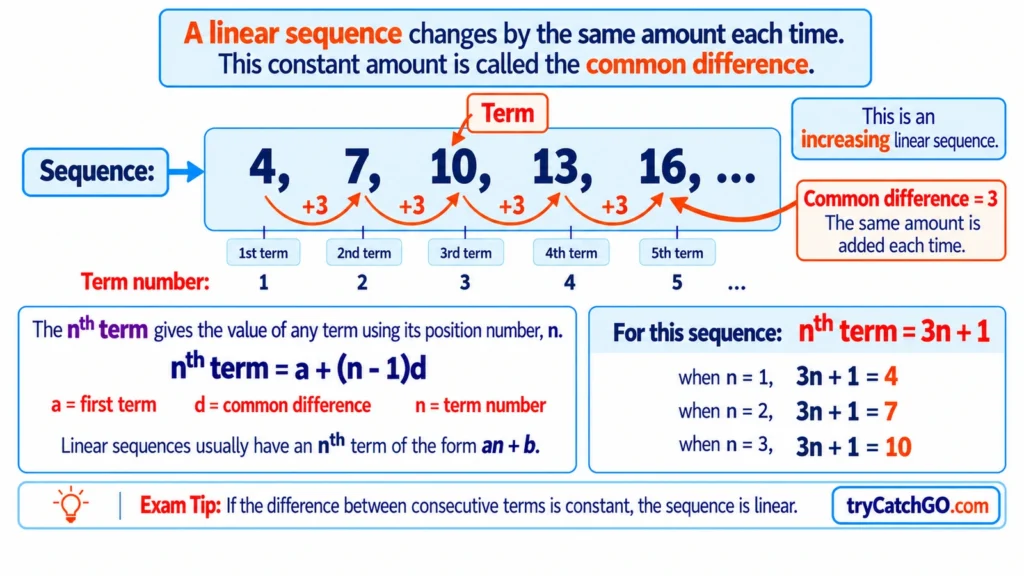
Consider this sequence:
4, 7, 10, 13, 16, …
Each term increases by 3.
This means it is a linear sequence.
Concept
A linear sequence is a sequence in which the terms change by the same amount each time.
That constant amount is called the common difference.
For example:
4, 7, 10, 13, 16, …
Find the differences:
7 – 4 = 3
10 – 7 = 3
13 – 10 = 3
16 – 13 = 3
The difference is always 3, so:
Common difference = 3
Since the first difference is constant, this is a linear sequence.
What Is a Sequence?
A sequence is an ordered list of numbers that follows a rule.
For example:
4, 7, 10, 13, 16, …
The numbers in the sequence are called terms.
So:
1st term = 4
2nd term = 7
3rd term = 10
4th term = 13
5th term = 16
The dots:
…
mean the sequence continues.
What Is a Term?
A term is one number in a sequence.
For the sequence:
4, 7, 10, 13, 16, …
the number 10 is a term.
More specifically:
10 is the 3rd term.
What Is the Term Number?
The term number tells us the position of a term.
We usually use the letter:
n
to represent the term number.
For example:
| Term number, n | Term |
|---|---|
| 1 | 4 |
| 2 | 7 |
| 3 | 10 |
| 4 | 13 |
| 5 | 16 |
So:
n = 1 means the first term
n = 2 means the second term
n = 3 means the third term
and so on.
Important
n is the position of the term, not the value of the term.
For example:
when n = 3, the term is 10.
Common Difference
The common difference is the fixed amount added or subtracted between consecutive terms in a linear sequence.
For:
4, 7, 10, 13, 16, …
the common difference is:
3
We often represent the common difference by:
d
So here:
d = 3
Increasing and Decreasing Linear Sequences
A linear sequence can be:
- increasing
- decreasing
Increasing linear sequence
4, 7, 10, 13, 16, …
The terms are getting larger, so it is increasing.
Decreasing linear sequence
20, 16, 12, 8, 4, …
Find the difference:
16 – 20 = -4
12 – 16 = -4
So the common difference is:
d = -4
This is a decreasing linear sequence.
Term-to-Term Rule
The term-to-term rule tells us how to move from one term to the next.
For:
4, 7, 10, 13, 16, …
the term-to-term rule is:
Add 3
because:
4 + 3 = 7
7 + 3 = 10
10 + 3 = 13
13 + 3 = 16
Formula
For a linear sequence, the general nth-term formula is:
nth term = a + (n – 1)d
where:
a = first term
d = common difference
n = term number
Linear sequences are also often written in the form:
an + b
where a and b are constants.
Finding the nth Term of a Linear Sequence
Consider:
4, 7, 10, 13, 16, …
Step 1: Identify the first term
a = 4
Step 2: Identify the common difference
d = 3
Step 3: Use the formula
nth term = a + (n – 1)d
Substitute the values:
nth term = 4 + (n – 1)(3)
Expand:
= 4 + 3n – 3
= 3n + 1
Therefore:
nth term = 3n + 1
Checking the nth Term
We should always check that the formula works.
For:
nth term = 3n + 1
First term
n = 1
3(1) + 1 = 4
Correct.
Second term
n = 2
3(2) + 1 = 7
Correct.
Third term
n = 3
3(3) + 1 = 10
Correct.
So the formula is correct.
Why Is It Called a Linear Sequence?
A sequence is called linear because its nth term has the form:
an + b
This means the highest power of n is just 1.
For example:
3n + 1
5n – 2
7n + 4
These are all linear expressions, so they produce linear sequences.
Example Math
Example 1
Find the next two terms:
6, 11, 16, 21, …
Find the common difference:
11 – 6 = 5
16 – 11 = 5
21 – 16 = 5
So:
d = 5
Continue:
21 + 5 = 26
26 + 5 = 31
Answer:
26, 31
Example 2
Find the nth term of:
3, 8, 13, 18, …
First term:
a = 3
Common difference:
d = 5
Use:
nth term = a + (n – 1)d
= 3 + (n – 1)(5)
= 3 + 5n – 5
= 5n – 2
Therefore:
nth term = 5n – 2
Example 3
Find the 20th term of:
4, 7, 10, 13, 16, …
We already found the nth term:
3n + 1
Substitute:
n = 20
3(20) + 1
= 60 + 1
= 61
Answer:
61
Example 4
State whether the sequence is linear:
9, 13, 17, 21, 25, …
Differences:
+4, +4, +4, +4
The difference is constant, so yes, it is a linear sequence.
How to Recognise a Linear Sequence
To identify a linear sequence:
Step 1
Find the differences between consecutive terms.
Step 2
Check whether the first difference is constant.
If the difference is constant, the sequence is linear.
For example:
12, 18, 24, 30, …
Differences:
+6, +6, +6
So it is linear.
Linear Sequence vs Non-Linear Sequence
Not every sequence is linear.
Linear sequence
2, 5, 8, 11, 14, …
Differences:
3, 3, 3, 3
Constant difference → linear
Non-linear sequence
1, 4, 9, 16, 25, …
Differences:
3, 5, 7, 9
The difference is not constant, so it is not linear.
This is a quadratic pattern, not a linear one.
Finding a Missing Term
Example:
8, 12, 16, __, 24
Find the common difference:
12 – 8 = 4
16 – 12 = 4
So continue by adding 4:
16 + 4 = 20
Answer:
20
Exam Tip
If the difference between consecutive terms is constant, the sequence is linear.
So whenever you see a sequence, the first thing to do is:
Check the differences.
That is the fastest way to recognise a linear sequence.
A/A* Exam Technique
For harder sequence questions, write the term numbers underneath the sequence.
For example:
Sequence:
4, 7, 10, 13, 16
Term number:
1, 2, 3, 4, 5
Then ask:
- What is the common difference?
- What is the first term?
- What is the nth term?
This makes the structure of the sequence much clearer.
Also remember:
If the common difference is d, the coefficient of n in the nth term is usually d.
For example:
4, 7, 10, 13, 16, …
Common difference = 3
So the nth term will begin with:
3n
Then adjust to match the first term:
3n + 1
This is a very useful shortcut.
Common Mistakes
Mistake 1: Forgetting to check the difference properly
For:
4, 7, 10, 13, …
the difference is:
7 – 4 = 3
not 4 – 7 = -3
Always go forward in the sequence.
Mistake 2: Confusing the first term with the common difference
For:
4, 7, 10, 13, …
First term:
a = 4
Common difference:
d = 3
These are different.
Mistake 3: Thinking every sequence is linear
Consider:
2, 4, 8, 16, …
Differences:
2, 4, 8
These are not constant.
So this is not linear.
Mistake 4: Confusing term-to-term rule and nth term
For:
4, 7, 10, 13, …
Term-to-term rule:
Add 3
nth term:
3n + 1
These are not the same thing.
Mistake 5: Writing the wrong nth term
For:
4, 7, 10, 13, …
Some students may guess:
3n
But:
when n = 1, 3n = 3, not 4.
So 3n is wrong.
The correct nth term is:
3n + 1
Question & Answer
1. What is a linear sequence?
A sequence that changes by the same amount each time.
2. What is the common difference?
The fixed amount added or subtracted between consecutive terms.
3. Is 4, 7, 10, 13, 16 linear?
Yes, because the common difference is constant.
4. What is the common difference of 4, 7, 10, 13, 16?
3
5. What is the term-to-term rule for 4, 7, 10, 13, 16?
Add 3
6. What is the nth term of 4, 7, 10, 13, 16?
3n + 1
7. What does n mean?
n means the term number.
8. What is the standard formula for a linear sequence?
nth term = a + (n – 1)d
9. What form do linear nth terms usually have?
an + b
10. How do I know if a sequence is linear?
If the difference between consecutive terms is constant.
Practice Questions
Try these before checking the answers.
1
Find the next two terms:
5, 9, 13, 17, …
2
Find the common difference:
12, 18, 24, 30, …
3
State whether the sequence is linear:
20, 15, 10, 5, 0, …
4
Find the nth term of:
2, 6, 10, 14, …
5
Find the 15th term of:
3, 8, 13, 18, …
6
Find the missing term:
7, 11, 15, __, 23
7
State whether the sequence is linear:
1, 4, 9, 16, 25, …
8
Find the nth term of:
10, 7, 4, 1, …
9
Find the 12th term of:
4, 7, 10, 13, …
10
The nth term is:
5n – 1
Find the 6th term.
Answers
1
21, 25
2
6
3
Yes
Common difference = -5
4
a = 2, d = 4
nth term:
2 + (n – 1)(4)
= 4n – 2
5
Nth term:
5n – 2
15th term:
5(15) – 2 = 73
6
19
7
No
The first differences are not constant.
8
a = 10, d = -3
nth term:
10 + (n – 1)(-3)
= 10 – 3n + 3
= 13 – 3n
9
Nth term:
3n + 1
12th term:
3(12) + 1 = 37
10
5(6) – 1 = 29
Want to Know More?
After learning linear sequences, continue with:
- Introduction to Sequences
- Term-to-Term Rules
- Finding the nth Term
- Arithmetic Sequences
- Quadratic Sequences
- Difference Tables
- Finding Missing Terms
- Checking Whether a Number Is in a Sequence
These topics build naturally from linear-sequence questions.
Final Exam Reminder
To recognise a linear sequence, remember this key idea:
A linear sequence changes by the same amount each time.
For example:
4, 7, 10, 13, 16, …
Common difference:
3
Term-to-term rule:
Add 3
Nth term:
3n + 1
General formula:
nth term = a + (n – 1)d
If you can identify the first term, the common difference, and the term number, you will be able to solve most O Level linear-sequence questions confidently.