
12.5 Cubic Sequences
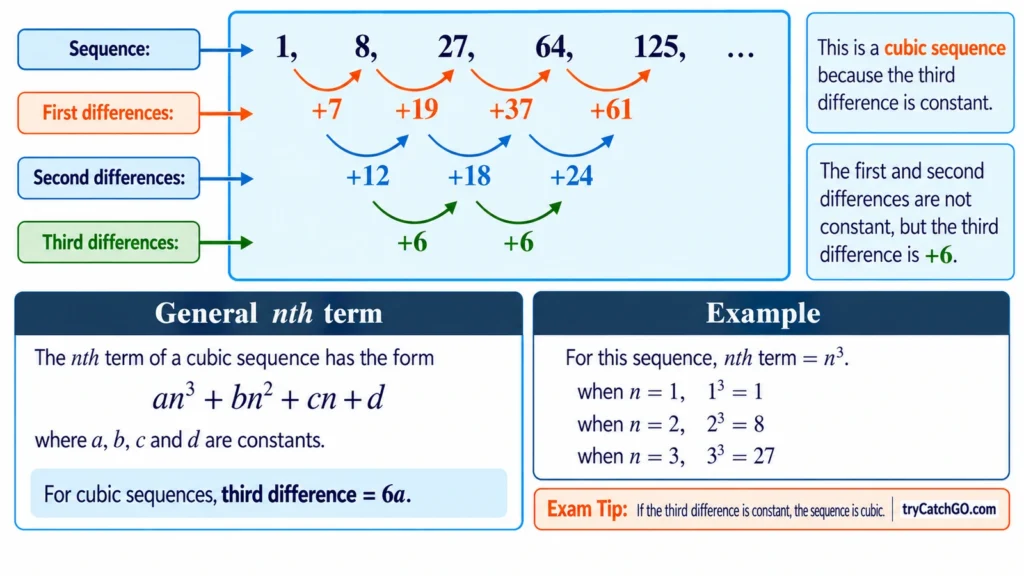
A cubic sequence is a sequence in which the third difference is constant.
Cubic sequences are more advanced than linear and quadratic sequences, but the same basic idea still works:
keep finding differences until you reach a constant difference.
For example:
1, 8, 27, 64, 125, …
These are the cube numbers:
1³, 2³, 3³, 4³, 5³, …
Let us examine the differences.
First differences:
7, 19, 37, 61
Second differences:
12, 18, 24
Third differences:
6, 6
The third difference is constant.
Therefore, this is a cubic sequence.
Concept
A cubic sequence has an nth term containing n³.
The general form is:
an³ + bn² + cn + d
where:
a, b, c and d are constants
and:
n = term number
The most important feature to remember is:
A cubic sequence has a constant third difference.
Difference Levels
Sequences can often be identified by how many times you need to calculate differences before they become constant.
| Sequence type | Constant difference |
|---|---|
| Linear | First difference |
| Quadratic | Second difference |
| Cubic | Third difference |
So:
constant first difference → linear
constant second difference → quadratic
constant third difference → cubic
First Differences
Consider:
1, 8, 27, 64, 125, …
Find the differences between consecutive terms:
8 – 1 = 7
27 – 8 = 19
64 – 27 = 37
125 – 64 = 61
So the first differences are:
7, 19, 37, 61
They are not constant.
Therefore, the sequence is not linear.
Second Differences
Now find the differences between the first differences:
19 – 7 = 12
37 – 19 = 18
61 – 37 = 24
So the second differences are:
12, 18, 24
These are also not constant.
Therefore, the sequence is not quadratic.
Third Differences
Now find the differences between the second differences:
18 – 12 = 6
24 – 18 = 6
So the third differences are:
6, 6
The third difference is constant.
Therefore:
The sequence is cubic.
Formula
The general nth term of a cubic sequence is:
an³ + bn² + cn + d
where:
a = coefficient of n³
b = coefficient of n²
c = coefficient of n
d = constant
n = term number
Important A/A* Rule
For a cubic sequence:
third difference = 6a
Therefore:
a = third difference ÷ 6
This is one of the most useful facts for finding the nth term of a cubic sequence.
Example: Cube Number Sequence
Consider:
1, 8, 27, 64, 125, …
Third difference:
6
Therefore:
6a = 6
a = 1
So the nth term begins with:
n³
Now check:
n = 1:
1³ = 1
n = 2:
2³ = 8
n = 3:
3³ = 27
n = 4:
4³ = 64
Therefore:
nth term = n³
Finding the nth Term of a Cubic Sequence
For A/A* questions, a very useful method is to remove the cubic part first.
Consider:
2, 10, 30, 68, 130, …
Step 1: Find the first differences
10 – 2 = 8
30 – 10 = 20
68 – 30 = 38
130 – 68 = 62
First differences:
8, 20, 38, 62
Step 2: Find the second differences
20 – 8 = 12
38 – 20 = 18
62 – 38 = 24
Second differences:
12, 18, 24
Step 3: Find the third differences
18 – 12 = 6
24 – 18 = 6
Third difference:
6
Therefore:
6a = 6
a = 1
So begin with:
n³
Step 4: Write the n³ sequence
n³ gives:
1, 8, 27, 64, 125, …
Original sequence:
2, 10, 30, 68, 130, …
Subtract:
2 – 1 = 1
10 – 8 = 2
30 – 27 = 3
68 – 64 = 4
130 – 125 = 5
The remaining sequence is:
1, 2, 3, 4, 5, …
Its nth term is:
n
Therefore:
nth term = n³ + n
Check the nth Term
Always check your answer.
Suppose:
nth term = n³ + n
For n = 1:
1³ + 1 = 2
For n = 2:
2³ + 2 = 10
For n = 3:
3³ + 3 = 30
The formula gives the correct terms.
So:
nth term = n³ + n
A/A* Method for Finding a Cubic nth Term
The quickest reliable method is:
- Find the third difference.
- Use third difference = 6a.
- Find a.
- Write the sequence generated by an³.
- Subtract it from the original sequence.
- The remaining sequence will usually be quadratic.
- Find the nth term of that quadratic sequence.
- Add the two expressions together.
For example:
Original cubic sequence
minus
an³ sequence
leaves
a quadratic sequence.
This turns a difficult cubic problem into a quadratic problem you already know how to solve.
Example with a Larger Third Difference
Suppose a cubic sequence has:
Third difference = 12
Use:
6a = 12
Therefore:
a = 2
So the nth term must begin with:
2n³
It may eventually be something like:
2n³ + 3n² – n + 4
but the cubic part must begin with:
2n³
Example Math
Consider:
3, 18, 57, 132, 255, …
First differences:
15, 39, 75, 123
Second differences:
24, 36, 48
Third differences:
12, 12
Therefore:
6a = 12
a = 2
So begin with:
2n³
Now calculate 2n³:
2, 16, 54, 128, 250
Subtract from the original sequence:
3 – 2 = 1
18 – 16 = 2
57 – 54 = 3
132 – 128 = 4
255 – 250 = 5
The remaining sequence is:
1, 2, 3, 4, 5
which has nth term:
n
Therefore:
nth term = 2n³ + n
Finding the Next Term Using Differences
You do not always need to find the nth term.
Suppose:
1, 8, 27, 64, 125, …
First differences:
7, 19, 37, 61
Second differences:
12, 18, 24
Third differences:
6, 6
Continue the third difference:
6
So the next second difference is:
24 + 6 = 30
The next first difference is:
61 + 30 = 91
The next term is:
125 + 91 = 216
Answer:
216
This makes sense because:
6³ = 216
Finding a Missing Term
Consider:
1, 8, 27, __, 125
Recognising cube numbers gives:
1³ = 1
2³ = 8
3³ = 27
4³ = 64
5³ = 125
Therefore the missing term is:
64
But in harder questions, you may need to use a difference table instead.
Linear vs Quadratic vs Cubic
Understanding the difference between these three sequence types is extremely important.
| Type | General nth term | Constant difference |
|---|---|---|
| Linear | an + b | First |
| Quadratic | an² + bn + c | Second |
| Cubic | an³ + bn² + cn + d | Third |
This is a very useful pattern to remember.
Why Is the Third Difference 6a?
For an nth term beginning:
an³
the third difference produced by the cubic part is:
6a
Therefore:
third difference = 6a
So if the third difference is:
18
then:
6a = 18
a = 3
The nth term begins with:
3n³
You still need to find the remaining quadratic, linear and constant parts.
Exam Tip
If:
- first differences are not constant
- second differences are not constant
- third differences are constant
then the sequence is cubic.
Do not stop after finding only the first or second differences.
A/A* Exam Technique
For a cubic-sequence question, keep your difference table neat.
For example:
Sequence:
2, 10, 30, 68, 130
First differences:
8, 20, 38, 62
Second differences:
12, 18, 24
Third differences:
6, 6
Then immediately write:
6a = 6
a = 1
This tells you that the cubic part is:
n³
From there, subtract n³ from the sequence and solve the remaining quadratic sequence.
Common Mistakes
Mistake 1: Calling a sequence cubic because the terms are large
Large numbers do not automatically mean a cubic sequence.
You must check the differences.
Mistake 2: Looking only at the first difference
For:
1, 8, 27, 64, 125
the first differences are:
7, 19, 37, 61
They are not constant.
You need to continue to the second and third differences.
Mistake 3: Forgetting the rule 6a
If the third difference is:
12
then:
a ≠ 12
Instead:
6a = 12
a = 2
Mistake 4: Assuming every cubic sequence is n³
The sequence:
1, 8, 27, 64, 125
has nth term:
n³
But:
2, 10, 30, 68, 130
has nth term:
n³ + n
And:
3, 18, 57, 132, 255
has nth term:
2n³ + n
So cubic sequences can have many different formulas.
Mistake 5: Stopping after finding an³
Finding the cubic part is only the beginning.
You must subtract it from the original sequence and find the nth term of what remains.
Question & Answer
1. What is a cubic sequence?
A sequence with a constant third difference.
2. What is the general nth term of a cubic sequence?
an³ + bn² + cn + d
3. What does n mean?
n means the term number.
4. What is the relationship between a and the third difference?
third difference = 6a
5. If the third difference is 18, what is a?
6a = 18
a = 3
6. What is the nth term of:
1, 8, 27, 64, 125, …
n³
7. What are the third differences of the cube-number sequence?
6, 6, …
8. Can a cubic sequence have a negative third difference?
Yes.
That would mean a is negative.
9. What do I do after finding a?
Construct the an³ sequence and subtract it from the original sequence.
10. What type of sequence usually remains?
A quadratic sequence.
Practice Questions
1
Find the first, second and third differences of:
1, 8, 27, 64, 125
2
State whether this sequence is cubic:
2, 10, 30, 68, 130
3
Find the next term:
1, 8, 27, 64, 125, …
4
The third difference is 18.
Find a.
5
The third difference is 24.
Find a.
6
Find the nth term:
2, 10, 30, 68, 130, …
7
Find the nth term:
3, 18, 57, 132, 255, …
8
Find the 6th term of:
n³ + n
9
Find the 5th term of:
2n³ + n
10
A sequence has constant second differences. Is it cubic?
Answers
1
First differences:
7, 19, 37, 61
Second differences:
12, 18, 24
Third differences:
6, 6
2
Yes.
Its third difference is constant.
3
216
4
6a = 18
a = 3
5
6a = 24
a = 4
6
n³ + n
7
2n³ + n
8
n = 6
6³ + 6
= 216 + 6
= 222
9
n = 5
2(5³) + 5
= 2(125) + 5
= 255
10
No.
A constant second difference indicates a quadratic sequence.
Want to Know More?
After mastering cubic sequences, continue with:
- Introduction to Sequences
- Term-to-Term Rules
- Linear Sequences
- Quadratic Sequences
- Difference Tables
- Finding the nth Term
- Exponential Sequences
- Finding Missing Terms
- Determining Whether a Number Belongs to a Sequence
These topics together give you a strong foundation for Cambridge O Level sequence questions.
Final Exam Reminder
Remember the pattern:
Linear → constant first difference
Quadratic → constant second difference
Cubic → constant third difference
For cubic sequences:
an³ + bn² + cn + d
and:
third difference = 6a
So your exam method is:
Find third difference → find a → subtract an³ → solve the remaining quadratic sequence → combine the expressions.
For:
2, 10, 30, 68, 130, …
third difference = 6
so:
a = 1
Subtracting n³ leaves:
1, 2, 3, 4, 5
which is:
n
Therefore:
nth term = n³ + n
That is the core method an A/A* Math D student should be confident using.