
Quadratic Sequences
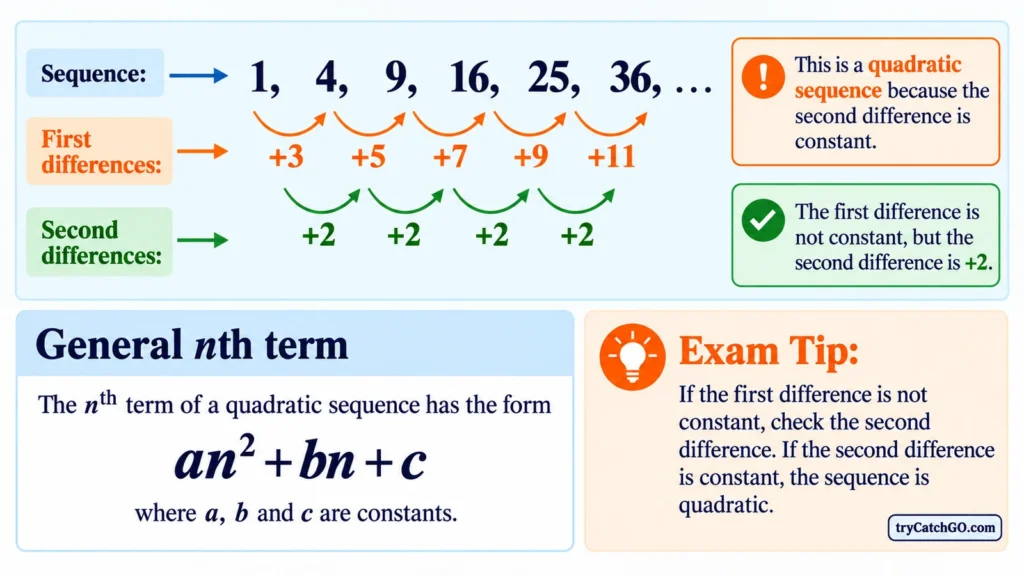
A quadratic sequence is a sequence where the second difference is constant.
Unlike a linear sequence, the first differences are not the same.
Consider:
1, 4, 9, 16, 25, 36, …
First differences:
+3, +5, +7, +9, +11
These are not constant.
Now find the differences between the first differences:
+2, +2, +2, +2
The second difference is constant.
Therefore, this is a quadratic sequence.
Concept
A quadratic sequence has an nth term of the form:
an² + bn + c
where:
a, b and c are constants
and:
n = term number
The key feature of a quadratic sequence is:
constant second difference
First Difference
The first difference is the difference between consecutive terms.
For:
1, 4, 9, 16, 25, 36, …
calculate:
4 – 1 = 3
9 – 4 = 5
16 – 9 = 7
25 – 16 = 9
36 – 25 = 11
So the first differences are:
3, 5, 7, 9, 11
These are not constant.
That tells us the sequence is not linear.
Second Difference
Now find the difference between the first differences.
5 – 3 = 2
7 – 5 = 2
9 – 7 = 2
11 – 9 = 2
So the second differences are:
2, 2, 2, 2
Therefore:
Second difference = 2
Since the second difference is constant, the sequence is quadratic.
How to Recognise a Quadratic Sequence
Follow these steps.
Step 1
Find the first differences.
Step 2
Check whether they are constant.
If yes, the sequence is linear.
If not, continue.
Step 3
Find the second differences.
Step 4
If the second differences are constant, the sequence is quadratic.
Example Math
Determine whether this sequence is quadratic:
3, 8, 15, 24, 35, …
First differences:
5, 7, 9, 11
Second differences:
2, 2, 2
The second difference is constant.
Therefore:
The sequence is quadratic.
Formula
The general nth term of a quadratic sequence is:
an² + bn + c
where:
a, b and c are constants.
Important A/A* Rule
For a quadratic sequence:
second difference = 2a
Therefore:
a = second difference ÷ 2
This is one of the most important shortcuts for finding the nth term.
Example: Square Number Sequence
Consider:
1, 4, 9, 16, 25, …
The first differences are:
3, 5, 7, 9
The second differences are:
2, 2, 2
Therefore:
2a = 2
So:
a = 1
The nth term begins with:
n²
Now check:
when n = 1:
1² = 1
when n = 2:
2² = 4
when n = 3:
3² = 9
So:
nth term = n²
Finding the nth Term of a Quadratic Sequence
Let us find the nth term of:
2, 6, 12, 20, 30, …
Step 1: Find the first differences
6 – 2 = 4
12 – 6 = 6
20 – 12 = 8
30 – 20 = 10
First differences:
4, 6, 8, 10
Step 2: Find the second differences
6 – 4 = 2
8 – 6 = 2
10 – 8 = 2
Second difference:
2
Step 3: Find a
2a = 2
a = 1
So the nth term begins with:
n²
Step 4: Compare with n²
n² gives:
1, 4, 9, 16, 25, …
Actual sequence:
2, 6, 12, 20, 30, …
Subtract:
Actual – n²:
1, 2, 3, 4, 5
That difference is:
n
Therefore:
nth term = n² + n
A Faster Method
For many O Level quadratic sequence questions, the easiest method is:
- Find the second difference.
- Divide it by 2 to get a.
- Write the an² sequence.
- Subtract it from the original sequence.
- Find the linear nth term of what remains.
- Combine the two parts.
Example Math
Find the nth term of:
4, 9, 16, 25, 36, …
First differences:
5, 7, 9, 11
Second differences:
2, 2, 2
So:
a = 1
Start with:
n²
n² sequence:
1, 4, 9, 16, 25, …
Original sequence:
4, 9, 16, 25, 36, …
Difference:
3, 5, 7, 9, 11
The nth term of:
3, 5, 7, 9, 11
is:
2n + 1
Therefore:
nth term = n² + 2n + 1
So:
nth term = (n + 1)²
Both forms are correct:
n² + 2n + 1
or
(n + 1)²
Example with a Different Second Difference
Find the nth term of:
3, 10, 21, 36, 55, …
First differences:
7, 11, 15, 19
Second differences:
4, 4, 4
Therefore:
2a = 4
a = 2
So start with:
2n²
The sequence for 2n² is:
2, 8, 18, 32, 50
Original sequence:
3, 10, 21, 36, 55
Subtract:
1, 2, 3, 4, 5
This remaining sequence is:
n
Therefore:
nth term = 2n² + n
Checking the nth Term
Always check your answer using the first few terms.
Suppose:
nth term = 2n² + n
For n = 1:
2(1)² + 1
= 3
For n = 2:
2(2)² + 2
= 8 + 2
= 10
For n = 3:
2(3)² + 3
= 18 + 3
= 21
The formula works.
Linear vs Quadratic Sequences
This difference is very important.
Linear Sequence
Example:
3, 7, 11, 15, 19, …
First differences:
4, 4, 4, 4
Constant first difference.
Therefore:
linear
Quadratic Sequence
Example:
1, 4, 9, 16, 25, …
First differences:
3, 5, 7, 9
Not constant.
Second differences:
2, 2, 2
Constant second difference.
Therefore:
quadratic
Understanding the Role of a
For:
an² + bn + c
the value of a is directly related to the second difference.
Remember:
second difference = 2a
So:
a = second difference ÷ 2
Examples:
If second difference = 2:
a = 1
If second difference = 4:
a = 2
If second difference = 6:
a = 3
If second difference = -4:
a = -2
This is extremely useful in exam questions.
Example with Negative Second Difference
Consider:
10, 17, 20, 19, 14, …
First differences:
7, 3, -1, -5
Second differences:
-4, -4, -4
Therefore:
2a = -4
a = -2
So the nth term begins with:
-2n²
The rest of the expression would then be found by comparing with the original sequence.
A quadratic sequence can have a negative second difference too.
Finding a Missing Term
Example:
2, 7, 14, 23, __, 47
First differences:
5, 7, 9, ?, ?
Second difference appears to be:
2
So the first differences should continue:
5, 7, 9, 11, 13
Therefore:
23 + 11 = 34
Answer:
34
Check:
34 + 13 = 47
Correct.
Finding the Next Terms
Consider:
5, 12, 21, 32, …
First differences:
7, 9, 11
Second difference:
2
The next first difference is:
13
So:
32 + 13 = 45
Next first difference:
15
So:
45 + 15 = 60
Answer:
45, 60
Exam Tip
When the first differences are not constant, do not immediately assume the pattern is complicated.
Find the second differences.
If the second differences are constant, you have found a quadratic sequence.
A/A* Exam Technique
For quadratic sequences, make a clear difference table.
Example:
Sequence:
2, 6, 12, 20, 30
First differences:
4, 6, 8, 10
Second differences:
2, 2, 2
Then immediately write:
2a = 2
a = 1
This reduces mistakes and makes the method easy to follow.
A/A* Shortcut
Once you know:
a = second difference ÷ 2
you can often solve quadratic nth-term questions quickly.
For example:
5, 14, 27, 44, 65, …
First differences:
9, 13, 17, 21
Second differences:
4, 4, 4
So:
a = 2
Begin with:
2n²
2n² gives:
2, 8, 18, 32, 50
Subtract from original:
3, 6, 9, 12, 15
This is:
3n
Therefore:
nth term = 2n² + 3n
Common Mistakes
Mistake 1: Calling the first difference constant
For:
1, 4, 9, 16, 25
the first differences are:
3, 5, 7, 9
They are not constant.
The second differences are constant.
Mistake 2: Forgetting to divide by 2
If the second difference is 6:
2a = 6
So:
a = 3
Not 6.
Mistake 3: Assuming every quadratic sequence is n²
Only:
1, 4, 9, 16, 25, …
has nth term:
n²
Other quadratic sequences may be:
n² + n
2n² + 3n
3n² – 2n + 4
and many others.
Mistake 4: Stopping after finding an²
Finding a is only the first part.
You must still determine the remaining:
bn + c
unless the sequence already matches an² exactly.
Mistake 5: Confusing First Difference and Second Difference
First difference:
difference between the original terms
Second difference:
difference between the first differences
Keep the rows separate.
Question & Answer
1. What is a quadratic sequence?
A sequence where the second difference is constant.
2. Is the first difference constant?
Usually no.
The first differences change, but the second differences are constant.
3. What is the general nth term?
an² + bn + c
4. What does n mean?
n represents the term number.
5. How do I find a?
Use:
a = second difference ÷ 2
6. What is the second difference of the square numbers?
For:
1, 4, 9, 16, 25
the second difference is:
2
7. What is the nth term of the square numbers?
n²
8. Is this quadratic?
2, 6, 12, 20, 30
Yes.
First differences:
4, 6, 8, 10
Second differences:
2, 2, 2
9. Can a quadratic sequence decrease?
Yes.
A quadratic sequence can have a negative value of a.
10. How do I check my nth term?
Substitute:
n = 1, 2, 3
and check that you get the first three terms.
Practice Questions
1
Find the first and second differences:
1, 4, 9, 16, 25
2
State whether this is quadratic:
2, 7, 14, 23, 34
3
Find the next term:
3, 8, 15, 24, 35, …
4
Find the nth term:
2, 6, 12, 20, 30, …
5
Find the nth term:
4, 9, 16, 25, 36, …
6
Find the nth term:
3, 10, 21, 36, 55, …
7
Find the missing term:
5, 12, 21, __, 45
8
The second difference is 8.
Find a.
9
The nth term is:
n² + 3n
Find the 10th term.
10
State whether this sequence is linear or quadratic:
5, 10, 17, 26, 37
Answers
1
First differences:
3, 5, 7, 9
Second differences:
2, 2, 2
2
Yes.
First differences:
5, 7, 9, 11
Second differences:
2, 2, 2
3
First differences:
5, 7, 9, 11
Next difference:
13
So:
35 + 13 = 48
Answer:
48
4
n² + n
5
n² + 2n + 1
or:
(n + 1)²
6
2n² + n
7
First differences:
7, 9, 11, 13
So:
21 + 11 = 32
Answer:
32
8
2a = 8
a = 4
9
n = 10
10² + 3(10)
= 100 + 30
= 130
Answer:
130
10
First differences:
5, 7, 9, 11
Second differences:
2, 2, 2
Therefore:
Quadratic
Want to Know More?
After mastering quadratic sequences, continue with:
- Introduction to Sequences
- Term-to-Term Rules
- Linear Sequences
- Finding the nth Term
- Difference Tables
- Cubic Sequences
- Exponential Sequences
- Finding Missing Terms
- Checking Whether a Number Belongs to a Sequence
These topics help build a complete understanding of sequence questions for O Level Mathematics D.
Final Exam Reminder
For a quadratic sequence:
First differences are not constant.
Second differences are constant.
The general nth term is:
an² + bn + c
And the most useful shortcut is:
a = second difference ÷ 2
For:
1, 4, 9, 16, 25, …
first differences:
3, 5, 7, 9
second differences:
2, 2, 2
Therefore:
a = 1
and:
nth term = n²
If you remember difference table → second difference → find a → compare with an² → find the remaining linear part, you will be able to handle most A/A* quadratic-sequence questions confidently.