
Domain Restrictions
A domain restriction tells us which input values are not allowed in a function.
Remember:
Domain = the set of allowed input values
Usually, the input is represented by:
x
So whenever you are asked to find the domain of a function, the important question is:
“Are there any values of x that would make this function impossible or undefined?”
For Cambridge O Level Mathematics D, the two restrictions you should check first are:
division by zero and square roots of negative numbers.
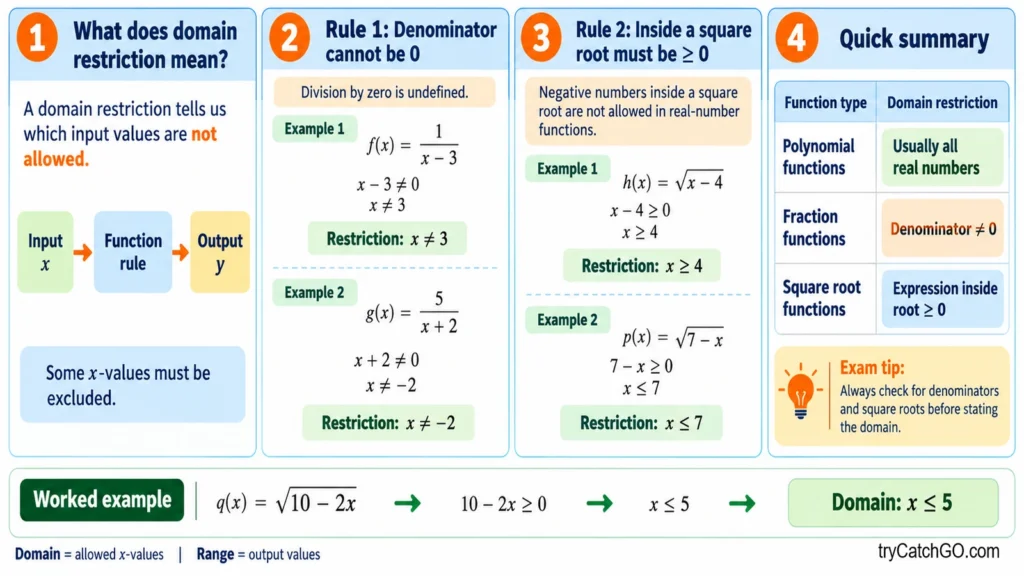
Concept
Imagine a function as a machine:
Input x → Function rule → Output y
Normally, you can put many different values of x into the machine.
But sometimes a particular value causes a mathematical problem.
For example:
f(x) = 1 / (x – 3)
If:
x = 3
then:
f(3) = 1 / (3 – 3)
= 1 / 0
But division by zero is undefined.
Therefore:
x = 3 is not allowed.
We write:
x ≠ 3
That is a domain restriction.
What Does “Restriction” Mean?
A restriction simply means:
a condition placed on the possible values of x
For example:
x ≠ 4
means:
x can be any real number except 4.
Similarly:
x ≥ 2
means:
x can be 2 or any number greater than 2.
And:
x ≤ 7
means:
x can be 7 or any number less than 7.
So a domain restriction tells us exactly which x-values the function can accept.
Why Do Functions Need Domain Restrictions?
Some mathematical operations are not defined for every real number.
For O Level functions, the two most important situations are:
A denominator cannot equal zero.
The expression inside a square root cannot be negative.
If neither of these problems occurs, the domain is often simply:
all real numbers
Rule 1: The Denominator Cannot Be Zero
Consider:
f(x) = 1 / (x – 3)
The denominator is:
x – 3
We cannot allow:
x – 3 = 0
So:
x ≠ 3
Therefore:
Domain: all real numbers except 3
Why Is Division by Zero Not Allowed?
Division asks how many times one number fits into another.
For example:
6 ÷ 2 = 3
because:
2 × 3 = 6
But:
6 ÷ 0
would ask:
“What number multiplied by 0 gives 6?”
There is no such number.
Therefore, division by zero is undefined.
Example Math 1
Find the domain restriction of:
f(x) = 5 / (x + 2)
The denominator cannot equal zero.
So:
x + 2 ≠ 0
Therefore:
x ≠ -2
Answer:
Domain: x ≠ -2
Example Math 2
Find the domain restriction of:
g(x) = 7 / (2x – 6)
Set the denominator not equal to zero:
2x – 6 ≠ 0
2x ≠ 6
x ≠ 3
Therefore:
Domain: x ≠ 3
Example Math 3
Find the domain restriction of:
h(x) = (x + 4) / (x – 5)
Only the denominator causes a restriction.
So:
x – 5 ≠ 0
Therefore:
x ≠ 5
Answer:
Domain: x ≠ 5
The numerator:
x + 4
is allowed to equal zero.
That would simply make the whole fraction equal to zero.
Important A/A* Point: Numerator Can Be Zero
Consider:
f(x) = (x – 2) / (x + 7)
If:
x = 2
then the numerator becomes:
0
So:
f(2) = 0 / 9
= 0
That is perfectly valid.
The problem happens only if the denominator becomes zero.
Therefore:
x + 7 ≠ 0
x ≠ -7
Rule 2: Inside a Square Root Must Be Non-Negative
Consider:
f(x) = √(x – 4)
For real-number functions, you cannot take the square root of a negative number.
So the expression inside the square root must satisfy:
x – 4 ≥ 0
Therefore:
x ≥ 4
So:
Domain: x ≥ 4
Why Do We Use ≥ and Not >?
Because:
√0 = 0
So zero is allowed inside a square root.
Therefore:
inside square root ≥ 0
not:
inside square root > 0
Example Math 4
Find the domain of:
f(x) = √(x + 3)
Require:
x + 3 ≥ 0
Subtract 3:
x ≥ -3
Therefore:
Domain: x ≥ -3
Example Math 5
Find the domain of:
g(x) = √(10 – x)
Require:
10 – x ≥ 0
Subtract 10:
-x ≥ -10
Multiply by -1 and reverse the inequality:
x ≤ 10
Therefore:
Domain: x ≤ 10
Example Math 6
Find the domain of:
h(x) = √(12 – 3x)
Require:
12 – 3x ≥ 0
-3x ≥ -12
Divide by -3.
Remember: dividing an inequality by a negative number reverses the sign.
So:
x ≤ 4
Therefore:
Domain: x ≤ 4
Why Does the Inequality Sign Reverse?
Suppose:
3 < 5
Multiply both sides by -1:
-3 > -5
The direction changes.
So whenever you multiply or divide an inequality by a negative number, reverse the inequality sign.
For example:
-2x ≥ -8
becomes:
x ≤ 4
This is very important in square-root domain questions.
Functions with No Restrictions
Consider:
f(x) = 4x + 7
There is:
no denominator involving x
and:
no square root involving x
So any real value of x can be used.
Therefore:
Domain = all real numbers
The same is true for ordinary polynomial functions such as:
f(x) = x² + 3x – 2
g(x) = 2x³ – 5x
h(x) = x⁴ + 7
Their domain is:
all real numbers
Quick Recognition Table
| Function type | What to check | Typical domain |
|---|---|---|
| Linear / polynomial | Usually no restriction | All real numbers |
| Fraction | Denominator cannot be 0 | Exclude value(s) making denominator 0 |
| Square root | Inside root must be ≥ 0 | Solve an inequality |
This is an excellent first check in an exam.
A Function Can Have More Than One Restriction
Consider:
f(x) = 1 / [(x – 2)(x + 5)]
The denominator cannot equal zero.
So:
(x – 2)(x + 5) ≠ 0
This means:
x ≠ 2
and:
x ≠ -5
Therefore:
Domain: x ≠ 2 and x ≠ -5
Example with a Quadratic Denominator
Consider:
f(x) = 1 / (x² – 9)
Factorise:
x² – 9
= (x – 3)(x + 3)
The denominator is zero when:
x = 3
or:
x = -3
Therefore:
Domain: x ≠ 3 and x ≠ -3
This is a useful A/A* extension because domain restrictions can require algebra first.
Domain Restrictions with Square Roots and Fractions
In harder questions, a function may contain both.
For example:
f(x) = √(x – 1) / (x – 4)
Now we need to satisfy both conditions.
For the square root:
x – 1 ≥ 0
so:
x ≥ 1
For the denominator:
x – 4 ≠ 0
so:
x ≠ 4
Therefore the domain is:
x ≥ 1, x ≠ 4
Both restrictions must be obeyed.
A/A* Example
Find the domain of:
f(x) = √(8 – 2x) / (x + 1)
First check the square root:
8 – 2x ≥ 0
-2x ≥ -8
x ≤ 4
Now check the denominator:
x + 1 ≠ 0
x ≠ -1
Therefore:
Domain: x ≤ 4, x ≠ -1
This means all numbers up to and including 4 are allowed, except -1.
Domain of Composite Functions
Domain restrictions can also appear in composite functions.
Suppose:
f(x) = 1/x
and:
g(x) = x + 3
Find:
f(g(x))
Since:
f(x) = 1/x
replace x with:
g(x) = x + 3
So:
f(g(x)) = 1 / (x + 3)
The denominator cannot equal zero.
Therefore:
x + 3 ≠ 0
x ≠ -3
So the composite function has the restriction:
x ≠ -3
This is why understanding domain restrictions is important before studying harder composite-function questions.
Domain Restrictions and Inverse Functions
Domain restrictions are also important when working with inverse functions.
Consider:
f(x) = x²
Over all real numbers:
f(2) = 4
and:
f(-2) = 4
So the function is not one-to-one.
If we restrict the domain to:
x ≥ 0
then the function becomes one-to-one and has inverse:
f⁻¹(x) = √x
This shows that sometimes a domain is restricted not because an operation is undefined, but because we need a function to satisfy a particular property.
Example Math
Example 7
Find the domain of:
f(x) = 3 / (x – 8)
Denominator:
x – 8 ≠ 0
So:
x ≠ 8
Answer:
x ≠ 8
Example 8
Find the domain of:
f(x) = √(2x + 6)
Require:
2x + 6 ≥ 0
2x ≥ -6
x ≥ -3
Answer:
x ≥ -3
Example 9
Find the domain of:
f(x) = √(5 – x)
Require:
5 – x ≥ 0
-x ≥ -5
Therefore:
x ≤ 5
Answer:
x ≤ 5
Example 10
Find the domain of:
f(x) = 1 / (x² – 16)
Factorise:
x² – 16
= (x – 4)(x + 4)
Therefore:
x ≠ 4
and:
x ≠ -4
Answer:
x ≠ ±4
Exam Tip
Before doing anything else with a function, look for:
a fraction
and:
a square root
If you see a fraction:
denominator ≠ 0
If you see a square root:
inside ≥ 0
This quick check can immediately reveal the domain restriction.
A/A* Exam Technique
When asked to find the domain, use this routine:
Step 1: Identify any denominator.
Step 2: Set the denominator ≠ 0.
Step 3: Identify any square root.
Step 4: Set the expression inside ≥ 0.
Step 5: Solve the equation or inequality.
Step 6: Combine all restrictions.
Step 7: Check that your answer actually makes the function valid.
Common Mistakes
Mistake 1: Setting the denominator equal to zero
To find the forbidden value, you may solve:
x – 3 = 0
which gives:
x = 3
But your final restriction is:
x ≠ 3
because 3 is the value you must exclude.
Mistake 2: Writing the Square Root Condition as > 0
Incorrect:
x > 4
for:
√(x – 4)
Correct:
x ≥ 4
because:
√0
is allowed.
Mistake 3: Restricting the Numerator
For:
(x – 2)/(x + 5)
the numerator may equal zero.
Only the denominator causes the restriction.
Mistake 4: Forgetting to Reverse an Inequality
From:
-2x ≥ -10
the correct result is:
x ≤ 5
not:
x ≥ 5
Mistake 5: Checking Only One Restriction
For:
√(x – 2)/(x – 5)
you need both:
x ≥ 2
and:
x ≠ 5
Do not stop after checking only the square root.
Question & Answer
1. What is a domain restriction?
A condition showing which input values are not allowed or which values are permitted.
2. What does domain mean?
The set of allowed input values.
3. Why can the denominator not equal zero?
Because division by zero is undefined.
4. What condition do we use for a square root?
The expression inside the square root must be:
≥ 0
5. What is the domain of:
f(x) = 1/(x – 4)
x ≠ 4
6. What is the domain of:
f(x) = √(x – 4)
x ≥ 4
7. Why is x = 4 allowed in √(x – 4)?
Because:
√0 = 0
which is defined.
8. What is the domain of a normal linear function?
Usually all real numbers.
9. Can a function have more than one excluded value?
Yes.
For example:
1/(x² – 9)
has:
x ≠ 3 and x ≠ -3
10. What two things should I check first?
Denominators and square roots.
Practice Questions
1
Find the domain of:
f(x) = 4x + 3
2
Find the domain of:
f(x) = 5/(x – 7)
3
Find the domain of:
f(x) = 2/(x + 4)
4
Find the domain of:
f(x) = √(x – 6)
5
Find the domain of:
f(x) = √(x + 5)
6
Find the domain of:
f(x) = √(12 – x)
7
Find the domain of:
f(x) = √(10 – 2x)
8
Find the domain of:
f(x) = 1/(x² – 25)
9
Find the domain of:
f(x) = √(x – 2)/(x – 5)
10
Find the domain of:
f(x) = √(6 – x)/(x + 3)
Answers
1
There are no restrictions.
Domain = all real numbers
2
x – 7 ≠ 0
x ≠ 7
3
x + 4 ≠ 0
x ≠ -4
4
x – 6 ≥ 0
x ≥ 6
5
x + 5 ≥ 0
x ≥ -5
6
12 – x ≥ 0
x ≤ 12
7
10 – 2x ≥ 0
-2x ≥ -10
x ≤ 5
8
x² – 25 ≠ 0
(x – 5)(x + 5) ≠ 0
Therefore:
x ≠ 5 and x ≠ -5
9
Square-root condition:
x – 2 ≥ 0
x ≥ 2
Denominator condition:
x – 5 ≠ 0
x ≠ 5
Therefore:
x ≥ 2, x ≠ 5
10
Square-root condition:
6 – x ≥ 0
x ≤ 6
Denominator condition:
x + 3 ≠ 0
x ≠ -3
Therefore:
x ≤ 6, x ≠ -3
Want to Know More?
After mastering domain restrictions, continue with:
- Domain of a Function
- Range of a Function
- Function Notation
- Composite Functions
- Inverse Functions
- One-to-One Functions
- Functions and Graphs
- Domain and Range from Graphs
Domain restrictions are particularly important when functions involve fractions, square roots, composite functions and inverses.
Final Exam Reminder
When you see a function, ask:
Which values of x would make this function invalid?
For fractions:
denominator ≠ 0
For square roots:
inside the square root ≥ 0
For ordinary polynomial functions:
domain is usually all real numbers
For example:
f(x) = 1/(x – 3)
gives:
x ≠ 3
while:
g(x) = √(x – 3)
gives:
x ≥ 3
And if both appear in the same function, both restrictions must be satisfied.
That simple checking habit will help an A/A* Math D student avoid many of the most common domain mistakes.