
13.8 Mapping in Functions
A mapping is a way of showing how each input in a function is connected to an output.
Mapping diagrams are useful because they make the relationship between the domain and the range easy to see.
For example, suppose:
f(x) = 2x + 1
For the inputs:
1, 2, 3, 4
we get:
1 → 3
2 → 5
3 → 7
4 → 9
So:
Domain = {1, 2, 3, 4}
Range = {3, 5, 7, 9}
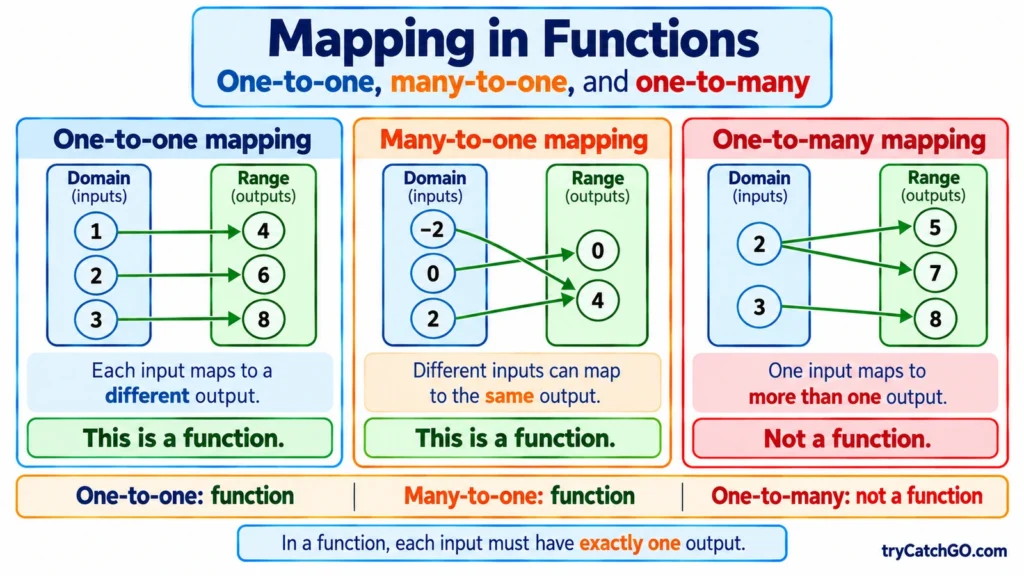
The arrows show the mapping from each input to its output.
Concept
A function takes an input, applies a rule, and produces an output.
Think of it as:
Input → Function Rule → Output
In a mapping diagram:
- the values on the left are usually the inputs
- the values on the right are the outputs
- arrows show how the inputs are connected to the outputs
The most important rule is:
Every input in a function must have exactly one output.
What Does Mapping Mean?
To map one value to another means to connect the input to the output produced by the function.
For example:
f(x) = 3x
Then:
1 → 3
2 → 6
3 → 9
4 → 12
We can say:
1 maps to 3
2 maps to 6
3 maps to 9
and so on.
Domain in a Mapping Diagram
The domain is the set of input values.
For example:
1 → 3
2 → 5
3 → 7
4 → 9
The inputs are:
1, 2, 3, 4
Therefore:
Domain = {1, 2, 3, 4}
Remember:
Domain = inputs
Range in a Mapping Diagram
The range is the set of output values actually produced.
Using:
1 → 3
2 → 5
3 → 7
4 → 9
the outputs are:
3, 5, 7, 9
Therefore:
Range = {3, 5, 7, 9}
Remember:
Range = outputs
Mapping from a Function Rule
Suppose:
f(x) = 2x + 1
and the domain is:
{1, 2, 3, 4}
Find the mapping.
For x = 1
f(1) = 2(1) + 1
= 3
So:
1 → 3
For x = 2
f(2) = 2(2) + 1
= 5
So:
2 → 5
For x = 3
f(3) = 2(3) + 1
= 7
So:
3 → 7
For x = 4
f(4) = 2(4) + 1
= 9
So:
4 → 9
Therefore the mapping is:
1 → 3, 2 → 5, 3 → 7, 4 → 9
Mapping Diagrams and Functions
A mapping represents a function only if every input has exactly one output.
For example:
1 → 4
2 → 6
3 → 8
This is a function.
Every input has one output.
What Is Not a Function?
Suppose:
1 → 4
but also:
1 → 7
Now the same input:
1
has two different outputs.
Therefore this is not a function.
Key Rule
One input cannot map to two different outputs in a function.
Can Two Inputs Have the Same Output?
Yes.
This is very important.
Consider:
f(x) = x²
with domain:
{-2, -1, 0, 1, 2}
Then:
-2 → 4
-1 → 1
0 → 0
1 → 1
2 → 4
Here:
-2 and 2 both map to 4
and:
-1 and 1 both map to 1
This is still a function because each individual input has only one output.
One-to-One Mapping
A function is one-to-one when each input maps to a different output.
Example:
1 → 3
2 → 5
3 → 7
4 → 9
No two inputs share the same output.
Therefore this is a one-to-one function.
Many-to-One Mapping
A function can also be many-to-one.
Example:
-2 → 4
2 → 4
-1 → 1
1 → 1
Different inputs can produce the same output.
This is still a function.
So:
many-to-one is allowed
One-to-Many Mapping
Consider:
2 → 5
and:
2 → 8
The input 2 has two outputs.
This is one-to-many.
Therefore:
It is not a function.
Quick Summary
| Mapping type | Is it a function? |
|---|---|
| One-to-one | Yes |
| Many-to-one | Yes |
| One-to-many | No |
This is an important A/A* idea.
Example Math
Example 1
Given:
f(x) = x + 4
with domain:
{1, 2, 3}
find the mapping.
Calculate:
f(1) = 5
f(2) = 6
f(3) = 7
Therefore:
1 → 5
2 → 6
3 → 7
Domain:
{1, 2, 3}
Range:
{5, 6, 7}
Example 2
Given:
f(x) = x²
with domain:
{-2, -1, 0, 1, 2}
find the mapping.
Calculate:
f(-2) = 4
f(-1) = 1
f(0) = 0
f(1) = 1
f(2) = 4
Mapping:
-2 → 4
-1 → 1
0 → 0
1 → 1
2 → 4
Range:
{0, 1, 4}
Notice that repeated outputs are written only once in the range.
A/A* Important Point: Range Uses Only Actual Outputs
Suppose a mapping diagram shows possible values on the right:
2, 4, 6, 8, 10
but the arrows only reach:
2, 6, 10
Then the range is:
{2, 6, 10}
Do not automatically include every number shown on the output side.
The range contains only values that are actually mapped to.
Mapping and Function Notation
Suppose:
f(x) = 3x – 1
and:
2 → 5
This means:
f(2) = 5
Similarly:
4 → 11
means:
f(4) = 11
So mapping diagrams and function notation describe the same relationship in different ways.
Mapping and Inverse Functions
Mappings are especially useful when studying inverse functions.
Suppose:
f maps:
1 → 5
2 → 7
3 → 9
Then the inverse reverses the arrows:
5 → 1
7 → 2
9 → 3
So if:
f(2) = 7
then:
f⁻¹(7) = 2
This is why one-to-one mappings are especially important when working with inverse functions.
Mapping and Domain Restrictions
Sometimes not every input is allowed.
For example:
f(x) = 1 / (x – 2)
The value:
x = 2
is not allowed because:
f(2) = 1 / 0
which is undefined.
So a mapping diagram for this function must not use:
x = 2
as an input.
Always check the domain before creating a mapping.
Mapping from a Table
A table can be converted directly into a mapping.
Suppose:
| x | f(x) |
|---|---|
| 1 | 4 |
| 2 | 7 |
| 3 | 10 |
| 4 | 13 |
Then the mapping is:
1 → 4
2 → 7
3 → 10
4 → 13
Mapping to Find an Unknown Output
Suppose:
f(x) = 4x + 1
and the input is:
x = 5
Then:
f(5) = 4(5) + 1
= 21
So:
5 → 21
Mapping to Find an Unknown Input
Suppose:
f(x) = 3x + 2
and the mapping is:
? → 17
We need:
3x + 2 = 17
Subtract 2:
3x = 15
Divide by 3:
x = 5
So:
5 → 17
Exam Tip
When looking at a mapping diagram, ask these three questions:
1. What are the inputs?
These form the domain.
2. Which outputs actually receive arrows?
These form the range.
3. Does every input have exactly one arrow leaving it?
If yes, the mapping can represent a function.
A/A* Exam Technique
For harder mapping questions, check the diagram in this order:
Step 1
Identify the domain.
Step 2
Follow each arrow.
Step 3
Write the corresponding output.
Step 4
Check whether any input has more than one output.
Step 5
Identify the range using only outputs that receive arrows.
Step 6
If an inverse is involved, reverse the mapping and check whether the result is still a function.
This systematic method prevents easy mistakes.
Common Mistakes
Mistake 1: Thinking Every Output Must Be Used
An output value shown in the diagram does not have to be part of the range unless an arrow reaches it.
Mistake 2: Writing Repeated Range Values More Than Once
Suppose:
-2 → 4
2 → 4
The range contains:
4
only once.
So:
Range = {4}
not:
{4, 4}
Mistake 3: Allowing One Input to Have Two Outputs
If:
3 → 7
and:
3 → 10
then the relation is not a function.
Mistake 4: Thinking Two Inputs Cannot Share an Output
They can.
For example:
2 → 4
-2 → 4
is allowed.
This is many-to-one.
Mistake 5: Confusing Domain and Range
Remember:
Domain = starting values
Range = resulting values
Question & Answer
1. What is mapping?
A way of showing how each input is connected to an output.
2. What is the domain?
The set of input values.
3. What is the range?
The set of output values actually produced.
4. How many outputs may one input have in a function?
Exactly one.
5. Can two different inputs have the same output?
Yes.
6. Is a one-to-one mapping a function?
Yes.
7. Is a many-to-one mapping a function?
Yes.
8. Is a one-to-many mapping a function?
No.
9. What happens to arrows for an inverse function?
They reverse direction.
10. If f(3) = 8, what mapping can be written?
3 → 8
Practice Questions
1
Given:
f(x) = 2x + 3
and domain:
{1, 2, 3}
write the mapping.
2
For the mapping:
1 → 4
2 → 7
3 → 10
state the domain.
3
For the same mapping, state the range.
4
Is this a function?
1 → 3
2 → 5
3 → 7
5
Is this a function?
1 → 3
1 → 6
2 → 8
6
Is this a function?
-2 → 4
2 → 4
3 → 9
7
Given:
f(x) = x²
with domain:
{-3, -1, 0, 1, 3}
find the range.
8
Given:
f(x) = 3x + 1
complete:
4 → ?
9
Given:
f(x) = 2x + 5
complete:
? → 17
10
If:
5 → 11
under function f, write the corresponding mapping under f⁻¹.
Answers
1
f(1) = 5
f(2) = 7
f(3) = 9
Mapping:
1 → 5
2 → 7
3 → 9
2
Domain = {1, 2, 3}
3
Range = {4, 7, 10}
4
Yes.
Each input has exactly one output.
5
No.
The input 1 has two outputs.
6
Yes.
Two inputs may share the same output.
7
Outputs:
9, 1, 0, 1, 9
Therefore:
Range = {0, 1, 9}
8
f(4) = 3(4) + 1
= 13
Therefore:
4 → 13
9
Set:
2x + 5 = 17
2x = 12
x = 6
Therefore:
6 → 17
10
Reverse the arrow:
11 → 5
Want to Know More?
After mastering mapping in functions, continue with:
- Function Notation
- Domain of a Function
- Range of a Function
- Domain Restrictions
- One-to-One Functions
- Inverse Functions
- Composite Functions
- Functions and Graphs
Mapping diagrams bring many of these function ideas together visually.
Final Exam Reminder
A mapping shows:
Domain → Function → Range
For example:
f(x) = 2x + 1
gives:
1 → 3
2 → 5
3 → 7
4 → 9
Remember the most important function rule:
Each input must map to exactly one output.
But:
different inputs may map to the same output.
So:
one-to-one → function
many-to-one → function
one-to-many → not a function
For A/A* Math D questions, also pay close attention to the domain, actual range, inverse mapping, and whether every input has exactly one outgoing arrow.