
Symmetry in a Quadratic Curve
A quadratic curve is symmetrical about a vertical line that passes through its turning point.
This vertical line is called the line of symmetry or axis of symmetry.
For a quadratic equation written in the standard form:
the line of symmetry is:
This formula helps us locate the centre of a parabola and also gives the x-coordinate of its turning point.
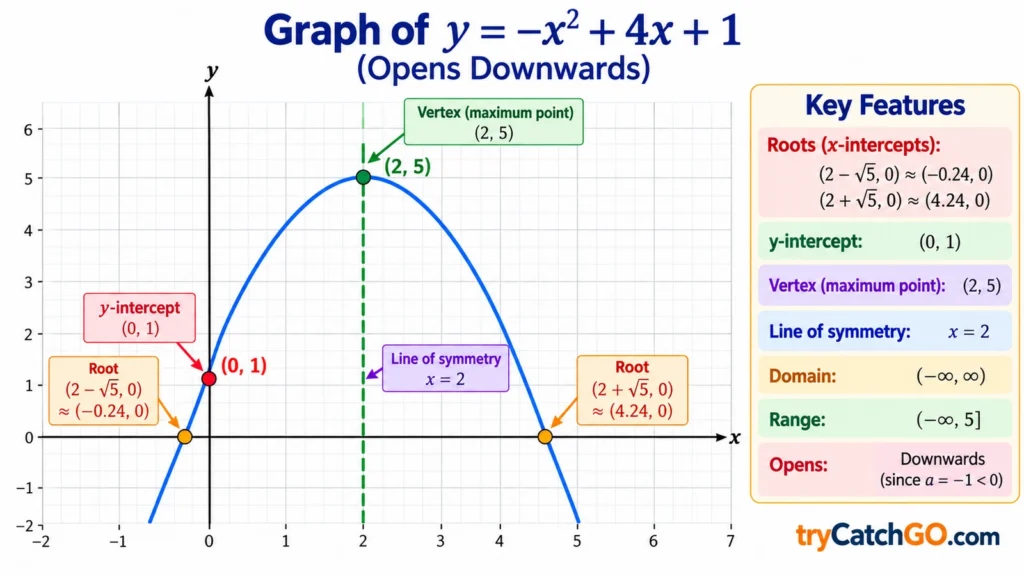
Concept
A quadratic graph forms a curve called a parabola. The two sides of the parabola are mirror images of each other.
Consider:
The line of symmetry is:
This means that points the same horizontal distance from x = 2 have the same y-coordinate.
For example, x = 1 and x = 3 are both 1 unit away from the line of symmetry.
When x = 1:
When x = 3:
Therefore, the points (1, 0) and (3, 0) are symmetrical about the vertical line x = 2.
What Is a Line of Symmetry?
A line of symmetry divides the quadratic curve into two matching halves.
For a parabola, the line of symmetry is always vertical. Its equation therefore has the form:
where k is a constant.
Formula
For:
the line of symmetry is:
- a = coefficient of x²
- b = coefficient of x
- c = constant term
Notice that c is not used when finding the line of symmetry.
Example Math 1
Find the line of symmetry of:
Here:
Use:
Therefore, the line of symmetry is x = 3.
Example Math 2
Find the line of symmetry of:
Here:
Therefore, the line of symmetry is x = −2.
Symmetry and the Turning Point
The line of symmetry always passes through the turning point of the quadratic curve.
Consider:
First find the line of symmetry:
Therefore, the x-coordinate of the turning point is 2.
Substitute x = 2:
Therefore, the turning point is (2, −1).
If the turning point is (h, k), then the line of symmetry is:
Finding the Line of Symmetry from the Roots
If a quadratic curve crosses the x-axis at two points, the line of symmetry lies exactly halfway between the two roots.
If the roots are x₁ and x₂, use:
Example Math 3
A quadratic curve has roots x = −2 and x = 6. Find the line of symmetry.
Therefore, the line of symmetry is x = 2.
Symmetrical Points on a Quadratic Curve
Points the same horizontal distance from the line of symmetry have the same y-coordinate.
For example, suppose the line of symmetry is x = 4.
The values x = 2 and x = 6 are both 2 units away from x = 4.
Therefore, if (2, 7) lies on the curve, then (6, 7) must also lie on the curve.
Using Symmetry to Check a Table of Values
Consider:
| x | y |
|---|---|
| 0 | 3 |
| 1 | 0 |
| 2 | −1 |
| 3 | 0 |
| 4 | 3 |
Notice that:
and:
This is because the pairs are equally far from the line of symmetry x = 2.
Upward and Downward Parabolas
For:
If a > 0, the parabola opens upwards.
If a < 0, the parabola opens downwards.
The line-of-symmetry formula remains the same in both cases.
Symmetry from Completed Square Form
A quadratic can also be written as:
In this form, the turning point is (h, k).
Therefore, the line of symmetry is immediately:
Example Math 4
Given:
the turning point is (4, −7).
Therefore, the line of symmetry is:
Three Ways to Find the Line of Symmetry
- From the equation: use the line-of-symmetry formula.
- From the roots: find the midpoint of the two roots.
- From the turning point: use the x-coordinate of the turning point.
Exam Tip
Always write the line of symmetry as an equation.
If the vertical line passes through 3 on the x-axis, write:
Do not write only 3, and do not write y = 3.
A/A* Exam Technique
- Identify the coefficient of x².
- Identify the coefficient of x.
- Substitute them carefully into the line-of-symmetry formula.
- Pay particular attention when b is negative.
- If the turning point is required, substitute the symmetry x-value back into the original quadratic.
- Check your graph using pairs of symmetrical points.
Common Mistakes
Mistake 1: Forgetting the Negative Sign
The correct formula is:
Mistake 2: Using c Instead of b
The formula uses a and b. The constant c is not used.
Mistake 3: Writing y = constant
The line of symmetry is vertical, so its equation has the form x = constant.
Mistake 4: Confusing the Turning Point with the Line
If the turning point is (2, −5), the line of symmetry is x = 2.
Mistake 5: Assuming Symmetrical Points Have Opposite y-values
Symmetrical points have the same y-coordinate, not opposite y-coordinates.
Question & Answer
1. What is symmetry in a quadratic curve?
The two sides of the parabola are mirror images of each other.
2. What is the line of symmetry?
It is the vertical line that divides the parabola into two mirror-image halves.
3. What is the main formula?
4. Does the line of symmetry pass through the turning point?
Yes.
5. If the turning point is (5, −3), what is the line of symmetry?
x = 5
6. If the roots are 2 and 8, what is the line of symmetry?
Practice Questions
- Find the line of symmetry of y = x² − 10x + 7.
- Find the line of symmetry of y = 2x² + 12x − 3.
- Find the line of symmetry of y = 3x² − 18x + 4.
- Find the line of symmetry of y = −x² + 8x − 5.
- A quadratic curve has roots x = 2 and x = 10. Find its line of symmetry.
- A quadratic curve has roots x = −5 and x = 3. Find its line of symmetry.
- The turning point is (4, −6). State the line of symmetry.
- Find the turning point of y = x² − 6x + 5.
- Given y = (x − 7)² + 4, state the line of symmetry.
- Given y = (x + 2)² − 5, state the line of symmetry.
Answers
- x = 5
- x = −3
- x = 3
- x = 4
- x = 6
- x = −1
- x = 4
- Turning point = (3, −4)
- x = 7
- x = −2
Want to Know More?
- Turning Point of a Quadratic Graph
- Roots of a Quadratic Graph
- Range of a Quadratic Graph
- Plotting Quadratic Graphs
- Maximum and Minimum Points
- Completing the Square
- How a Changes the Shape of a Parabola
- Estimating Gradient Using a Tangent
Final Exam Reminder
For a quadratic curve:
the line of symmetry is:
If the roots are x₁ and x₂:
If the turning point is (h, k), then:
The line of symmetry passes vertically through the turning point and divides the parabola into two mirror-image halves.