
17.8 How ‘a‘ Changes the Width of a Parabola
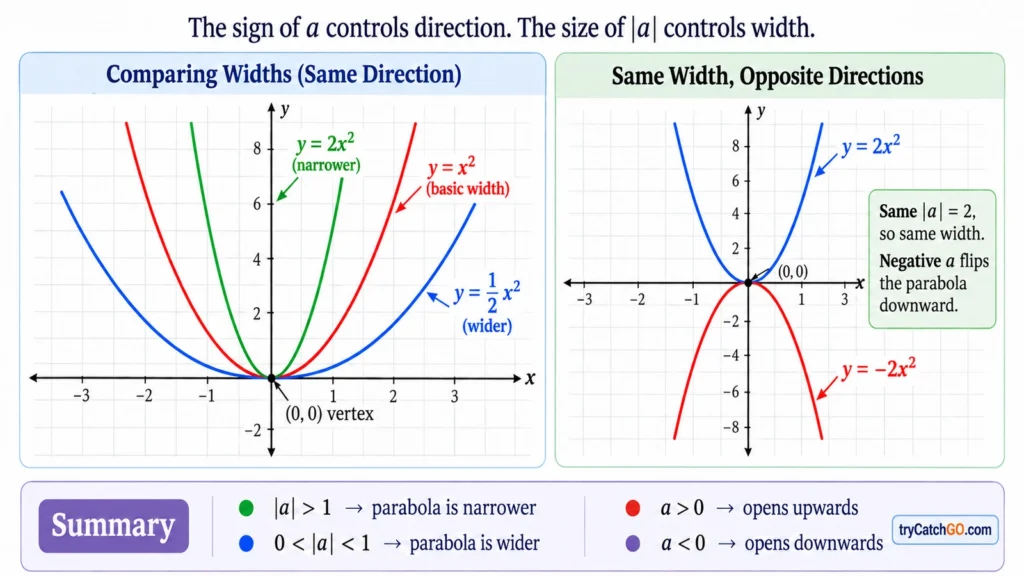
🟦 Concept
A quadratic equation can be written as:
The coefficient affects two important features of the parabola:
- whether the curve opens upwards or downwards
- how wide or narrow the curve appears
For the width, we look at the size of a, or more precisely:
🟩 When
Consider:
This gives the basic parabola that we can use for comparison.
🟪 When
Consider:
Here:
Since:
the parabola becomes narrower and steeper than:
For example:
is even narrower than:
Rule
As becomes larger, the parabola becomes narrower.
🟨 When
Consider:
Here:
Since:
the parabola becomes wider and flatter than:
For example:
is wider than:
Rule
As gets closer to zero, the parabola becomes wider.
🟧 What If Is Negative?
The sign of determines the direction of the parabola.
If:
the parabola opens upwards.
If:
the parabola opens downwards.
However, the width depends on ∣a∣|a|.
For example:
and:
have the same width.
The only difference is their direction.
📘 Compare These Three Graphs
→ Wider
→ Basic width
→ Narrower
So:
but for comparing the shape, think about the magnitude:
💡 Exam Tip
Do not look only at whether is positive or negative.
First ask:
What is the value of ∣a∣|a|?
Then use:
→ narrower
and:
→ wider
⚠️ Common Mistake
Students sometimes think a negative value of automatically makes the parabola wider.
That is incorrect.
For example:
and:
produce parabolas with the same width.
The negative sign only changes the direction of the curve.
⭐ Quick Summary
For:
→ parabola is narrower
→ basic parabola width
→ parabola is wider
And:
→ opens upwards
→ opens downwards
Remember
The sign of a controls the direction.
The size of ∣a∣|a| controls how wide or narrow the parabola appears.