
18.3 why a normal quadratic has −∞<x<∞
🟦 Concept
The domain of a graph is the set of all possible x-values that can be used in the function.
A quadratic equation in standard form is:
where:
For a normal quadratic function, x can be any real number.
Therefore, the domain is:
It can also be written in interval notation as:
🟩 Why Can Be Any Real Number?
Consider:
We can substitute any real value for .
For example, if:
then:
If:
then:
If:
then:
We could also use decimal, fractional, very large positive, or very large negative values of .
There is no value of xx that makes an ordinary quadratic expression undefined.
🟪 What Does This Look Like on the Graph?
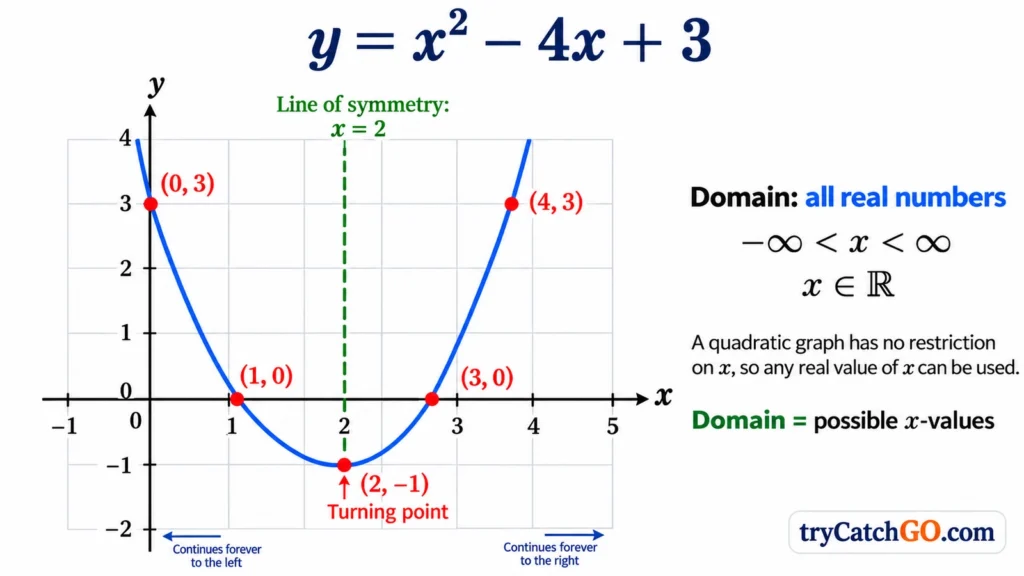
A quadratic curve continues indefinitely:
← to the left and to the right →
This means the graph contains x-values extending without limit in both directions.
Therefore:
which means:
x belongs to the set of all real numbers.
So the domain is:
🟨 Domain vs Range
Do not confuse domain with range.
Domain → possible x-values
Range → possible y-values
For:
the domain is:
The turning point is:
Since the parabola opens upwards, its range is:
So:
Domain: all real x-values
Range: y-values from upwards
💡 Exam Tip
For an ordinary quadratic function:
the domain is always:
unless the question specifically restricts the values of .
⚠️ Common Mistake
Students sometimes use the turning point to find the domain.
The turning point determines the minimum or maximum y-value, so it is important when finding the range, not the domain.
For a normal quadratic curve, the graph continues indefinitely to both the left and right.
⭐ Quick Summary
The domain tells us which x-values are allowed.
For a quadratic function:
every real value of is allowed.
Therefore:
or:
Remember
Quadratic graph → extends left and right forever → domain is all real numbers.