
12.1 Introduction to Sequences
Sequences are an important part of Cambridge O Level Mathematics D. A sequence is simply a list of numbers arranged in a particular order and following a rule.
Once you understand terms, term numbers, common differences and nth terms, sequence questions become much easier.
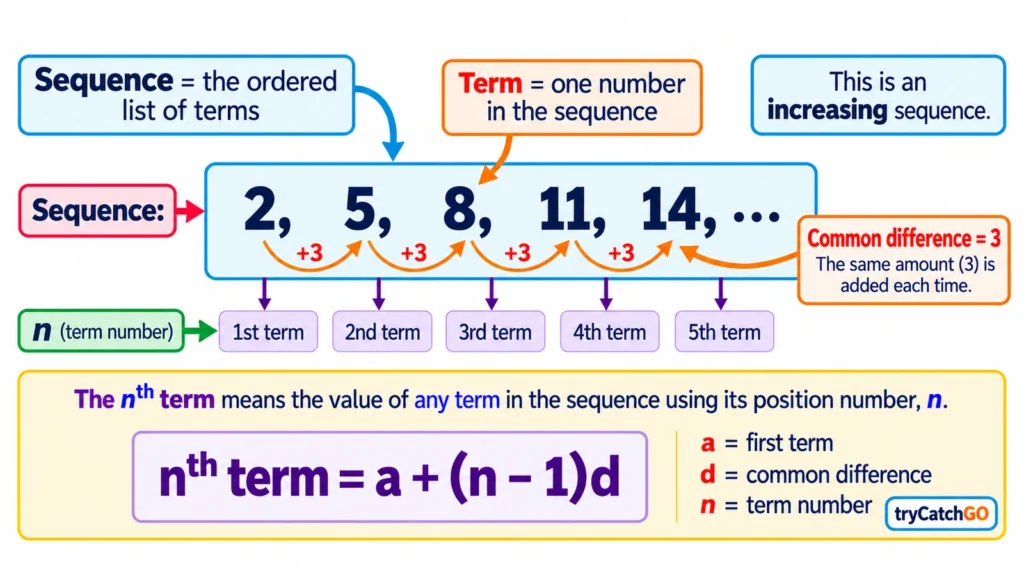
Consider the sequence:
2, 5, 8, 11, 14, …
Each number increases by 3.
So this is an increasing arithmetic sequence.
Concept
A sequence is an ordered list of numbers that follows a particular rule or pattern.
For example:
2, 5, 8, 11, 14, …
The numbers in the sequence are called terms.
Here:
1st term = 2
2nd term = 5
3rd term = 8
4th term = 11
5th term = 14
The dots:
…
mean that the sequence continues.
What Is a Term?
A term is one number in a sequence.
For the sequence:
2, 5, 8, 11, 14, …
the number 8 is a term.
More specifically:
8 is the 3rd term.
Similarly:
2 is the 1st term
5 is the 2nd term
11 is the 4th term
14 is the 5th term
What Is the Term Number?
The term number tells us the position of a term in the sequence.
We normally use the letter:
n
to represent the term number.
For example:
| Term number, n | Term |
|---|---|
| 1 | 2 |
| 2 | 5 |
| 3 | 8 |
| 4 | 11 |
| 5 | 14 |
So:
n = 1 means the first term
n = 2 means the second term
n = 3 means the third term
and so on.
Important
n does not mean the value of the term.
It tells us the position of the term.
For example, in:
2, 5, 8, 11, 14, …
when:
n = 3
the term value is:
8
Common Difference
Look again at:
2, 5, 8, 11, 14, …
Find the difference between consecutive terms:
5 – 2 = 3
8 – 5 = 3
11 – 8 = 3
14 – 11 = 3
The same amount is added each time.
Therefore:
Common difference = 3
The common difference is usually represented by:
d
So in this sequence:
d = 3
What Is a Common Difference?
The common difference is the fixed amount added or subtracted from one term to get the next term in an arithmetic sequence.
For example:
4, 9, 14, 19, 24, …
Differences:
+5, +5, +5, +5
Therefore:
d = 5
Increasing Sequence
A sequence is increasing when its terms become larger.
Example:
2, 5, 8, 11, 14, …
The terms increase because we add 3 each time.
Decreasing Sequence
A sequence is decreasing when its terms become smaller.
Example:
20, 16, 12, 8, 4, …
The common difference is:
d = -4
because:
16 – 20 = -4
12 – 16 = -4
So the sequence decreases by 4 each time.
Term-to-Term Rule
The term-to-term rule tells us how to move from one term to the next.
For:
2, 5, 8, 11, 14, …
the rule is:
Add 3.
So:
2 + 3 = 5
5 + 3 = 8
8 + 3 = 11
11 + 3 = 14
Therefore:
Term-to-term rule = add 3
Example Math
Find the next two terms:
7, 12, 17, 22, …
First find the difference:
12 – 7 = 5
17 – 12 = 5
22 – 17 = 5
So:
d = 5
Continue:
22 + 5 = 27
27 + 5 = 32
Answer:
27, 32
What Is the nth Term?
The nth term is a formula that allows us to find the value of any term in a sequence using its position number.
The letter:
n
represents the term number.
For an arithmetic sequence, a useful formula is:
nth term = a + (n – 1)d
where:
a = first term
d = common difference
n = term number
Understanding the Formula
For the sequence:
2, 5, 8, 11, 14, …
we have:
a = 2
d = 3
So:
nth term = a + (n – 1)d
Substitute:
nth term = 2 + (n – 1)(3)
Expand:
= 2 + 3n – 3
= 3n – 1
Therefore:
nth term = 3n – 1
Checking the nth Term
We should always check that the formula produces the correct terms.
For:
nth term = 3n – 1
First term
n = 1
3(1) – 1
= 3 – 1
= 2
Correct.
Second term
n = 2
3(2) – 1
= 6 – 1
= 5
Correct.
Third term
n = 3
3(3) – 1
= 9 – 1
= 8
Correct.
So the formula works.
Important Difference: Term-to-Term Rule vs nth Term
These two ideas are different.
Term-to-term rule
Tells you how to get from one term to the next.
For:
2, 5, 8, 11, 14, …
the term-to-term rule is:
Add 3.
nth term
Tells you how to find any term directly from its position.
For the same sequence:
nth term = 3n – 1
For example, to find the 50th term, you do not need to add 3 repeatedly.
Use:
n = 50
3(50) – 1
= 150 – 1
= 149
So the 50th term is:
149
Formula
For an arithmetic sequence:
nth term = a + (n – 1)d
where:
a = first term
d = common difference
n = term number
Example Math
Consider:
6, 10, 14, 18, 22, …
Step 1: Find the first term
a = 6
Step 2: Find the common difference
10 – 6 = 4
So:
d = 4
Step 3: Use the formula
nth term = a + (n – 1)d
= 6 + (n – 1)(4)
= 6 + 4n – 4
= 4n + 2
Therefore:
nth term = 4n + 2
Check
For n = 1:
4(1) + 2 = 6
For n = 2:
4(2) + 2 = 10
For n = 3:
4(3) + 2 = 14
The formula is correct.
Finding a Particular Term
Suppose the nth term is:
5n – 2
Find the 10th term.
Since:
n = 10
Substitute:
5(10) – 2
= 50 – 2
= 48
Answer:
48
Finding the Next Term
Sometimes a question only asks you to continue the sequence.
Example:
13, 18, 23, 28, …
Difference:
+5
Therefore:
28 + 5 = 33
Answer:
33
You do not always need to find the nth term if the question only asks for the next term.
Finding a Missing Term
Example:
4, 9, 14, __, 24
The common difference is:
+5
Therefore:
14 + 5 = 19
Answer:
19
Exam Tip
When you see a sequence, start by calculating the differences between consecutive terms.
For example:
8, 13, 18, 23, 28
Write:
+5, +5, +5, +5
This immediately tells you:
Common difference = 5
It also shows that the sequence is an arithmetic sequence.
A/A* Exam Technique
For sequence questions, it is useful to write the term numbers above or below the terms.
For example:
n:
1, 2, 3, 4, 5
Sequence:
2, 5, 8, 11, 14
This makes it easier to understand the relationship between:
- term number
- term value
- common difference
- nth term
Also remember:
n = position
It is not the actual term value.
Common Mistakes
Mistake 1: Confusing n with the term value
For:
2, 5, 8, 11, …
the third term is:
8
But:
n = 3
Do not write:
n = 8
The correct statement is:
n = 3 gives term value 8.
Mistake 2: Confusing the common difference with the first term
For:
2, 5, 8, 11, …
First term:
a = 2
Common difference:
d = 3
They are not the same thing.
Mistake 3: Finding the difference incorrectly
For:
5, 9, 13, 17, …
calculate:
9 – 5 = 4
not:
5 – 9 = -4
When moving forward through the sequence, subtract the earlier term from the next term.
Mistake 4: Thinking every sequence has a common difference
Consider:
1, 4, 9, 16, 25, …
Differences:
3, 5, 7, 9
The differences are not constant.
Therefore this is not a linear arithmetic sequence.
It is the sequence of square numbers.
Mistake 5: Using 3n – 1 as a formula for every sequence
The formula:
3n – 1
works specifically for:
2, 5, 8, 11, 14, …
It is not a standard formula for every sequence.
The general arithmetic-sequence formula is:
nth term = a + (n – 1)d
Question & Answer
1. What is a sequence?
A sequence is an ordered list of numbers that follows a rule or pattern.
2. What is a term?
A term is one number in a sequence.
3. What does n mean?
n represents the term number, or position of a term.
4. What does a mean?
a represents the first term.
5. What does d mean?
d represents the common difference.
6. What is the common difference?
It is the fixed amount added or subtracted between consecutive terms in an arithmetic sequence.
7. What is the common difference of:
3, 7, 11, 15, …
Difference:
7 – 3 = 4
So:
d = 4
8. What is the term-to-term rule for:
10, 15, 20, 25, …
Add 5.
9. What does nth term mean?
It is a formula that gives the value of any term using its position number, n.
10. What is the standard arithmetic-sequence formula?
nth term = a + (n – 1)d
Practice Questions
Try these before looking at the answers.
1
Find the next two terms:
3, 7, 11, 15, …
2
Find the common difference:
10, 16, 22, 28, …
3
Find the next term:
40, 35, 30, 25, …
4
State the first term and common difference:
7, 12, 17, 22, …
5
Find the missing term:
5, 9, 13, __, 21
6
The nth term is:
4n + 1
Find the 6th term.
7
The nth term is:
7n – 3
Find the 10th term.
8
Find the nth term of:
3, 8, 13, 18, …
9
Find the nth term of:
6, 10, 14, 18, …
10
Is this an arithmetic sequence?
1, 4, 9, 16, 25, …
Answers
1
19, 23
2
6
3
20
4
a = 7
d = 5
5
17
6
4(6) + 1
= 25
7
7(10) – 3
= 67
8
a = 3
d = 5
nth term:
3 + (n – 1)(5)
= 3 + 5n – 5
= 5n – 2
9
a = 6
d = 4
nth term:
6 + (n – 1)(4)
= 4n + 2
10
No.
Its first differences are:
3, 5, 7, 9
so the first difference is not constant.
Want to Know More?
After learning the basic ideas of sequences, continue with:
- Finding the nth Term
- Linear Sequences
- Arithmetic Sequences
- Quadratic Sequences
- Cubic Sequences
- Exponential Sequences
- Difference Tables
- Finding Missing Terms
- Finding Whether a Number Is in a Sequence
These topics all build on the ideas of term number, common difference and nth term.
Final Exam Reminder
For a sequence such as:
2, 5, 8, 11, 14, …
remember:
First term
a = 2
Common difference
d = 3
Term number
n = position of the term
Term-to-term rule
Add 3
nth term
3n – 1
And the general arithmetic-sequence formula is:
nth term = a + (n – 1)d
If you can identify a, d and n correctly, you already have the foundation for solving most introductory O Level sequence questions.