
Exponential Sequences
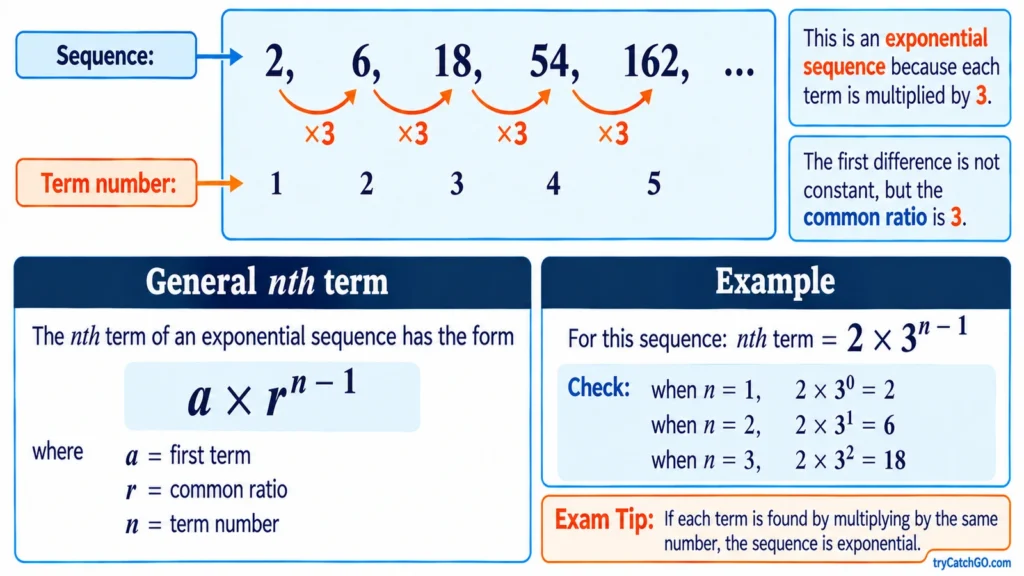
An exponential sequence is a sequence where each term is found by multiplying the previous term by the same number.
That repeated multiplier is called the common ratio.
For example:
2, 6, 18, 54, 162, …
Each term is multiplied by 3.
So:
Common ratio = 3
This is an exponential sequence.
Concept
In a linear sequence, we repeatedly add or subtract the same amount.
In an exponential sequence, we repeatedly multiply or divide by the same amount.
Consider:
2, 6, 18, 54, 162, …
Check the relationship between consecutive terms:
6 ÷ 2 = 3
18 ÷ 6 = 3
54 ÷ 18 = 3
162 ÷ 54 = 3
The ratio is always the same.
Therefore:
Common ratio = 3
and the sequence is exponential.
What Is the Common Ratio?
The common ratio is the number by which one term is multiplied to get the next term.
It is usually represented by:
r
For:
2, 6, 18, 54, …
r = 3
because:
2 × 3 = 6
6 × 3 = 18
18 × 3 = 54
Formula
The nth term of an exponential sequence is:
a × rⁿ⁻¹
where:
a = first term
r = common ratio
n = term number
Why Is the Power n – 1?
Look at:
2, 6, 18, 54, …
The first term is:
2
To get the second term:
2 × 3
To get the third term:
2 × 3 × 3
To get the fourth term:
2 × 3 × 3 × 3
So:
1st term:
2 × 3⁰
2nd term:
2 × 3¹
3rd term:
2 × 3²
4th term:
2 × 3³
Therefore the power is:
n – 1
So the nth term is:
2 × 3ⁿ⁻¹
Example Math
Consider:
2, 6, 18, 54, 162, …
Step 1: Find the first term
a = 2
Step 2: Find the common ratio
6 ÷ 2 = 3
So:
r = 3
Step 3: Use the formula
nth term = a × rⁿ⁻¹
Substitute:
nth term = 2 × 3ⁿ⁻¹
Therefore:
nth term = 2 × 3ⁿ⁻¹
Checking the Formula
For:
nth term = 2 × 3ⁿ⁻¹
First term
n = 1
2 × 3⁰
= 2 × 1
= 2
Correct.
Second term
n = 2
2 × 3¹
= 6
Correct.
Third term
n = 3
2 × 3²
= 18
Correct.
Recognising an Exponential Sequence
To decide whether a sequence is exponential, divide each term by the term before it.
Example:
5, 10, 20, 40, 80, …
Check:
10 ÷ 5 = 2
20 ÷ 10 = 2
40 ÷ 20 = 2
80 ÷ 40 = 2
Since the ratio is constant:
r = 2
Therefore, the sequence is exponential.
Exponential Growth
If the common ratio is greater than 1, the sequence increases.
Example:
3, 9, 27, 81, …
Common ratio:
r = 3
The terms become larger very quickly.
This is called exponential growth.
Nth term:
3 × 3ⁿ⁻¹
This can also be simplified to:
3ⁿ
Exponential Decay
If the common ratio is between 0 and 1, the sequence decreases.
Example:
160, 80, 40, 20, 10, …
Each term is multiplied by:
1/2
So:
r = 1/2
This is an exponential sequence.
Its nth term is:
160 × (1/2)ⁿ⁻¹
This is called exponential decay.
Multiplying vs Dividing
A sequence may look like it is dividing each time, but you can still write it using multiplication.
For example:
81, 27, 9, 3, 1, …
The rule is:
÷3
But dividing by 3 is the same as multiplying by:
1/3
So:
r = 1/3
The nth term is:
81 × (1/3)ⁿ⁻¹
Linear vs Exponential Sequences
This distinction is very important.
Linear Sequence
4, 7, 10, 13, 16, …
Differences:
+3, +3, +3
Constant difference.
So this is linear.
Exponential Sequence
4, 8, 16, 32, 64, …
Ratios:
×2, ×2, ×2, ×2
Constant ratio.
So this is exponential.
Quick Comparison
| Type | What stays constant? |
|---|---|
| Linear | Difference |
| Exponential | Ratio |
So:
constant difference → linear
constant ratio → exponential
Finding the Next Term
Consider:
7, 21, 63, 189, …
Check:
21 ÷ 7 = 3
63 ÷ 21 = 3
189 ÷ 63 = 3
So:
r = 3
Next term:
189 × 3 = 567
Answer:
567
Finding Missing Terms
Consider:
4, 12, __, 108
The ratio is:
12 ÷ 4 = 3
So each term is multiplied by 3.
Therefore:
12 × 3 = 36
Check:
36 × 3 = 108
Answer:
36
Finding the nth Term
Find the nth term of:
5, 15, 45, 135, …
First term:
a = 5
Common ratio:
r = 3
Use:
nth term = a × rⁿ⁻¹
So:
nth term = 5 × 3ⁿ⁻¹
Finding a Particular Term
The nth term is:
4 × 2ⁿ⁻¹
Find the 6th term.
Substitute:
n = 6
4 × 2⁵
= 4 × 32
= 128
Answer:
128
Example with a Fractional Ratio
Consider:
64, 32, 16, 8, 4, …
Common ratio:
32 ÷ 64 = 1/2
So:
r = 1/2
Nth term:
64 × (1/2)ⁿ⁻¹
Example with a Negative Ratio
Exponential sequences can also have a negative common ratio.
Consider:
2, -6, 18, -54, 162, …
Check:
-6 ÷ 2 = -3
18 ÷ (-6) = -3
-54 ÷ 18 = -3
So:
r = -3
Nth term:
2 × (-3)ⁿ⁻¹
The signs alternate because the common ratio is negative.
A/A* Exam Technique
When you see a sequence, do not immediately assume it is linear.
Check:
- Are the differences constant?
- If not, are the ratios constant?
For example:
3, 6, 12, 24, …
Differences:
3, 6, 12
Not constant.
Ratios:
2, 2, 2
Constant.
Therefore:
Exponential sequence
Exam Tip
For an exponential sequence, calculate:
next term ÷ previous term
If you keep getting the same answer, that answer is the common ratio.
For example:
12, 36, 108, 324, …
36 ÷ 12 = 3
108 ÷ 36 = 3
324 ÷ 108 = 3
Therefore:
r = 3
Common Mistakes
Mistake 1: Looking at differences instead of ratios
For:
2, 6, 18, 54, …
Differences are:
4, 12, 36
These are not constant.
But the ratio is constant:
3
So the sequence is exponential.
Mistake 2: Forgetting the n – 1
The standard form is:
a × rⁿ⁻¹
not:
a × rⁿ
Why?
Because the first term must use:
r⁰ = 1
Mistake 3: Confusing the first term with the common ratio
For:
2, 6, 18, 54, …
a = 2
r = 3
They are different values.
Mistake 4: Using subtraction for a decreasing exponential sequence
For:
81, 27, 9, 3, …
the terms do not decrease by the same difference.
They are divided by 3.
So:
r = 1/3
Mistake 5: Assuming every increasing sequence is linear
Consider:
2, 4, 8, 16, …
The sequence increases, but not by a constant difference.
It doubles each time.
Therefore, it is exponential.
Question & Answer
1. What is an exponential sequence?
A sequence where each term is multiplied by the same number to get the next term.
2. What is the common ratio?
The fixed multiplier between consecutive terms.
3. What symbol is used for the common ratio?
r
4. What is the standard nth-term formula?
a × rⁿ⁻¹
5. What does a mean?
a is the first term.
6. What does r mean?
r is the common ratio.
7. What does n mean?
n is the term number.
8. What is the common ratio of:
2, 8, 32, 128, …
4
9. What is the nth term of:
2, 8, 32, 128, …
2 × 4ⁿ⁻¹
10. How do you recognise exponential decay?
The common ratio is between 0 and 1.
Practice Questions
1
Find the next two terms:
3, 9, 27, 81, …
2
Find the common ratio:
4, 12, 36, 108, …
3
Find the nth term:
5, 10, 20, 40, …
4
Find the nth term:
7, 21, 63, 189, …
5
Find the next term:
128, 64, 32, 16, …
6
Find the common ratio:
81, 27, 9, 3, …
7
Find the 6th term of:
2 × 3ⁿ⁻¹
8
Find the 5th term of:
4 × 2ⁿ⁻¹
9
State whether this sequence is linear or exponential:
6, 12, 24, 48, …
10
Find the missing term:
5, 15, __, 135
Answers
1
243, 729
2
3
3
5 × 2ⁿ⁻¹
4
7 × 3ⁿ⁻¹
5
8
6
1/3
7
n = 6
2 × 3⁵
= 2 × 243
= 486
8
n = 5
4 × 2⁴
= 4 × 16
= 64
9
Exponential
Common ratio = 2
10
45
Want to Know More?
After mastering exponential sequences, continue with:
- Introduction to Sequences
- Term-to-Term Rules
- Linear Sequences
- Quadratic Sequences
- Cubic Sequences
- Finding the nth Term
- Difference Tables
- Growth and Decay
- Compound Interest
- Reverse Growth Problems
These topics are closely connected and help build a complete understanding of sequences.
Final Exam Reminder
For an exponential sequence:
the ratio between consecutive terms is constant.
The general nth term is:
a × rⁿ⁻¹
where:
a = first term
r = common ratio
n = term number
For example:
2, 6, 18, 54, 162, …
a = 2
r = 3
so:
nth term = 2 × 3ⁿ⁻¹
Remember the key comparison:
Linear → constant difference
Exponential → constant ratio
If you can recognise that difference quickly, exponential sequence questions become much easier.