
Introduction to Functions
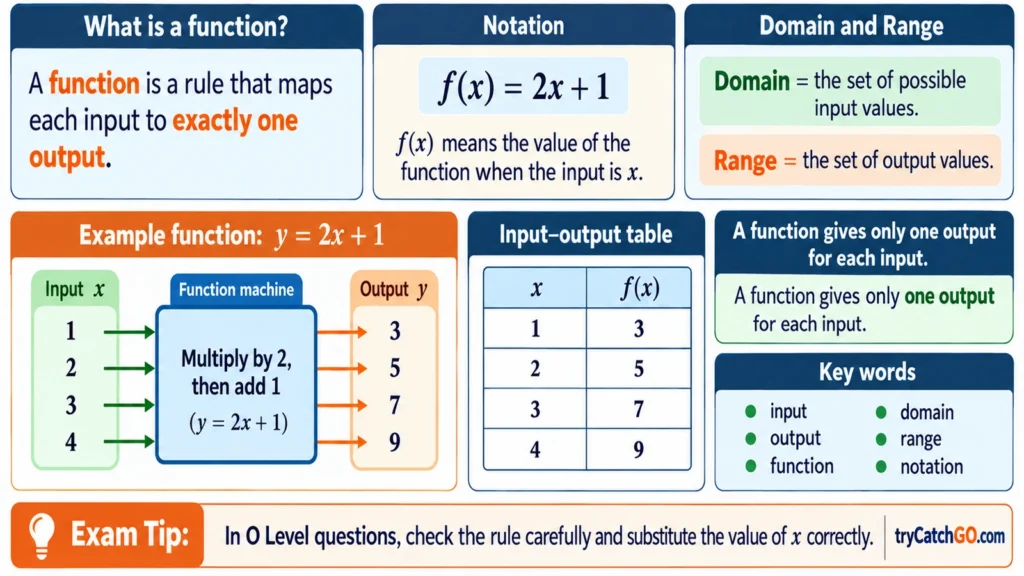
Functions are an important part of Cambridge O Level Mathematics D. A function is simply a rule that takes an input, performs an operation, and gives an output.
You can think of a function as a machine:
Input → Function rule → Output
For example, suppose:
f(x) = 2x + 1
If the input is:
x = 3
then:
f(3) = 2(3) + 1
= 7
So the output is:
7
Concept
A function is a rule that maps each input to exactly one output.
For example:
f(x) = 2x + 1
This means:
- multiply the input by 2
- then add 1
If:
x = 1
then:
f(1) = 2(1) + 1
= 3
If:
x = 2
then:
f(2) = 2(2) + 1
= 5
If:
x = 3
then:
f(3) = 2(3) + 1
= 7
So the function produces:
1 → 3
2 → 5
3 → 7
What Is an Input?
The input is the value that goes into the function.
It is often represented by:
x
For example:
f(x) = 3x + 2
If:
x = 4
then 4 is the input.
What Is an Output?
The output is the value produced after the function rule is applied.
For:
f(x) = 3x + 2
and:
x = 4
we get:
f(4) = 3(4) + 2
= 14
So:
Input = 4
Output = 14
Function Notation
Functions are commonly written using notation such as:
f(x)
This is read as:
“f of x”
It does not mean:
f × x
Instead:
f(x)
means:
the value of the function f when the input is x
Example
Suppose:
f(x) = 2x + 5
Find:
f(3)
Substitute:
x = 3
So:
f(3) = 2(3) + 5
= 6 + 5
= 11
Answer:
11
Understanding f(x)
Suppose:
f(x) = 4x – 1
Then:
f(1) = 4(1) – 1 = 3
f(2) = 4(2) – 1 = 7
f(5) = 4(5) – 1 = 19
The number inside the brackets tells you what value to substitute for x.
Function Machine
A useful way to understand a function is to imagine a machine.
For:
f(x) = 2x + 1
the machine does:
Multiply by 2 → Add 1
Example:
Input:
4
Multiply by 2:
4 × 2 = 8
Add 1:
8 + 1 = 9
So:
f(4) = 9
Input-Output Table
A function can also be shown in a table.
For:
f(x) = 2x + 1
| x | f(x) |
|---|---|
| 1 | 3 |
| 2 | 5 |
| 3 | 7 |
| 4 | 9 |
Each input has exactly one output.
Domain
The domain is the set of possible input values.
For example, suppose:
f(x) = x + 2
and the domain is:
{1, 2, 3, 4}
Then the only input values we use are:
1, 2, 3, 4
So:
Domain = {1, 2, 3, 4}
Range
The range is the set of output values produced by the function.
Using:
f(x) = x + 2
with domain:
{1, 2, 3, 4}
we get:
f(1) = 3
f(2) = 4
f(3) = 5
f(4) = 6
Therefore:
Range = {3, 4, 5, 6}
Domain vs Range
Remember:
Domain = input values
Range = output values
For:
x → f(x)
we can think:
Domain → Function → Range
One Input, One Output
This is one of the most important rules of functions.
A function gives exactly one output for each input.
For example:
x = 3
cannot produce both:
7 and 10
under the same function.
That would not satisfy the definition of a function.
Important A/A* Point
Different inputs can produce the same output.
That is still allowed.
For example:
f(x) = x²
Then:
f(2) = 4
and:
f(-2) = 4
Two different inputs give the same output.
That is still a function because each individual input has only one output.
Example Math
Example 1
Given:
f(x) = 3x + 4
find:
f(5)
Substitute:
x = 5
f(5) = 3(5) + 4
= 15 + 4
= 19
Answer:
19
Example 2
Given:
g(x) = 5x – 7
find:
g(4)
g(4) = 5(4) – 7
= 20 – 7
= 13
Answer:
13
Example 3
Given:
h(x) = x² + 3
find:
h(5)
h(5) = 5² + 3
= 25 + 3
= 28
Answer:
28
Substituting Negative Values
Be especially careful when the input is negative.
Suppose:
f(x) = x² + 2x
Find:
f(-3)
Substitute carefully:
f(-3) = (-3)² + 2(-3)
= 9 – 6
= 3
Answer:
3
Why Brackets Matter
If:
x = -3
write:
(-3)²
not:
-3²
because:
(-3)² = 9
but:
-3² = -9
Brackets help avoid sign errors.
Finding an Unknown Input
Sometimes you are given the output and asked to find the input.
Suppose:
f(x) = 3x + 2
and:
f(x) = 17
Then:
3x + 2 = 17
Subtract 2:
3x = 15
Divide by 3:
x = 5
Answer:
x = 5
Example Math
Given:
g(x) = 4x – 3
and:
g(x) = 21
find x.
Set:
4x – 3 = 21
Add 3:
4x = 24
Divide by 4:
x = 6
Answer:
6
Function Notation with Different Letters
Functions do not always use:
f(x)
You may see:
g(x)
h(x)
p(x)
and others.
For example:
g(x) = x + 4
h(x) = 2x²
These are simply different function names.
Two Functions
You may be given two functions.
For example:
f(x) = 2x + 1
g(x) = x²
Then:
f(3) = 7
and:
g(3) = 9
The same input can give different outputs under different functions because the rules are different.
Mapping Diagrams
Functions can also be represented by arrows.
For example:
1 → 3
2 → 5
3 → 7
4 → 9
This represents:
f(x) = 2x + 1
A mapping diagram helps you see how each input connects to an output.
Is It a Function?
Suppose:
1 → 4
2 → 5
3 → 6
This is a function.
Each input has exactly one output.
But if:
1 → 4
1 → 7
then the input 1 has two different outputs.
Therefore, this relation is not a function.
Formula
A function is usually written in the form:
f(x) = expression involving x
Examples:
f(x) = 2x + 1
f(x) = x² + 3
f(x) = 5 – x
f(x) = 1/x
The expression tells you what operation to perform on the input.
A/A* Exam Technique
When evaluating a function:
Step 1
Write the function.
Example:
f(x) = 3x² – 2
Step 2
Replace every x with the given value.
If:
x = 4
write:
f(4) = 3(4)² – 2
Step 3
Follow the correct order of operations.
= 3(16) – 2
= 48 – 2
= 46
Step 4
Check your substitution.
Make sure every x has been replaced.
Exam Tip
When substituting a negative number, always use brackets.
For example, if:
f(x) = x² + 4x
and:
x = -2
write:
f(-2) = (-2)² + 4(-2)
This greatly reduces sign errors.
Common Mistakes
Mistake 1: Thinking f(x) Means f × x
It does not.
f(x)
means:
the value of function f at x
Mistake 2: Forgetting to Substitute Every x
Suppose:
f(x) = x² + 3x
Find:
f(2)
Correct:
f(2) = 2² + 3(2)
= 4 + 6
= 10
Do not replace only one x.
Mistake 3: Forgetting Brackets for Negative Inputs
Suppose:
f(x) = x²
Find:
f(-4)
Correct:
(-4)² = 16
Mistake 4: Confusing Domain and Range
Remember:
Domain = inputs
Range = outputs
Mistake 5: Thinking Every Relation Is a Function
If one input produces two different outputs, it is not a function.
Question & Answer
1. What is a function?
A rule that maps each input to exactly one output.
2. What does f(x) mean?
The value of function f when the input is x.
3. Does f(x) mean f multiplied by x?
No.
4. What is the domain?
The set of possible input values.
5. What is the range?
The set of output values.
6. If f(x) = 2x + 3, what is f(4)?
f(4) = 2(4) + 3
= 11
7. If f(x) = x², what is f(-3)?
f(-3) = (-3)²
= 9
8. Can two different inputs have the same output?
Yes.
That can still be a function.
9. Can one input have two different outputs?
No.
Then it would not be a function.
10. What does n have to do with functions?
Usually nothing directly. In sequence notation, n often means term number, while in function notation x usually represents the input.
Practice Questions
1
Given:
f(x) = 2x + 5
find:
f(3)
2
Given:
g(x) = 4x – 1
find:
g(6)
3
Given:
h(x) = x² + 2
find:
h(5)
4
Given:
f(x) = x² – 3x
find:
f(-2)
5
Given:
f(x) = 3x + 4
and:
f(x) = 25
find x.
6
Given:
g(x) = 5 – 2x
and:
g(x) = -7
find x.
7
The domain is:
{1, 2, 3}
and:
f(x) = x + 4
Find the range.
8
The domain is:
{-2, -1, 0, 1, 2}
and:
f(x) = x²
Find the range.
9
Is this relation a function?
1 → 3
2 → 5
3 → 7
10
Is this relation a function?
1 → 4
1 → 8
2 → 6
Answers
1
f(3) = 2(3) + 5
= 11
2
g(6) = 4(6) – 1
= 23
3
h(5) = 25 + 2
= 27
4
f(-2) = (-2)² – 3(-2)
= 4 + 6
= 10
5
3x + 4 = 25
3x = 21
x = 7
6
5 – 2x = -7
-2x = -12
x = 6
7
f(1) = 5
f(2) = 6
f(3) = 7
Range:
{5, 6, 7}
8
Outputs:
4, 1, 0, 1, 4
So the range is:
{0, 1, 4}
Remember: repeated values are written only once in a set.
9
Yes.
Each input has exactly one output.
10
No.
The input 1 has two different outputs.
Want to Know More?
After understanding the basics of functions, continue with:
- Function Notation
- Domain and Range
- Evaluating Functions
- Finding Unknown Inputs
- Composite Functions
- Inverse Functions
- Functions and Graphs
- Mapping Diagrams
- One-to-One Functions
These topics build directly on the ideas of input, output and function rules.
Final Exam Reminder
For functions, remember:
Input → Function rule → Output
For example:
f(x) = 2x + 1
Input:
x = 3
Output:
f(3) = 2(3) + 1
= 7
And remember the three key ideas:
Function: each input gives exactly one output.
Domain: possible input values.
Range: output values.
For A/A* level questions, always substitute carefully, use brackets for negative inputs, and check that you understand exactly what the function notation is asking.