
Domain of a Function
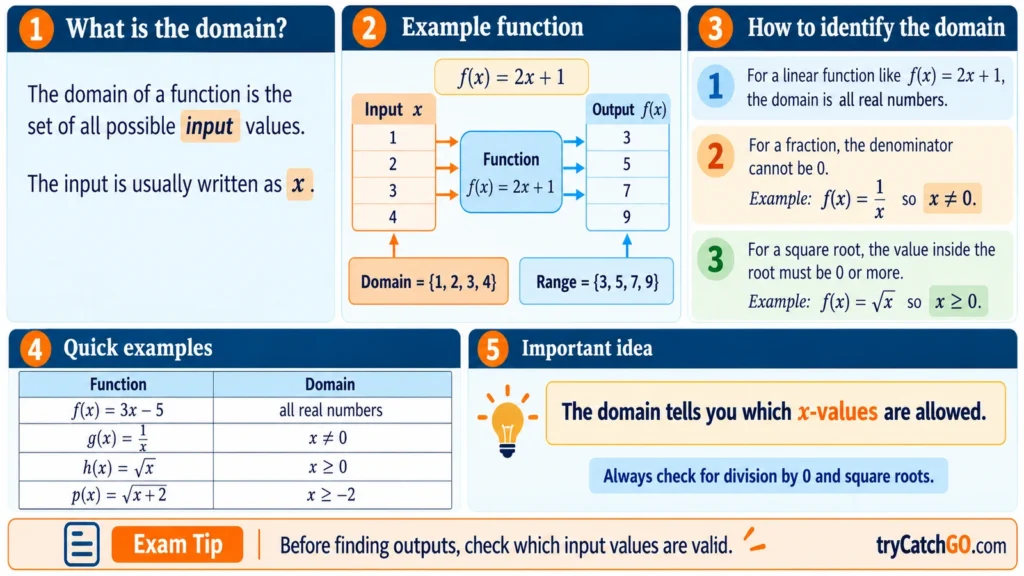
The domain of a function is the set of all input values that are allowed to go into the function.
In function notation, the input is usually represented by:
x
So when we talk about the domain, we are asking:
Which values of x are allowed?
For example, if:
f(x) = 2x + 1
then any real number can be substituted for x.
So the domain is:
all real numbers
Understanding domain is important because some functions have values of x that cannot be used.
Concept
A function can be thought of as a machine:
Input → Function Rule → Output
The domain is the collection of possible inputs.
For example:
f(x) = 2x + 1
Suppose the allowed inputs are:
{1, 2, 3, 4}
Then:
f(1) = 3
f(2) = 5
f(3) = 7
f(4) = 9
So:
Domain = {1, 2, 3, 4}
Range = {3, 5, 7, 9}
Domain vs Range
Do not confuse these two terms.
Domain = input values
Range = output values
Think:
Domain → Function → Range
For:
f(x) = 2x + 1
with domain:
{1, 2, 3}
we get:
1 → 3
2 → 5
3 → 7
So:
Domain = {1, 2, 3}
Range = {3, 5, 7}
What Does the Domain Tell Us?
The domain tells us which values of x can be substituted into a function.
For some functions, every real number is allowed.
For others, certain values must be excluded.
The two most important restrictions to look for are:
- division by zero
- square roots of negative numbers
Domain of a Linear Function
Consider:
f(x) = 3x – 5
You can substitute any real number for x.
For example:
x = 0
x = 10
x = -4
x = 1/2
All of these work.
Therefore:
Domain = all real numbers
Example Math
Given:
f(x) = 5x + 2
state the domain.
There is no denominator containing x and no square root restriction.
Therefore:
Domain = all real numbers
Domain of a Quadratic Function
Consider:
f(x) = x² + 3x – 4
Again, any real number can be substituted for x.
So:
Domain = all real numbers
For ordinary polynomial functions such as:
x² + 4
3x³ – 2x
5x⁴ + x – 7
the domain is usually all real numbers.
Restriction 1: Division by Zero
Division by zero is undefined.
Therefore, if a function contains a fraction, the denominator cannot equal zero.
Consider:
f(x) = 1/x
If:
x = 0
then:
f(0) = 1/0
This is undefined.
Therefore:
x ≠ 0
So the domain is:
all real numbers except 0
Example Math
Find the restriction on the domain of:
f(x) = 5/(x – 3)
The denominator cannot equal zero.
So:
x – 3 ≠ 0
Therefore:
x ≠ 3
So:
Domain = all real numbers except 3
A/A* Example: Fractional Function
Find the domain of:
f(x) = 4/(2x + 6)
The denominator cannot be zero.
So:
2x + 6 ≠ 0
2x ≠ -6
x ≠ -3
Therefore:
Domain = all real numbers except -3
Restriction 2: Square Roots
For real-number functions, the quantity inside a square root cannot be negative.
Therefore:
inside the square root ≥ 0
Consider:
f(x) = √x
For this function:
x ≥ 0
because square roots of negative numbers are not real numbers.
So:
Domain: x ≥ 0
Example Math
Find the domain of:
f(x) = √(x + 4)
The expression inside the square root must be at least zero.
So:
x + 4 ≥ 0
Subtract 4:
x ≥ -4
Therefore:
Domain: x ≥ -4
Another Square Root Example
Find the domain of:
f(x) = √(7 – x)
The expression inside the square root must satisfy:
7 – x ≥ 0
Rearrange:
-x ≥ -7
So:
x ≤ 7
Therefore:
Domain: x ≤ 7
Why Does the Inequality Change?
From:
-x ≥ -7
when multiplying or dividing both sides by -1, the inequality sign reverses.
So:
x ≤ 7
This is an important algebra skill in harder domain questions.
Domain Given as a Set
Sometimes the question gives the domain directly.
For example:
f(x) = x² + 1
Domain:
{-2, -1, 0, 1, 2}
This means you only use those five input values.
Calculate:
f(-2) = 5
f(-1) = 2
f(0) = 1
f(1) = 2
f(2) = 5
So:
Domain = {-2, -1, 0, 1, 2}
Range = {1, 2, 5}
Notice that repeated range values are written only once when using set notation.
Domain from a Mapping Diagram
Suppose a mapping shows:
1 → 4
2 → 7
3 → 10
4 → 13
The domain is simply the set of inputs:
{1, 2, 3, 4}
The range is:
{4, 7, 10, 13}
Domain from an Input-Output Table
Suppose:
| x | f(x) |
|---|---|
| -2 | 5 |
| 0 | 1 |
| 3 | 10 |
| 5 | 26 |
The domain consists of the x-values:
{-2, 0, 3, 5}
The range consists of the f(x)-values:
{1, 5, 10, 26}
Domain from a Graph
On a graph, the domain represents the x-values covered by the graph.
So when finding domain from a graph, look:
from left to right
The range represents the y-values, so you look:
from bottom to top
This is a very useful way to remember the difference.
Interval-Type Domain
Sometimes a domain may be described using inequalities.
For example:
- x ≥ 2
- x < 5
- -3 ≤ x ≤ 7
These tell you which input values are allowed.
For:
-3 ≤ x ≤ 7
the domain includes all real values from -3 to 7, including both endpoints.
Formula
There is no single formula for finding every domain.
Instead, check the function for restrictions.
For polynomial functions
Domain:
all real numbers
For fractions
Denominator:
≠ 0
For square roots
Inside the root:
≥ 0
These are the most important rules to remember.
Example Math
Example 1
Find the domain of:
f(x) = 4x – 9
There are no restrictions.
Answer:
all real numbers
Example 2
Find the domain of:
f(x) = 3/(x + 5)
The denominator cannot equal zero.
x + 5 ≠ 0
x ≠ -5
Answer:
all real numbers except -5
Example 3
Find the domain of:
f(x) = √(x – 2)
The expression inside the root must be non-negative.
x – 2 ≥ 0
x ≥ 2
Answer:
x ≥ 2
Example 4
Find the domain of:
f(x) = √(10 – 2x)
Require:
10 – 2x ≥ 0
-2x ≥ -10
Divide by -2 and reverse the inequality:
x ≤ 5
Answer:
x ≤ 5
A/A* Exam Technique
When asked to find the domain, use this checklist:
Step 1
Look at the type of function.
Step 2
Ask:
Is there a denominator involving x?
If yes, make sure it cannot equal zero.
Step 3
Ask:
Is there a square root involving x?
If yes, make sure the expression inside the root is at least zero.
Step 4
Solve the resulting equation or inequality.
Step 5
State the domain clearly.
Exam Tip
Before substituting values into a function, check whether those values are actually allowed.
For example:
f(x) = 1/(x – 2)
If x = 2:
f(2) = 1/0
which is undefined.
Therefore:
x = 2 is not in the domain.
Common Mistakes
Mistake 1: Confusing Domain and Range
Remember:
Domain = input
Range = output
Mistake 2: Allowing Division by Zero
For:
f(x) = 1/(x – 4)
do not include:
x = 4
because the denominator becomes zero.
Mistake 3: Allowing Negative Values Inside a Square Root
For:
f(x) = √(x – 3)
you need:
x – 3 ≥ 0
So:
x ≥ 3
Not:
x > 3
because x = 3 gives:
√0
which is valid.
Mistake 4: Using > Instead of ≥
Square root of zero is allowed.
Therefore:
√x
has:
x ≥ 0
not:
x > 0
Mistake 5: Forgetting to Reverse an Inequality
If:
-2x ≥ -8
divide by -2:
x ≤ 4
The inequality reverses.
Question & Answer
1. What is the domain?
The set of all allowed input values.
2. What variable usually represents the input?
x
3. What is the difference between domain and range?
Domain contains input values.
Range contains output values.
4. What is the domain of:
f(x) = 3x + 2
All real numbers.
5. What is the domain of:
f(x) = 1/x
All real numbers except 0.
6. Why can x not equal 0 in 1/x?
Because division by zero is undefined.
7. What is the domain of:
f(x) = √x
x ≥ 0
8. What is the domain of:
f(x) = √(x + 6)
x ≥ -6
9. What is the domain of:
f(x) = 2/(x – 7)
x ≠ 7
10. When reading a domain from a graph, which direction should I look?
Look from left to right because the domain concerns x-values.
Practice Questions
1
State the domain of:
f(x) = 5x + 7
2
State the domain of:
f(x) = x² – 4x + 3
3
Find the domain of:
f(x) = 1/(x – 6)
4
Find the domain of:
f(x) = 5/(x + 2)
5
Find the domain of:
f(x) = √(x – 4)
6
Find the domain of:
f(x) = √(x + 9)
7
Find the domain of:
f(x) = √(12 – x)
8
Find the domain of:
f(x) = √(8 – 2x)
9
A function has domain:
{-3, -1, 2, 5}
What are the possible input values?
10
For:
f(x) = x²
with domain:
{-2, -1, 0, 1, 2}
find the range.
Answers
1
All real numbers
2
All real numbers
3
x – 6 ≠ 0
x ≠ 6
4
x + 2 ≠ 0
x ≠ -2
5
x – 4 ≥ 0
x ≥ 4
6
x + 9 ≥ 0
x ≥ -9
7
12 – x ≥ 0
x ≤ 12
8
8 – 2x ≥ 0
-2x ≥ -8
x ≤ 4
9
The allowed inputs are:
-3, -1, 2 and 5
10
Calculate:
(-2)² = 4
(-1)² = 1
0² = 0
1² = 1
2² = 4
Therefore:
Range = {0, 1, 4}
Want to Know More?
After mastering the domain of a function, continue with:
- Range of a Function
- Function Notation
- Evaluating Functions
- Mapping Diagrams
- Functions and Graphs
- Composite Functions
- Inverse Functions
- Domain and Range of Graphs
These topics build directly on your understanding of input and output values.
Final Exam Reminder
Remember:
Domain = allowed x-values
Before giving your answer, always check:
Is there a denominator?
If yes:
denominator ≠ 0
Is there a square root?
If yes:
inside the square root ≥ 0
For example:
f(x) = 1/(x – 3)
gives:
x ≠ 3
while:
f(x) = √(x – 3)
gives:
x ≥ 3
That distinction is extremely important for A/A* Cambridge O Level Mathematics D function questions.