
17.5 Standard Form vs Factorised Form vs Vertex Form
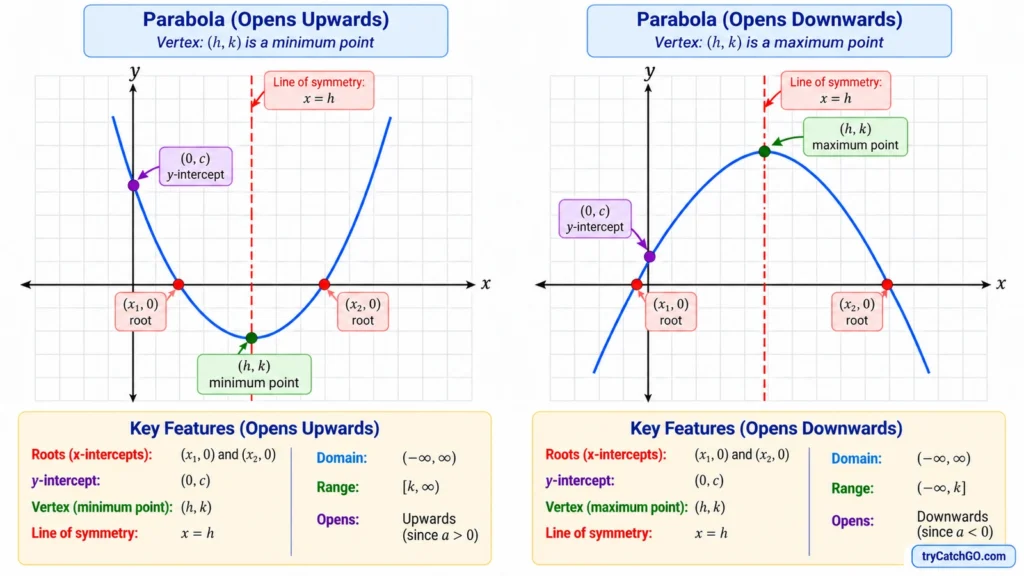
1. Standard Form
This equation can be used to find a, b, and c using the simultaneous equations method. If you know the coordinates of three points on the graph, substitute their – and -values into the quadratic equation to form three equations. Then solve these equations simultaneously to find the values of a, b, and c.
What the letters tell us
y-intercept
Line of symmetry
2. Factorised Form
where and are the roots.
Roots
Therefore, the x-intercepts are:
and
Line of symmetry
The line of symmetry lies halfway between the roots:
3. Vertex Form
Turning point
Line of symmetry
Minimum or maximum value
If:
the parabola opens upwards and:
If:
the parabola opens downwards and:
Comparing the Three Forms
| Form | Formula | Information seen directly |
|---|---|---|
| Standard Form | , , y-intercept | |
| Factorised Form | roots | |
| Vertex Form | turning point |
Same Quadratic in All Three Forms
Consider:
Standard Form
Factorised Form
Vertex Form
All three equations describe exactly the same parabola.
They simply show different information more clearly:
Quick Formula Summary
Same quadratic, different forms, different useful information.