
18.2 How Many Roots Can a Quadratic Graph Have?
🟦 Concept
A root of a quadratic graph is an -value where the curve meets the x-axis.
At a root:
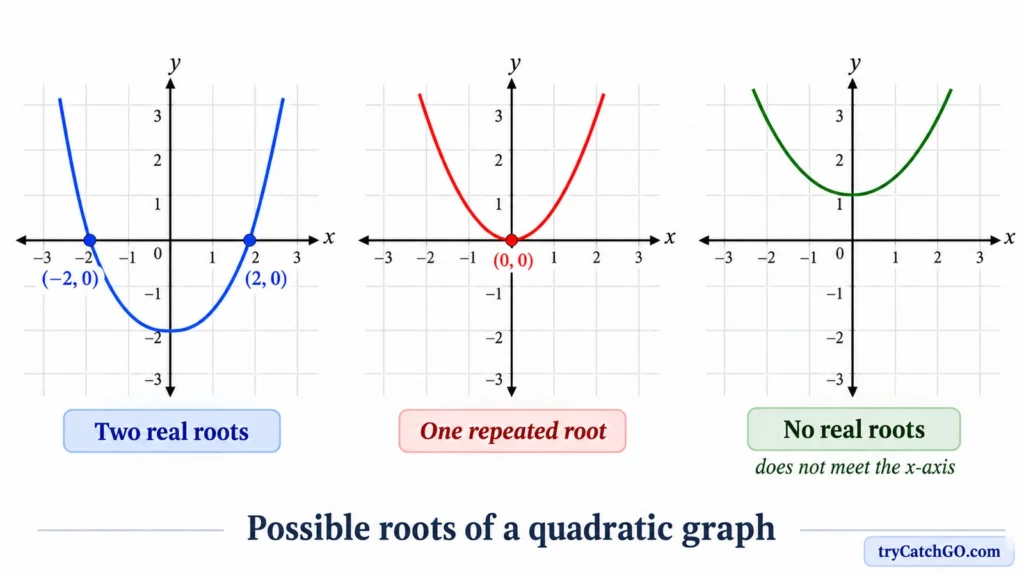
A quadratic graph can have:
- Two real roots
- One repeated real root
- No real roots
The number of roots depends on how the parabola meets the x-axis.
🟩 1. Two Real Roots
If the quadratic curve crosses the x-axis at two different points, it has two real roots.
For example:
Factorising:
The roots are:
and
Therefore, the x-intercepts are:
and
Graphically
The parabola crosses the x-axis twice.
Two crossings → Two real roots
🟪 2. One Repeated Root
A quadratic has one repeated root when the curve touches the x-axis at exactly one point and then turns back.
For example:
The root is:
The graph touches the x-axis at:
This point is also the turning point.
Graphically
The parabola touches the x-axis once but does not cross it.
One touch → One repeated root
🟨 3. No Real Roots
A quadratic has no real roots when the curve does not meet the x-axis at all.
For example:
The minimum value of is:
Since the graph always stays above the x-axis, there are no x-intercepts.
Graphically
The parabola never touches or crosses the x-axis.
No intersection → No real roots
🟧 Using the Discriminant
For a quadratic equation:
the discriminant is:
It can also tell us how many real roots the quadratic has.
If:
there are two distinct real roots.
If:
there is one repeated real root.
If:
there are no real roots.
💡 Exam Tip
When a graph is given, look at the x-axis first.
Count how many times the parabola meets it:
Crosses twice → 2 roots
Touches once → 1 repeated root
Does not meet it → 0 real roots
⚠️ Common Mistake
Do not count the y-intercept as a root.
A root must lie on the x-axis, where:
⭐ Quick Summary
A quadratic graph can have:
| Graph behaviour | Number of real roots |
|---|---|
| Crosses the x-axis twice | 2 |
| Touches the x-axis once | 1 repeated root |
| Does not meet the x-axis | 0 |
Remember
A quadratic can have at most two real roots.