
17.3 What is ‘b’ in Quadratic Equaton?
In a quadratic equation,
the b is the coefficient of xx.
For example, in:
we have:
So here:
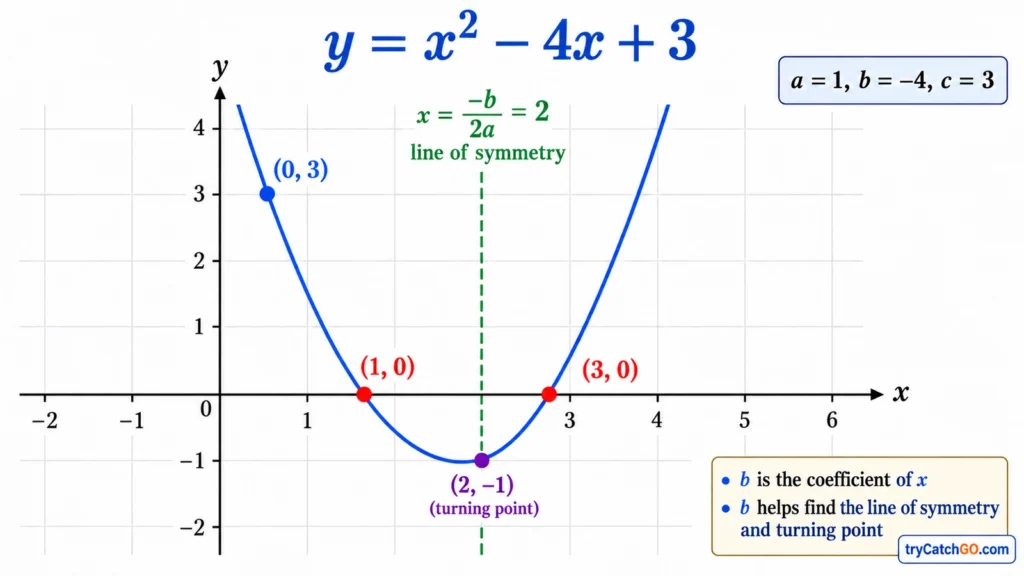
🟦 What does do?
The value of helps determine the horizontal position of the turning point and the line of symmetry.
The x-coordinate of the turning point is:
For:
Therefore:
So the line of symmetry is:
and the turning point also has x-coordinate .
🟩 Another Example
Consider:
Here:
Find the line of symmetry:
So the turning point lies on:
⭐ Easy Way to Remember
For:
- controls whether the parabola opens up or down and how wide it is.
- helps determine the horizontal position of the turning point.
- gives the y-intercept.
Quick Example
Therefore:
So bb is simply the number multiplying xx.
One important point: if there is no -term, then:
For example:
has: b=0