
17.4 What is in a Quadratic Equation?
In the quadratic equation
the c is the constant term.
It is the number that does not have beside it.
🟦 What does tell us?
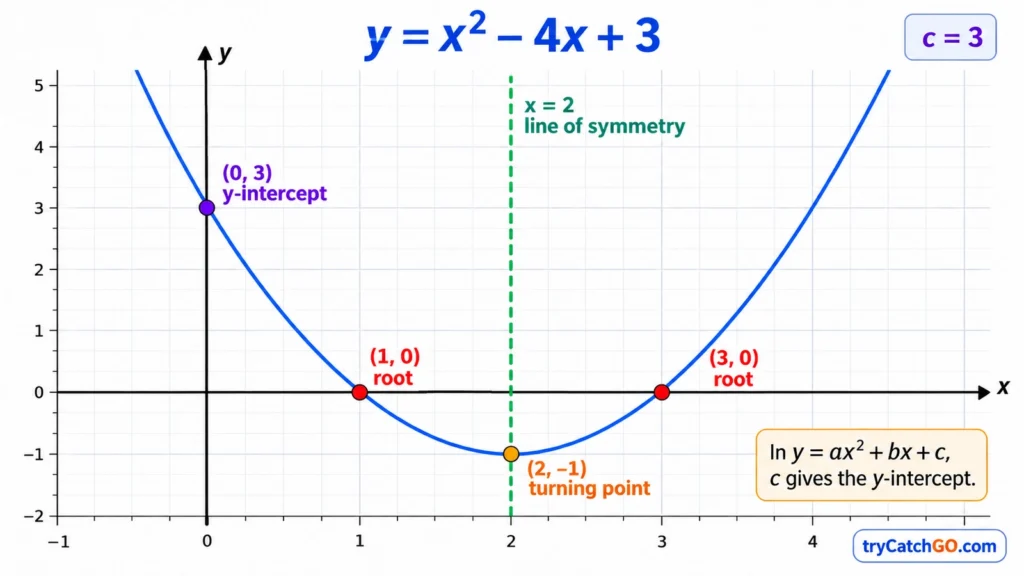
The value of gives the y-intercept of the quadratic graph.
The y-intercept is the point where the parabola crosses the y-axis.
On the y-axis:
So if:
substitute :
Therefore, the y-intercept is:
🟩 Example
Consider:
Compare it with:
So:
Therefore:
and the y-intercept is:
🟪 Another Example
Consider:
Here:
So the graph crosses the y-axis at:
💡 Easy Way to Remember
For:
- controls the direction and width of the parabola.
- helps locate the turning point and line of symmetry.
- gives the y-intercept.