
2.1 Introduction to Sets
Venn diagrams are one of the easiest ways to understand sets visually. Instead of only reading symbols and lists of numbers, a Venn diagram shows exactly where each element belongs.
For Cambridge O Level Mathematics D, you should be comfortable with:
- sets
- elements
- universal sets
- intersection
- union
- complements
- elements outside sets
Concept
A set is a collection of objects or numbers.
For example:
A = {1, 2, 3, 4}
This means set A contains the elements 1, 2, 3 and 4.
Another set may be:
B = {3, 4, 5, 6}
Notice that 3 and 4 appear in both sets.
This is exactly why Venn diagrams are useful: they show the relationship between sets clearly.
The Universal Set
The universal set contains every element being considered in the question.
It is usually represented by the letter:
U
In our example:
U = {1, 2, 3, 4, 5, 6, 7, 8}
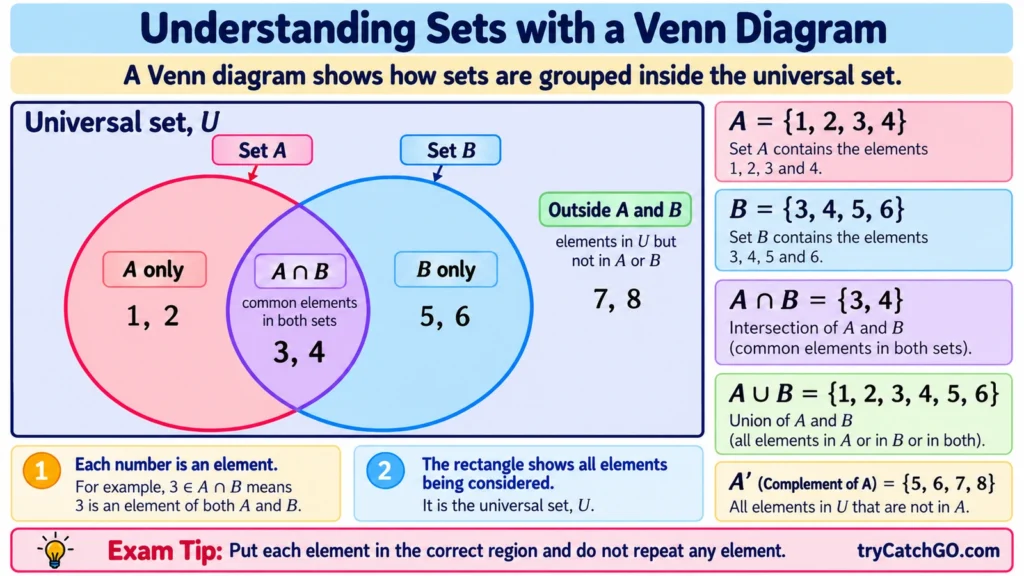
In a Venn diagram, the universal set is represented by the large rectangle surrounding the circles.
Everything inside this rectangle belongs to U.
Set A
Consider:
A = {1, 2, 3, 4}
In the diagram, circle A contains all the elements belonging to set A.
However, some of these elements may also belong to B.
The elements that belong only to A are:
{1, 2}
The numbers 3 and 4 also belong to A, but they are placed in the overlapping region because they also belong to B.
Set B
Now consider:
B = {3, 4, 5, 6}
The elements that belong only to B are:
{5, 6}
The numbers 3 and 4 belong to both A and B, so they appear in the overlapping region.
Intersection of Sets
The intersection of two sets means the elements that are common to both sets.
The symbol for intersection is:
∩
For our example:
A ∩ B = {3, 4}
This is read as:
A intersection B
It means:
the elements that belong to both A and B.
In the Venn diagram
The intersection is the overlapping part of the two circles.
So the numbers 3 and 4 are placed there.
Example: Finding an Intersection
Let:
P = {2, 4, 6, 8}
Q = {4, 6, 9}
The elements appearing in both sets are 4 and 6.
Therefore:
P ∩ Q = {4, 6}
Union of Sets
The union of two sets contains every element that belongs to:
- A
- B
- or both A and B
The symbol for union is:
∪
For our example:
A ∪ B = {1, 2, 3, 4, 5, 6}
This is read as:
A union B
Notice that 3 and 4 are written only once.
Even though they belong to both sets, we do not repeat them when listing the union.
Example: Finding a Union
Let:
P = {1, 2, 3}
Q = {3, 4, 5}
Then:
P ∪ Q = {1, 2, 3, 4, 5}
Do not write:
{1, 2, 3, 3, 4, 5}
because an element should not be repeated in a set.
Elements Outside A and B
Look at the universal set:
U = {1, 2, 3, 4, 5, 6, 7, 8}
The elements 7 and 8 do not belong to either A or B.
Therefore, they are placed:
- inside the universal set rectangle
- but outside both circles
These elements are still members of U.
Complement of a Set
The complement of A means:
all elements in the universal set that are not in A.
The complement of A can be written as:
A′
For our example:
U = {1, 2, 3, 4, 5, 6, 7, 8}
and
A = {1, 2, 3, 4}
Therefore:
A′ = {5, 6, 7, 8}
Why?
Because 5, 6, 7 and 8 are inside the universal set but are not members of A.
Important: Complement Does Not Mean Outside the Diagram
This is a common misunderstanding.
The complement of A does not mean everything outside the universal set.
It means:
everything inside U but outside A.
So when working with complements, always look at the universal set first.
Understanding the Regions of the Venn Diagram
Using:
A = {1, 2, 3, 4}
B = {3, 4, 5, 6}
U = {1, 2, 3, 4, 5, 6, 7, 8}
we can divide the diagram into four important regions.
A only
Elements that belong to A but not B:
{1, 2}
A ∩ B
Elements belonging to both sets:
{3, 4}
B only
Elements belonging to B but not A:
{5, 6}
Outside A and B
Elements that belong to U but neither A nor B:
{7, 8}
Membership
The symbol:
∈
means:
is an element of
For example:
3 ∈ A
because 3 belongs to set A.
Also:
3 ∈ B
because 3 belongs to B.
Therefore:
3 ∈ A ∩ B
because 3 belongs to both sets.
The symbol:
∉
means:
is not an element of
For example:
7 ∉ A
and:
7 ∉ B
Example Math 1
Given:
U = {1, 2, 3, 4, 5, 6, 7, 8}
A = {1, 2, 3, 4}
B = {3, 4, 5, 6}
Find:
(a) A ∩ B
Look for elements appearing in both sets.
A ∩ B = {3, 4}
(b) A ∪ B
Take all elements belonging to A or B.
A ∪ B = {1, 2, 3, 4, 5, 6}
(c) A′
Find every element in U that is not in A.
A′ = {5, 6, 7, 8}
Example Math 2
Let:
U = {1, 2, 3, 4, 5, 6, 7, 8, 9, 10}
P = {2, 4, 6, 8, 10}
Q = {2, 3, 5, 7}
Find:
P ∩ Q
The only number appearing in both sets is 2.
P ∩ Q = {2}
P ∪ Q
Combine the elements without repeating any number.
P ∪ Q = {2, 3, 4, 5, 6, 7, 8, 10}
P′
Find all elements of U that are not in P.
P′ = {1, 3, 5, 7, 9}
How to Fill a Venn Diagram
When completing a Venn diagram in an exam, use this order:
- Fill the intersection first.
- Fill the A only region.
- Fill the B only region.
- Finally, place the remaining elements outside the circles but inside U.
This order helps prevent elements being placed twice.
Exam Tip
Always fill the overlapping region first.
If an element belongs to both sets and you put it inside A only or B only first, you may accidentally repeat it later.
Also remember:
each element should appear only once in the Venn diagram.
Common Mistake
Do not confuse:
A ∩ B
with:
A ∪ B
Remember:
∩ = intersection = common elements
∪ = union = all elements from both sets
A useful memory trick is:
Intersection = Inside both
and:
Union = Unite everything
Another Common Mistake
Do not repeat elements in a set.
For example:
A ∪ B = {1, 2, 3, 4, 5, 6}
not:
A ∪ B = {1, 2, 3, 4, 3, 4, 5, 6}
Even if an element belongs to both sets, it is written only once.
Quick Check
Let:
U = {1, 2, 3, 4, 5, 6, 7}
A = {1, 2, 3, 4}
B = {3, 4, 5}
Question 1
Find:
A ∩ B
Answer:
A ∩ B = {3, 4}
Question 2
Find:
A ∪ B
Answer:
A ∪ B = {1, 2, 3, 4, 5}
Question 3
Find:
A′
Answer:
A′ = {5, 6, 7}
Question 4
Which elements lie outside both A and B?
Answer:
{6, 7}
What You Should Remember
A Venn diagram shows how sets are related.
The rectangle represents the universal set U.
The circles represent individual sets such as A and B.
A ∩ B means the elements common to both sets.
A ∪ B means all elements belonging to A or B or both.
A′ means all elements in the universal set that are not in A.
Most importantly:
Put every element in the correct region and write each element only once.
Once you understand these regions clearly, questions involving union, intersection, complements and probability using Venn diagrams become much easier.