
17.1 Introduction to Quadratic Curve
17.2 What is a in a Quadratic Equation?
17.3 What is b in a Quadratic Equation?
17.4 What is c in a Quadratic Equation?
17.5 Must Memorise: Quadratic Equation Formula
17.6 Quadratic Curve When It Opens Upwards
17.7 Quadratic Curve When It Opens Downwards
17.8 How ‘a‘ Changes the Width of a Parabola
17.9 Line of Symmetry in a Quadratic Graph
17.10 Turning Point of a Quadratic Curve
17.1 Introduction to Quadratic Curves
A quadratic curve is one of the most important types of graphs in Cambridge O Level Mathematics D.
Quadratic curves appear in many topics, including:
- roots
- turning points
- maximum and minimum points
- line of symmetry
- x-intercepts
- y-intercepts
- domain and range
- drawing graphs
- estimating gradients
This lesson gives you an introduction to quadratic curves. Each important feature will be explained in greater detail in separate lessons.
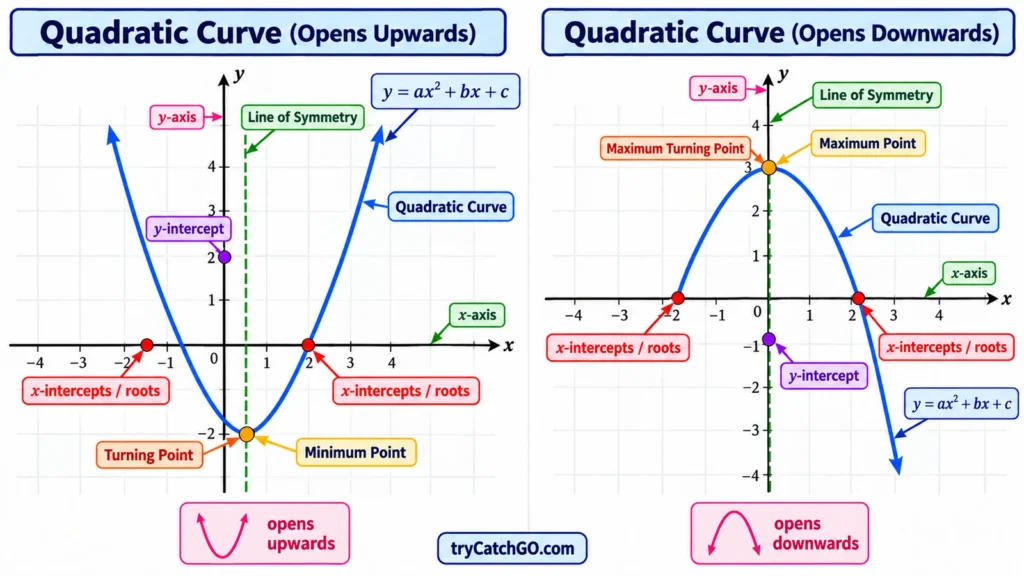
Concept
A quadratic curve is the graph of a quadratic equation.
The general form of a quadratic equation is:
y = ax² + bx + c
where a, b and c are constants and:
a ≠ 0
The graph of a quadratic equation is called a parabola.
A parabola is a smooth curved graph that can open either:
- upwards
- downwards
The direction of the curve depends mainly on the value of a.
General Form of a Quadratic Equation
The general form is:
y = ax² + bx + c
Examples of quadratic equations include:
y = x² − 2x − 3
y = −x² + 4x − 1
y = 2x² + 3x + 1
All of these are quadratic equations because the highest power of x is 2.
What Is a Parabola?
A parabola is the curved shape produced by a quadratic equation.
A parabola may look like a U-shape when it opens upwards.
It may also look like an upside-down U-shape when it opens downwards.
The value and sign of a in:
y = ax² + bx + c
help determine the direction and shape of the parabola.
Quadratic Curve Opening Upwards
If a is positive:
a > 0
the quadratic curve opens upwards.
An upward-opening parabola has a minimum point.
The minimum point is also the turning point of the curve.
It is the lowest point reached by the graph.
Quadratic Curve Opening Downwards
If a is negative:
a < 0
the quadratic curve opens downwards.
A downward-opening parabola has a maximum point.
The maximum point is also the turning point of the curve.
It is the highest point reached by the graph.
Turning Point
The turning point is the point where the quadratic curve changes direction.
For a curve that opens upwards:
Turning Point = Minimum Point
For a curve that opens downwards:
Turning Point = Maximum Point
The exact method for finding the turning point will be discussed in a separate lesson.
Minimum Point
An upward-opening quadratic curve has a minimum point.
This is the lowest point on the graph.
The curve moves downwards towards the minimum point and then begins to rise again.
Maximum Point
A downward-opening quadratic curve has a maximum point.
This is the highest point on the graph.
The curve rises towards the maximum point and then begins to fall.
Line of Symmetry
Every quadratic curve has a line of symmetry.
This is a vertical line that passes through the turning point.
The two sides of the parabola are mirror images of each other.
The line of symmetry is also called the axis of symmetry.
You will learn how to find its equation in a separate lesson.
x-Intercepts or Roots
The points where a quadratic curve meets or crosses the x-axis are called x-intercepts.
They are also called the roots of the quadratic equation.
At an x-intercept:
y = 0
A quadratic graph can have:
- two real roots
- one real root
- no real roots
The number of roots a quadratic graph can have will be studied separately.
y-Intercept
The y-intercept is the point where the quadratic curve crosses the y-axis.
At the y-intercept:
x = 0
Consider the general quadratic equation:
y = ax² + bx + c
When:
x = 0
the equation becomes:
y = c
Therefore, the value of c gives the y-intercept.
We will study the y-intercept in greater detail in a separate lesson.
Domain of a Quadratic Graph
The domain tells us which values of x can be used.
For a quadratic graph, x can take any real value.
We can write:
x ∈ ℝ
This means:
x belongs to the set of real numbers.
A quadratic curve continues indefinitely to both the left and the right.
Range of a Quadratic Graph
The range tells us which y-values are possible on the graph.
The range depends on:
- the turning point
- whether the curve opens upwards or downwards
For an upward-opening quadratic curve, the turning point gives the minimum y-value.
For a downward-opening quadratic curve, the turning point gives the maximum y-value.
Range will be explained fully in a separate lesson.
Example Math
Consider:
y = x² − 4
The coefficient of x² is positive.
Therefore:
a > 0
So the quadratic curve opens upwards.
Now consider:
y = −x² + 4
The coefficient of x² is negative.
Therefore:
a < 0
So the quadratic curve opens downwards.
How to Recognise a Quadratic Equation
Look at the highest power of x.
For example:
y = 3x² + 2x − 5
The highest power of x is 2.
Therefore, this is a quadratic equation.
Now consider:
y = 2x + 3
The highest power of x is 1.
Therefore, this is a linear equation, not a quadratic equation.
Similarly:
y = x³ + 2
has x³ as its highest power.
Therefore, it is a cubic equation, not a quadratic equation.
Main Features of a Quadratic Curve
When looking at a quadratic graph, you should gradually learn to identify:
- quadratic curve or parabola
- direction of opening
- turning point
- minimum point
- maximum point
- line of symmetry
- x-intercepts or roots
- y-intercept
- domain
- range
These are the main features that you will study throughout the quadratic graphs chapter.
Example 1
Consider:
y = 2x² + 3x − 1
The coefficient of x² is:
a = 2
Since:
a > 0
the parabola opens upwards.
Therefore, the graph has a minimum turning point.
Example 2
Consider:
y = −3x² + 2x + 5
Here:
a = −3
Since:
a < 0
the parabola opens downwards.
Therefore, the graph has a maximum turning point.
Exam Tip
When you see a quadratic equation, first look at the coefficient of x².
If:
a > 0
the curve opens upwards.
If:
a < 0
the curve opens downwards.
This immediately helps you determine whether the curve has a minimum or maximum turning point.
Common Mistake
Do not assume that every curved graph is a quadratic graph.
For a quadratic equation, the highest power of x must be 2.
For example:
y = 4x² − 3x + 2
is quadratic.
But:
y = 4x − 3
is linear.
And:
y = x³ − 3x
is cubic.
Another common mistake is confusing the:
- turning point
- roots
- y-intercept
These are three different features of a quadratic graph.
Quick Check
Question 1
What is the general form of a quadratic equation?
Answer:
y = ax² + bx + c
Question 2
What is the graph of a quadratic equation called?
Answer:
A parabola.
Question 3
If:
a > 0
which way does the quadratic curve open?
Answer:
Upwards.
Question 4
If:
a < 0
which way does the quadratic curve open?
Answer:
Downwards.
Question 5
What is the turning point of an upward-opening quadratic curve called?
Answer:
The minimum point.
Question 6
What is the turning point of a downward-opening quadratic curve called?
Answer:
The maximum point.
Question 7
What is the value of y at an x-intercept?
Answer:
y = 0
Question 8
What is the value of x at the y-intercept?
Answer:
x = 0
What You Should Remember
The general form of a quadratic equation is:
y = ax² + bx + c
The graph of a quadratic equation is called a parabola.
If:
a > 0
the curve opens upwards and has a minimum point.
If:
a < 0
the curve opens downwards and has a maximum point.
A quadratic curve may also have:
- a turning point
- a line of symmetry
- x-intercepts or roots
- a y-intercept
- a domain
- a range
These ideas form the foundation for understanding quadratic graphs.