
17.2 What is ‘a’ in Quadratic Equation?
In a quadratic equation,
the a is the coefficient of . It is especially important because it controls the direction and shape of the parabola.
If:
the curve opens upwards.
If:
the curve opens downwards.
Also, the larger is, the narrower the curve becomes.
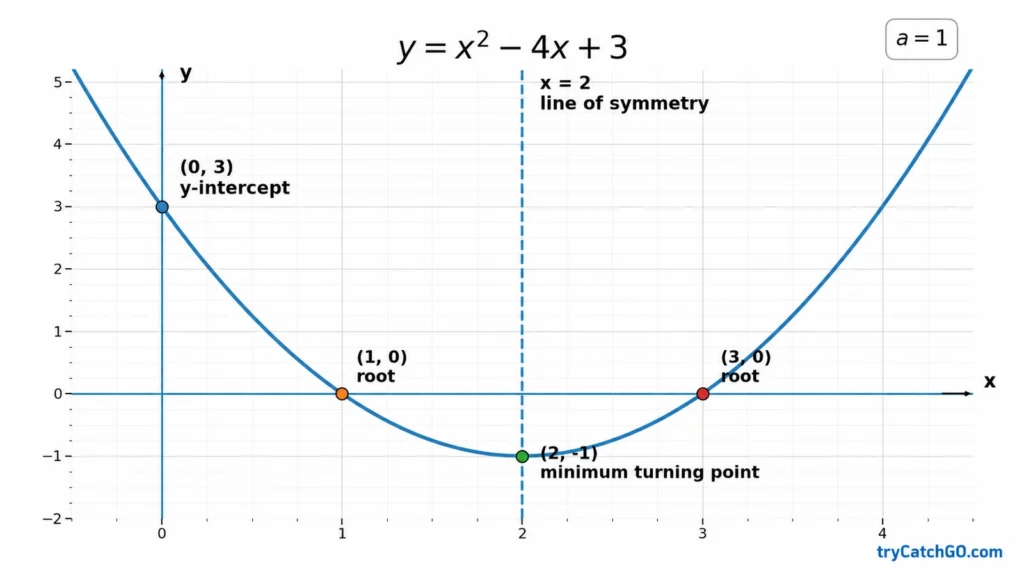
How can we find ?
For O Level work, there are 4 common ways.
1. Read it directly from the equation
Example:
The coefficient of is 3.
So:
Another example:
So:
This is the easiest case.
2. Use the turning point and another point
If the turning point is:
use the vertex form:
Suppose the turning point is:
and the graph passes through:
Then:
Substitute :
So the equation begins:
3. Use the roots and another point
If the roots are and , use:
Suppose the roots are:
and
Then:
If the graph passes through:
substitute:
Therefore:
So:
4. Use three points on the graph
If you know three points, substitute them into:
Suppose the points are:
Using :
So:
Using :
Using :
You then solve the simultaneous equations to find and .
In this example:
⭐ Quick Summary
There are 4 main ways to find :
| Information given | Method |
|---|---|
| Full quadratic equation | Read coefficient of |
| Turning point + another point | Use |
| Two roots + another point | Use |
| Three points | Use and simultaneous equations |
Remember
And also controls how wide or narrow the parabola is.